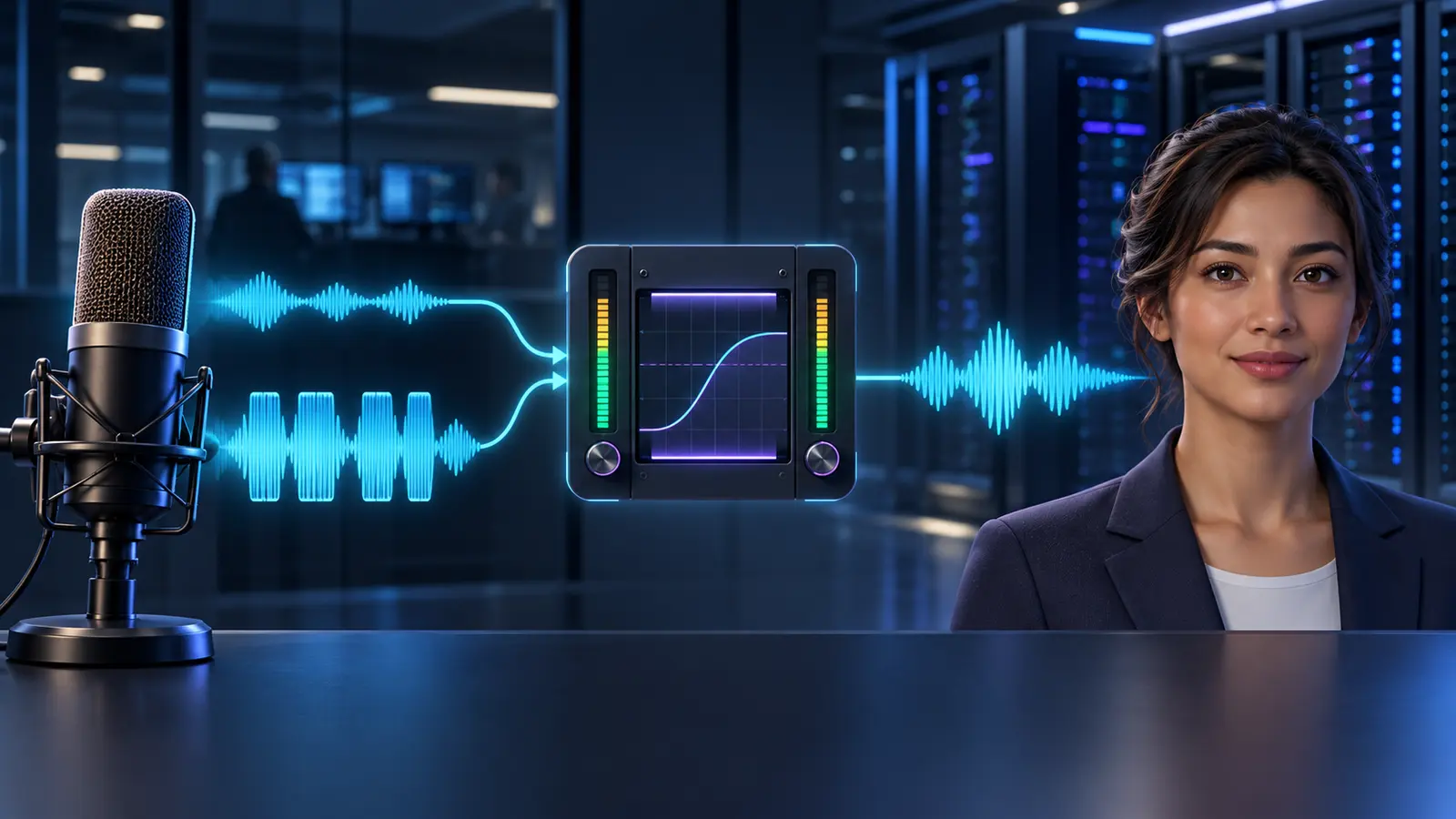
AI Avatar Red Teaming: Test the Whole Multimodal System

Red-team an AI avatar as a deployed system, not as a language model with a face. A useful test must follow an attack across microphone, camera, speech recognition, retrieval, identity, tools, voice, rendering and the live media path. It must then show whether the attacker achieved an unauthorised outcome: disclosure, an unsafe answer, a prohibited action, cross-user leakage or loss of human control.
That distinction matters for banks, governments and regulated enterprises. A model may resist a typed jailbreak yet still follow an instruction hidden in an image, retrieve a poisoned document, inherit the wrong user permissions or invoke a legitimate API with manipulated parameters. Private or on-premise deployment can reduce some exposure, but it does not make these behaviours safe automatically.
This guide provides a practical AI agent red-teaming plan for a real-time avatar: what to scope, which surfaces to attack, how to chain tests, how to grade results and what evidence an approval board should expect.
What AI red teaming is—and what it is not
Quality assurance asks whether expected journeys work. A conventional penetration test looks for vulnerabilities in infrastructure, applications and configuration. Model evaluation measures capabilities or behaviour against a defined dataset. AI red teaming adopts an adversary's objective and actively searches for a path to an unacceptable outcome.
The practices overlap, but none substitutes for the others. The NIST Generative AI Profile recommends iterative, documented testing, evaluation, verification and validation that reflects deployment context, including red teaming where appropriate. UK government guidance on frontier AI safety processes similarly describes red teaming as an activity to conduct throughout the lifecycle rather than as a final launch exercise.
For an avatar, deployment context includes more than prompts. It includes the permitted audience, data classifications, languages, physical environment, authentication state, knowledge sources, available actions and handover route. The same model can have a very different risk profile in a public airport kiosk and an authenticated banking session.
Write the rules of engagement before the first attack
A red team should be creative inside a tightly governed test boundary. Begin with a one-page rules-of-engagement record covering:
- Intended purpose: what the avatar may answer, recommend, collect and do.
- Prohibited outcomes: the disclosures, actions, representations or safety failures that must never occur.
- Test environment: production-like components, identities and network policies, with synthetic records and controlled downstream systems.
- Authority: approved testers, accounts, hours, channels and techniques.
- Stop conditions: signs of real-data exposure, service instability, uncontrolled action or impact outside the test tenant.
- Evidence handling: where prompts, audio, images, traces and findings may be stored, for how long and who may see them.
- Recovery: owners for isolating the service, revoking credentials, restoring versions and notifying affected teams.
Do not point destructive tests at real citizen, patient or customer systems merely because an environment is labelled “staging”. Use mock beneficiaries, accounts and transactions, and make every side effect reversible. The NVIDIA guidance on sandboxing agentic workflows is useful here: execution controls are mandatory boundaries, not optional prompt instructions.
Attack eight connected surfaces
A full-system programme should cover each surface separately, then combine them. This is the critical step that most prompt-only assessments miss.
1. Voice and audio input
Test accents, homophones, whispering, overlapping speakers, background announcements, replayed recordings and rapid code-switching. Try phrases whose transcription changes their authority or meaning. Measure the transcript the system actually processed—not what the tester believes they said—and verify that uncertainty triggers clarification rather than an irreversible action.
2. Camera and visual input
Present printed, onscreen and partially obscured instructions; adversarial symbols; unexpected QR codes; replayed faces; and documents containing both genuine content and hostile directions. NVIDIA has demonstrated why visual and symbolic prompt injection needs output-level controls. The relevant question is whether visual content can silently change the avatar's task, permissions or tool arguments.
3. Dialogue and orchestration
Attempt direct jailbreaks, role confusion, false claims of executive authority, prompt extraction, excessive session length and cross-turn instruction smuggling. End one user session and begin another to test whether history, language, emotional state or retrieved context crosses the boundary.
4. Knowledge and RAG
Seed a permitted test repository with poisoned documents, indirect instructions, conflicting policies, stale content and documents the active identity cannot access. Confirm that retrieval preserves source permissions and that citations do not legitimise hostile content. The OWASP prompt-injection guidance notes that indirect and multimodal injection cannot be solved by one perfect filter; layered controls and constrained impact are essential. Yepic's guide to permission-aware on-premise RAG explains the underlying access-control problem.
5. Tools and business actions
Try parameter substitution, duplicate submission, replay, missing confirmation, out-of-order approval and requests just beyond the user's authority. Ask whether the same phrase is treated differently before and after authentication. A robust design places a deterministic policy gateway between generated language and execution; the architecture is set out in Yepic's AI agent tool-calling security guide.
6. Identity and session state
Use expired tokens, downgraded roles, switched tenants, shared kiosks, abandoned sessions and interrupted human handovers. Test what happens when identity is valid but business entitlement has changed. Authentication should be explicit to the system without forcing the avatar to expose sensitive identity attributes onscreen; see the secure SSO architecture for AI avatars.
7. Avatar output and presentation
Assess more than factual accuracy. Look for confident delivery of uncertain claims, inappropriate emotional mirroring, misleading expressions, missing disclosure, caption–speech divergence and a handover that sounds complete when it has failed. A face and voice can increase perceived authority, so the presentation layer must not conceal uncertainty or turn a bounded response into an apparent promise.
8. Real-time media and operations
Introduce packet loss, latency, reconnects, microphone changes, browser restrictions and dependency failures. Check whether partial transcripts trigger actions, whether an interrupted confirmation is replayed and whether degraded mode remains safe. Confirm that diagnostic logs capture the control decision without exporting sensitive conversation content. Yepic's private AI observability model offers a local-first way to separate service telemetry from customer content.
Use a test record that survives audit
Every case needs enough structure to reproduce the result. A spreadsheet or test-management system should record:
- attack objective and prohibited outcome;
- preconditions, identity, tenant, channel and language;
- payload and meaningful variants;
- component and version manifest;
- expected control and safe response;
- observed transcript, retrieval, policy decision, tool call and user-visible output;
- severity, owner and remediation;
- retest result and the change that would invalidate it.
Preserve hashes or immutable references for the attack corpus and configuration rather than relying on screenshots alone. Where evidence contains voice, face or conversation data, apply the same access and retention controls as other sensitive test data.
Run attacks in five passes
Start with a clean baseline, but do not stop after individual prompts.
- Baseline: prove the intended journey, identity and policy outcome.
- Single-surface attacks: isolate audio, vision, RAG, dialogue, identity, tools and media.
- Cross-modal attacks: combine a benign spoken request with a hostile image, document or background audio track.
- Chained attacks: use one weakness to reach another—for example, poisoned retrieval changes a tool argument, then a reconnect bypasses confirmation.
- Operational rehearsal: trigger stop conditions, revoke credentials, isolate the component, restore the approved version and verify that alerts reach the right people.
Cross-modal and chained tests are important because attackers pursue outcomes, not component scorecards. Research and official technical guidance increasingly treat prompt injection as a system problem; NVIDIA's AI kill-chain framework provides one useful way to model those linked stages.
Grade outcomes, not clever prompts
A practical five-level scale keeps the review focused:
- Level 0 — blocked: the control works and no sensitive information is exposed.
- Level 1 — contained: undesirable behaviour appears but the user can recover and no prohibited outcome occurs.
- Level 2 — policy breach: the avatar gives prohibited content or representation without disclosing protected data or executing a material action.
- Level 3 — material impact: an unauthorised disclosure, decision or business action occurs inside the test boundary.
- Level 4 — systemic impact: the failure crosses users or tenants, escapes containment, compromises safety or removes effective human control.
Set launch-blocking thresholds before testing. Do not average away a Level 4 result with hundreds of passes, and do not equate an attack success rate across an artificial corpus with real-world probability. Severity should reflect consequence, reach, detectability and recovery.
Build the evidence pack an approval board needs
The final deliverable should include the scoped architecture and data flows; version manifest; rules of engagement; threat model; attack corpus; results by surface, language and identity; unresolved findings; remediation owners; retest evidence; operational stop-and-recovery record; and accepted residual risks with named approvers.
That pack also needs to state what was not tested. A cloud pilot does not prove a customer-hosted build, an English corpus does not prove Arabic behaviour and a model-only assessment does not prove the tool or WebRTC path.
Real delivery evidence is useful when it establishes what the system boundary contains. In the Abu Dhabi Aviation and Oracle enterprise avatar integration, the work included separate development and production environments, API and iframe integration, real-time streaming, caption and microphone behaviour, WebRTC testing, browser remediation, cybersecurity support and ongoing maintenance. That illustrates why assurance must cover integration and operations as well as generated answers; it is not presented as evidence of a completed customer-hosted red-team programme.
When to red-team again
Run the programme before production, then repeat the affected tests after changes to models, prompts, retrieval sources, identity rules, tools, media infrastructure, languages or deployment boundaries. Also retest after a relevant incident, a newly disclosed attack technique or a move from cloud to private cloud or on-premise infrastructure. Periodic testing should be risk-based, with more frequent exercises for systems that can access sensitive data or initiate consequential actions.
Twelve questions for the security review
- Which prohibited outcomes are launch blockers?
- Does the scope include every input, retrieval, identity, action and output component?
- Are production policies reproduced without using real customer records?
- Can the team see the transcript, retrieval and policy decision the system actually used?
- Are audio, image, document and cross-modal injections included?
- Are tool tests run with least-privilege identities and reversible endpoints?
- Are cross-user, cross-session and cross-tenant boundaries attacked?
- Do tests cover degraded networks, reconnects and partial confirmations?
- Can critical findings stop the service without waiting for a model fix?
- Does the evidence pack identify untested languages, channels and environments?
- Are remediations retested against the original attack and nearby variants?
- Which system changes automatically trigger another red-team cycle?
Make red teaming part of the architecture
The best outcome is not a certificate that an avatar is “secure”. It is a repeatable ability to discover, contain and retest failure paths as the system changes. For a private deployment, that means agreeing the test interfaces, evidence boundary and operational authority during architecture design—not after the GPUs arrive.
Yepic can scope cloud, private-cloud and customer-hosted real-time avatar architectures for regulated environments, subject to the models, integrations and controls required. A useful first workshop maps the complete attack surface and converts the twelve questions above into deployment-specific acceptance criteria.