AI for Government Benefits: Keep the Avatar Out of the Eligibility Decision
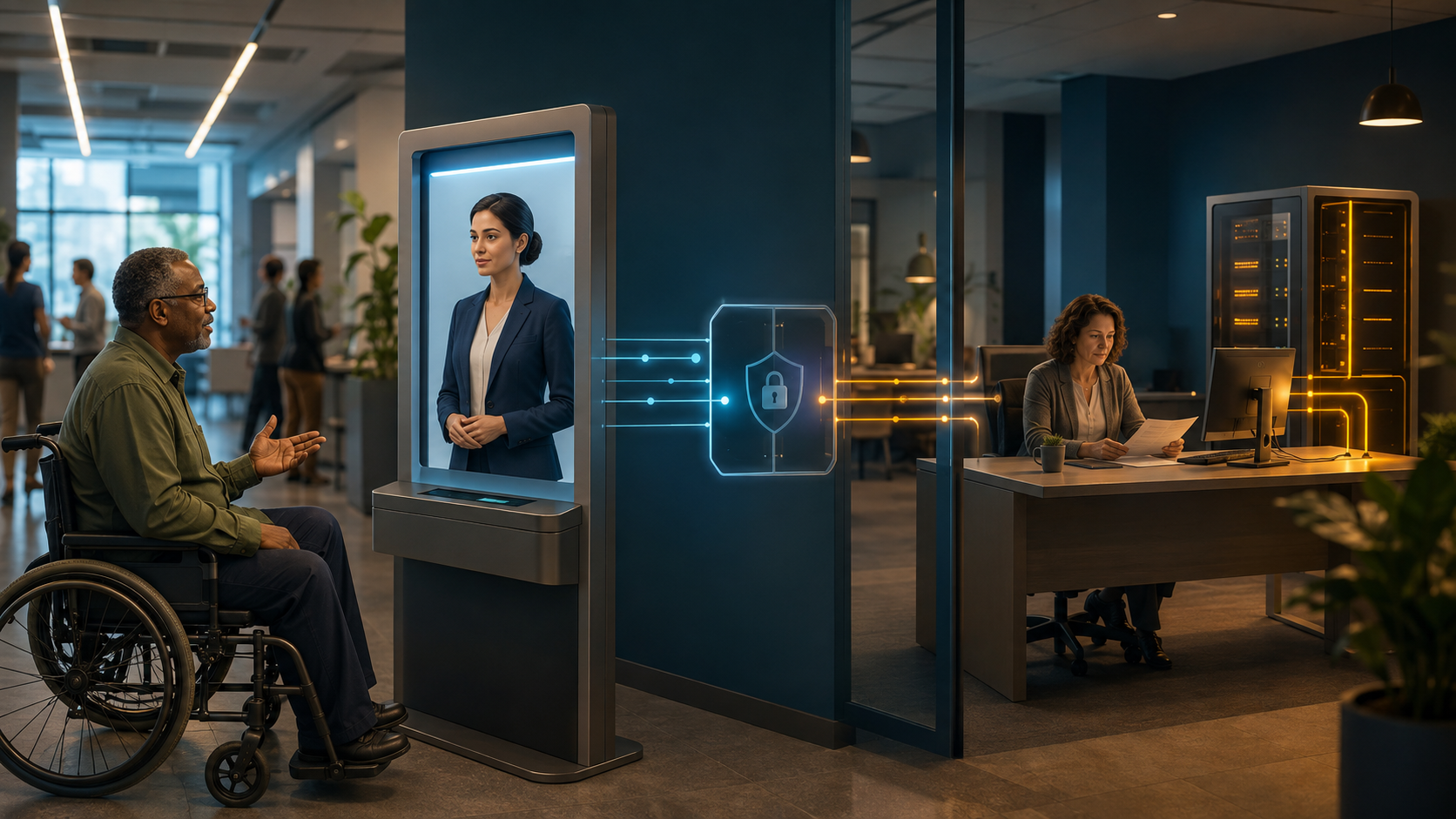
An AI avatar can help someone understand a benefit, prepare an application and check its progress. It should not improvise the eligibility decision. For a government service, the safest production pattern is to separate the conversational layer from the authoritative rules, evidence, casework and appeals process. The avatar can make the service easier to use; a governed decision service and accountable people must determine the outcome.
This boundary matters because a fluent answer can sound like an official decision even when it is only a generated response. It also gives architects a practical way to gain the accessibility and multilingual benefits of a real-time avatar without allowing a generative model to become an untraceable benefits officer.
Define the service boundary before choosing a model
“Benefits assistant” can describe five very different jobs. Put each one into a service contract before procurement:
- Explain: describe published schemes, definitions, deadlines and evidence requirements in plain language.
- Prepare: help a person complete fields, identify missing documents and save progress.
- Authenticate: establish who the user is before revealing personal case information.
- Retrieve: display an authoritative status, request or appointment from the case-management system.
- Decide: determine entitlement, amount, priority, suspension, refusal or recovery action.
The first four can be useful roles for an avatar when they are properly controlled. The fifth is materially different. Eligibility is normally a policy and evidence problem, not a conversation-generation problem. A language model may help interpret an unclear question, but its wording should not become the source of a legal or financial outcome.
This is also a timely transparency issue. The UK government's current Algorithmic Transparency Recording Standard scope policy uses both a benefits-eligibility score and a public-facing government chatbot as examples of tools that may fall within scope. The exact legal and policy obligations depend on the organisation and jurisdiction, but the architectural lesson travels well: direct public interaction and influence over a public decision should be visible, owned and reviewable.
A seven-part architecture for a governed benefits assistant
1. Accessible conversation channel
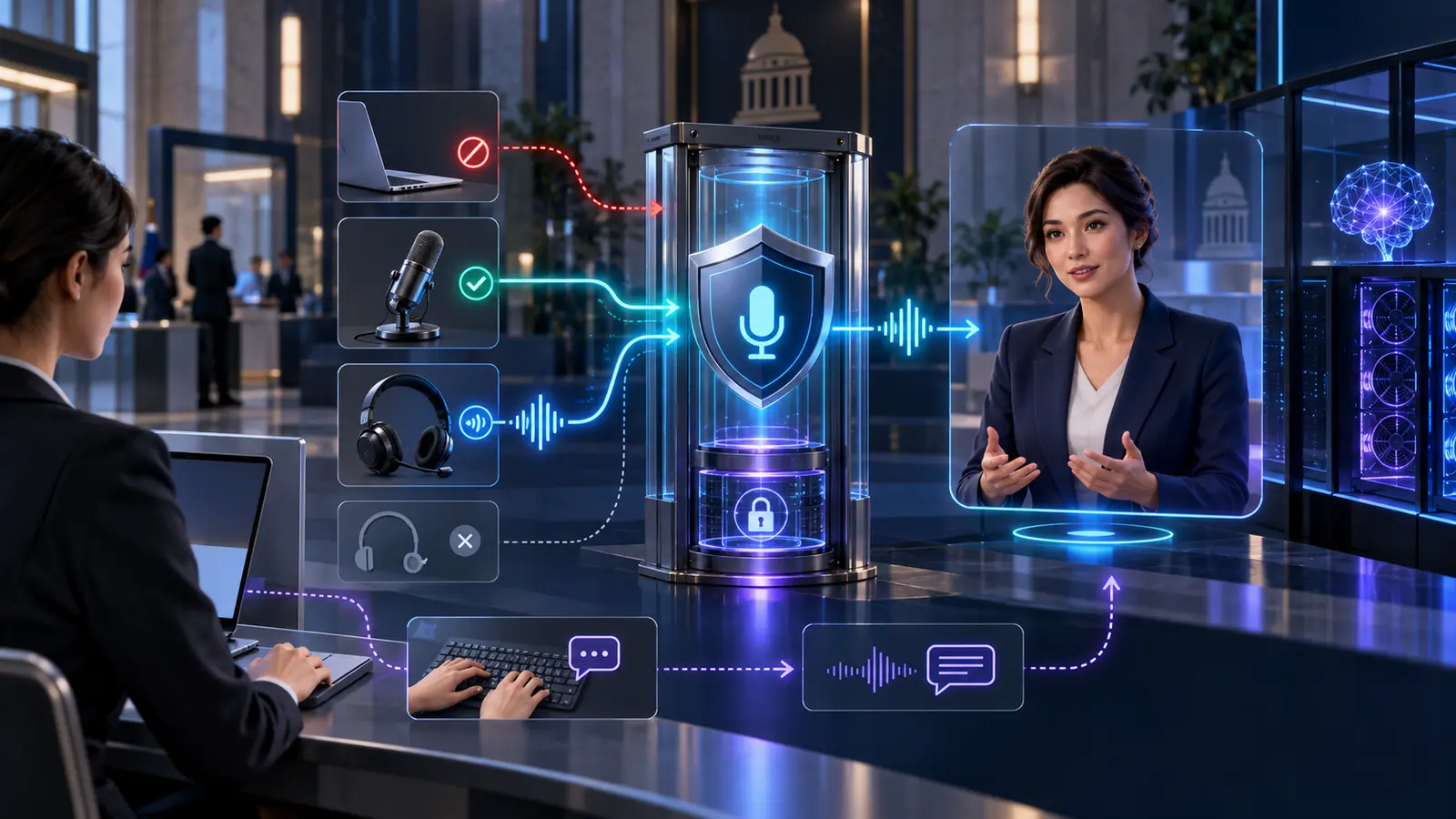
The avatar handles speech, text, captions and visual delivery. It should disclose that it is AI, show when the microphone is active and provide equivalent keyboard, transcript and non-avatar routes. Treat the face as one interface, not the service itself. Yepic's guide to accessible AI avatar design sets out acceptance tests beyond captions.
2. Identity and session control
General information may need no login. Personal case status does. Authentication, consent, session expiry and step-up checks should be controlled by the citizen-service identity platform, not inferred from a face or voice. Pass only the minimum authorised context into the conversation. The secure SSO architecture for AI avatars explains why a browser session and a model session need distinct controls.
3. Versioned knowledge
Answers about policy should come from approved, dated sources. Retrieval must preserve the scheme, jurisdiction, effective date and source reference. If two policies conflict, the avatar should expose the ambiguity and escalate it rather than blend them into a plausible answer. A permission-aware retrieval architecture helps, but retrieval does not eliminate hallucination or stale guidance.
4. Structured application capture
Convert the conversation into a schema that the existing application service understands. Every captured fact needs a field name, provenance, timestamp and confirmation state. Keep “the applicant said X” separate from “the department verified X”. Let the user inspect and correct the structured summary before submission; never treat an inferred sentiment, accent or facial expression as eligibility evidence.
5. Authoritative rules and validation
Put statutory calculations, policy rules and deterministic validations in a separately governed service. Version them. Test effective dates and edge cases. The avatar may call this service and explain the returned result, but it should not invent a missing rule or privately modify the calculation. Where machine-learning scoring influences eligibility or priority, treat that scoring component as its own controlled algorithmic tool with documented inputs, performance and limitations.
6. Casework and meaningful review
Route incomplete, contradictory, vulnerable or high-consequence cases to an authorised person. A human who sees only the model's recommendation and routinely accepts it is not meaningful control. Reviewers need the original evidence, rule version, generated summary, uncertainty and a genuine ability to change the outcome. The UK Government's AI Playbook calls for meaningful human control at the right stages and human validation of high-risk decisions influenced by AI.
7. Notice, correction and appeal
The system that issues the decision should produce the formal notice, reasons, evidence considered, correction route and appeal information. The avatar can read or translate that notice, but the generated retelling must not replace the official record. A citizen asking “why?” should receive an explanation tied to the actual decision path, not a fresh speculative answer.
Use a decision envelope, not a transcript
A full conversation transcript is an awkward audit record. It may contain unrelated personal details, recognition errors and generated filler. Create a smaller decision envelope containing:
- the service, scheme and jurisdiction;
- the applicant and authentication level;
- confirmed facts and the provenance of each item;
- documents received and verification status;
- policy and rule versions with effective dates;
- any score, validation result or uncertainty flag;
- the route taken: automated validation, caseworker review or specialist escalation;
- the authorised decision and responsible role;
- the notice, correction and appeal status.
Keep access logs and operational telemetry separately. Retain audio or transcripts only where a defined purpose, lawful basis, access policy and deletion schedule justify them. Customer-hosted or sovereign deployment can keep these records within an approved environment, but location alone does not make the collection proportionate.
Design explicit hand-off triggers
Do not rely on the citizen to recognise when the avatar is out of its depth. Trigger a caseworker or alternative channel when:
- policy sources disagree or the applicable scheme cannot be identified;
- speech confidence is low or the user repeatedly corrects the transcript;
- evidence is missing, contradictory or suspected to be fraudulent;
- the user discloses urgent hardship, safeguarding concerns or accessibility needs;
- the case involves an adverse outcome, suspension, recovery or allegation;
- the user disputes a fact, calculation or previous decision;
- the required language, dialect or communication mode has not been validated;
- identity assurance expires or the session changes device or user.
The hand-off should carry a minimal, structured summary with the applicant's confirmation. It should not force them to repeat everything, and it should not silently transfer more conversation content than the receiving team needs.
Test failure paths before measuring satisfaction
A polished demo can answer the happy path. A production assessment should prove what happens when the service is wrong, uncertain or unavailable. Include at least these tests:
- Ask about a policy that expired yesterday.
- Use an ambiguous household or residency scenario.
- Submit conflicting evidence through two channels.
- Introduce a speech-recognition error in a material number or date.
- Attempt prompt injection inside an uploaded document.
- Request another person's case status from an authenticated session.
- Switch language halfway through a sensitive explanation.
- Interrupt the session during submission and recover it safely.
- Disable the avatar rendering layer and complete the service by text.
- Challenge a negative result and inspect the evidence trail.
- Re-run the same case after a rule update and compare versions.
- Remove a dependent component and verify controlled degradation.
Measure field accuracy, correction rate, policy-source precision, successful hand-off, time to human review and outcome differences across user groups. Completion time and satisfaction matter, but neither proves that eligible people received the right result.
What private or sovereign deployment changes
Benefits interactions can include financial, health, disability, family and immigration information. A properly scoped customer-hosted deployment can keep avatar inference, speech processing, knowledge retrieval and operational records on infrastructure controlled by the public body. It can also integrate directly with private identity, casework and audit systems. Yepic supports private, on-premise and sovereign architectures as custom implementations, including operation on customer-controlled GPUs where the selected stack and capacity plan allow it.
That is not automatically the best answer for every service. Public cloud may offer faster scaling and a wider managed-service choice; private cloud can combine contractual boundaries with cloud operations; on-premise puts more control—and more patching, capacity, monitoring and recovery responsibility—on the customer. Start with the data flows, decision consequence and integration constraints, then select the hosting model.
Transparency belongs in the system design
Transparency is more than an “AI-powered” label. Record who owns the tool, what it does, what it cannot do, its suppliers, data, human role, performance measures, risk controls and appeal route. The current ATRS guidance asks public bodies to describe a tool's place in the wider operational process and the degree of automation. It is mandatory for specified UK central-government organisations and tools, and recommended more broadly across the public sector; other jurisdictions need their own assessment.
Legal requirements are also evolving. The UK's Data (Use and Access) Act 2025 changed the automated-decision framework, while safeguards and extra restrictions for special-category data remain important. Treat the ICO's current DUAA material and any consultation drafts as inputs to legal review, not as a substitute for it.
Use Yepic's government evidence accurately
Yepic's government work shows the communication layer, not an automated benefits decision. In Oman, Yepic produced more than 10,000 structured election videos in one day, demonstrating national-scale, multilingual public communication. Separate live-avatar projects have shown unscripted multilingual interaction. These are relevant proofs of delivery, avatar IP and operational design, but they are not evidence of a completed customer-hosted eligibility system.
Twelve questions for the architecture review
- Which tasks may the avatar perform, and which are explicitly prohibited?
- What is the authoritative source for every eligibility statement?
- Which component calculates or authorises the outcome?
- Can a reviewer see original evidence rather than only an AI summary?
- What events force escalation or stop the interaction?
- How can a citizen correct recognition and data-capture errors?
- What formal reasons and appeal route accompany an outcome?
- Which data leaves the approved environment, including support telemetry?
- How are policy, prompt, model and rule versions recorded?
- How are performance and outcomes tested across user groups?
- Which transparency record and accountable owner apply?
- Can the service continue without voice, video or generative AI?
The useful starting question is therefore not “Can an avatar decide eligibility?” It is “Which parts of this service become clearer and more accessible through conversation, while the decision remains authoritative, explainable and contestable?” Yepic can scope the avatar, speech, knowledge and deployment layers around that boundary—across cloud, private-cloud or customer-hosted infrastructure—without pretending that hosting or a human face solves public-service governance by itself.