AI in Aviation Maintenance: A Controlled Avatar Assistant
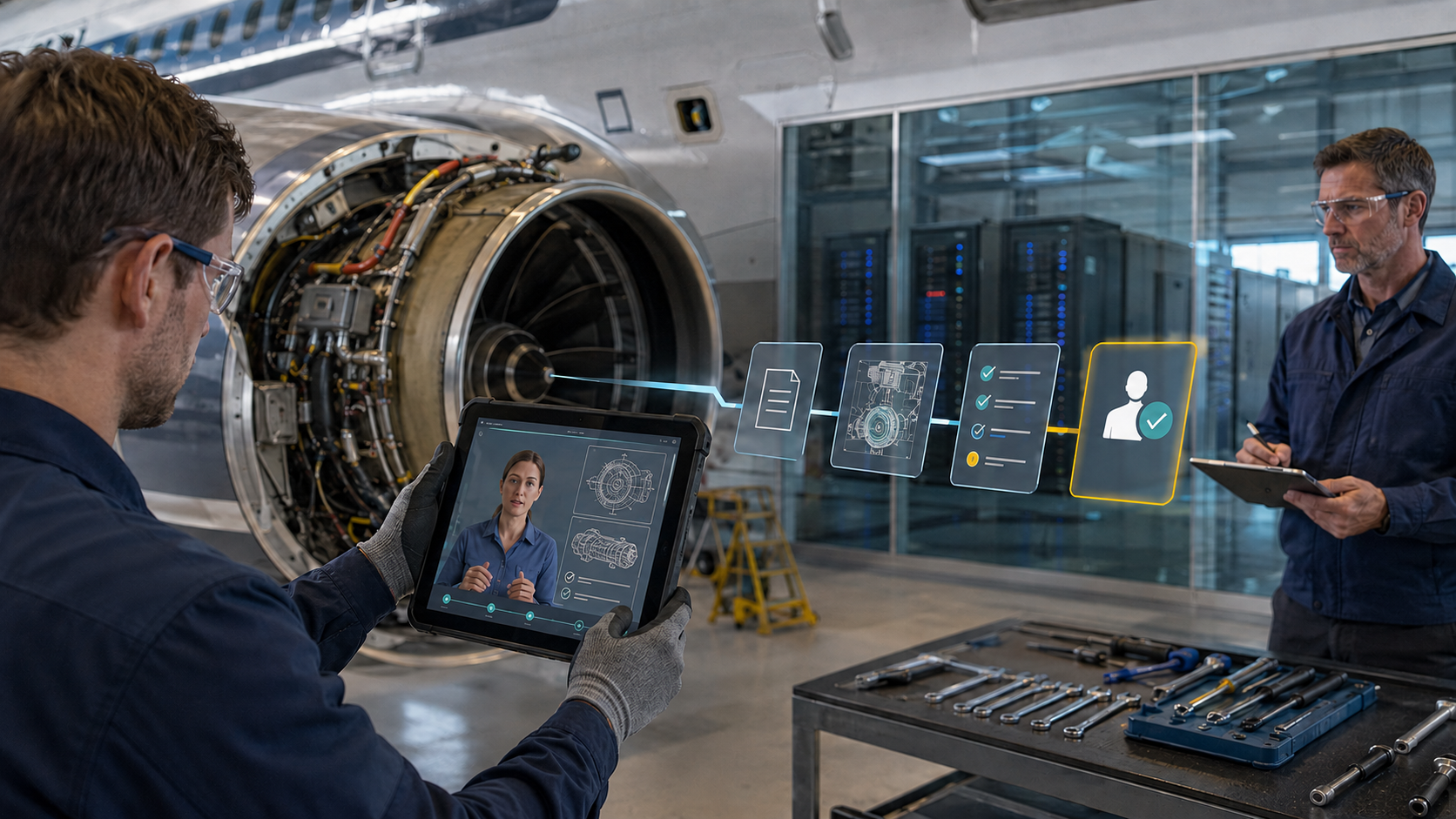
The safest role for an AI avatar in aviation maintenance is to make approved, configuration-specific information easier to find and understand—not to invent a procedure, certify work or release an aircraft to service. The avatar can accept a technician’s question, retrieve the right source, explain it in plain language and preserve an audit trail. The authorised person still selects the applicable data, performs or supervises the task, records the work and makes the regulated decision.
That boundary is more useful than either extreme. Treating the avatar as a talking search box wastes its ability to clarify, translate and ask follow-up questions. Treating it as an autonomous mechanic creates authority, currency and human-factors risks that a confident voice can conceal. The practical design lies between them: a controlled conversational interface over governed maintenance knowledge.
Why aviation maintenance needs a different AI pattern
Aircraft maintenance is knowledge-intensive. A technician may need to reconcile aircraft configuration, current maintenance instructions, task cards, service information, parts data, previous work and local approved procedures. Natural-language access could reduce the time spent navigating that estate. The UK Civil Aviation Authority’s AI in Aviation Technology Outlook identifies aircraft maintenance among the potential uses of AI in airport ground operations.
But the answer cannot be merely plausible. EASA’s Part-145 maintenance-data guidance says an approved maintenance organisation should demonstrate that the maintenance data it uses is current. Where the relevant data is unavailable or not current, the maintenance should not be performed and released. It also describes recording the maintenance data used, including the revision status where appropriate, so the work can be audited.
An avatar therefore needs to return more than fluent prose. It needs an evidence package: source, applicability, revision, access basis, limitations and the next authorised human action.
Define four levels of authority before choosing technology
Level 0: orientation and training
The avatar explains terminology, organisational processes or training material without representing its answer as an instruction for live maintenance. It can quiz learners, adapt an explanation and switch language, but it should distinguish training content from approved operational data.
Level 1: retrieval and explanation
The avatar locates applicable documents or records and explains the retrieved passage. It shows the exact source and revision, makes uncertainty visible and allows the technician to open the controlled original. This is often the strongest first production use case: it improves navigation without changing who is authorised to act.
Level 2: bounded work assistance
The avatar may collect symptoms, prepare a search, compare permitted records, populate a draft or guide the user through an approved checklist. Every consequential step remains constrained by policy, and any generated summary is clearly subordinate to the controlled source. Inputs and outputs are recorded in the approved system of record where required.
Level 3: certification or release
This is not an appropriate authority for a conversational avatar. A model should not issue a certificate of release to service, confer a personnel authorisation or make itself the accountable maintenance decision-maker. The organisation’s competent and authorised people remain responsible under the applicable regulatory and organisational framework.
This four-level model prevents scope drift. A pilot can begin at Levels 0 or 1 and demonstrate value without quietly becoming a Level 2 or 3 system because a new tool connection was added.
Build six evidence gates into every operational answer
1. Confirm the asset and configuration
The same question can have different answers across aircraft type, serial number, modification state, installed component, operator configuration and jurisdiction. The avatar should obtain configuration from a trusted system or ask the user to select it through a controlled interface. It must not infer configuration from conversational hints.
2. Restrict the source set
Define which repositories are approved for each task. Public web content, historic manuals, training notes and informal technician commentary should not be blended into an operational answer merely because they are semantically similar. A permission-aware RAG architecture should preserve source access controls and separate authoritative knowledge from useful but non-authoritative context.
3. Check revision and effective status
Store document identity, revision, effective date, applicability and supersession state as structured metadata. Retrieval should reject or quarantine a source when those controls cannot be established. Caches and vector indexes need update rules too: an up-to-date document store is not enough if the avatar is querying an older index.
4. Verify the user and purpose
A trainee, mechanic, certifying staff member, planner and external contractor may need different material and functions. Use the organisation’s identity service and policy engine, following a pattern such as the four-plane avatar authentication architecture. Do not ask the model to decide privileges from a job title spoken into the microphone.
5. Cite before explaining
The response should make the source reference, revision and relevant section inspectable. The explanation can then simplify vocabulary or connect related facts, but it must not hide where retrieved material ends and generated interpretation begins. If two approved sources conflict, expose the conflict and route it to the defined authority.
6. Require the human decision
The final gate is an explicit handback: open the controlled procedure, request supervisor review, submit a draft, or stop. A warm human voice and face can make the interface approachable, but they can also increase perceived authority. Interaction design should reinforce, not obscure, the user’s responsibility.
A controlled reference architecture
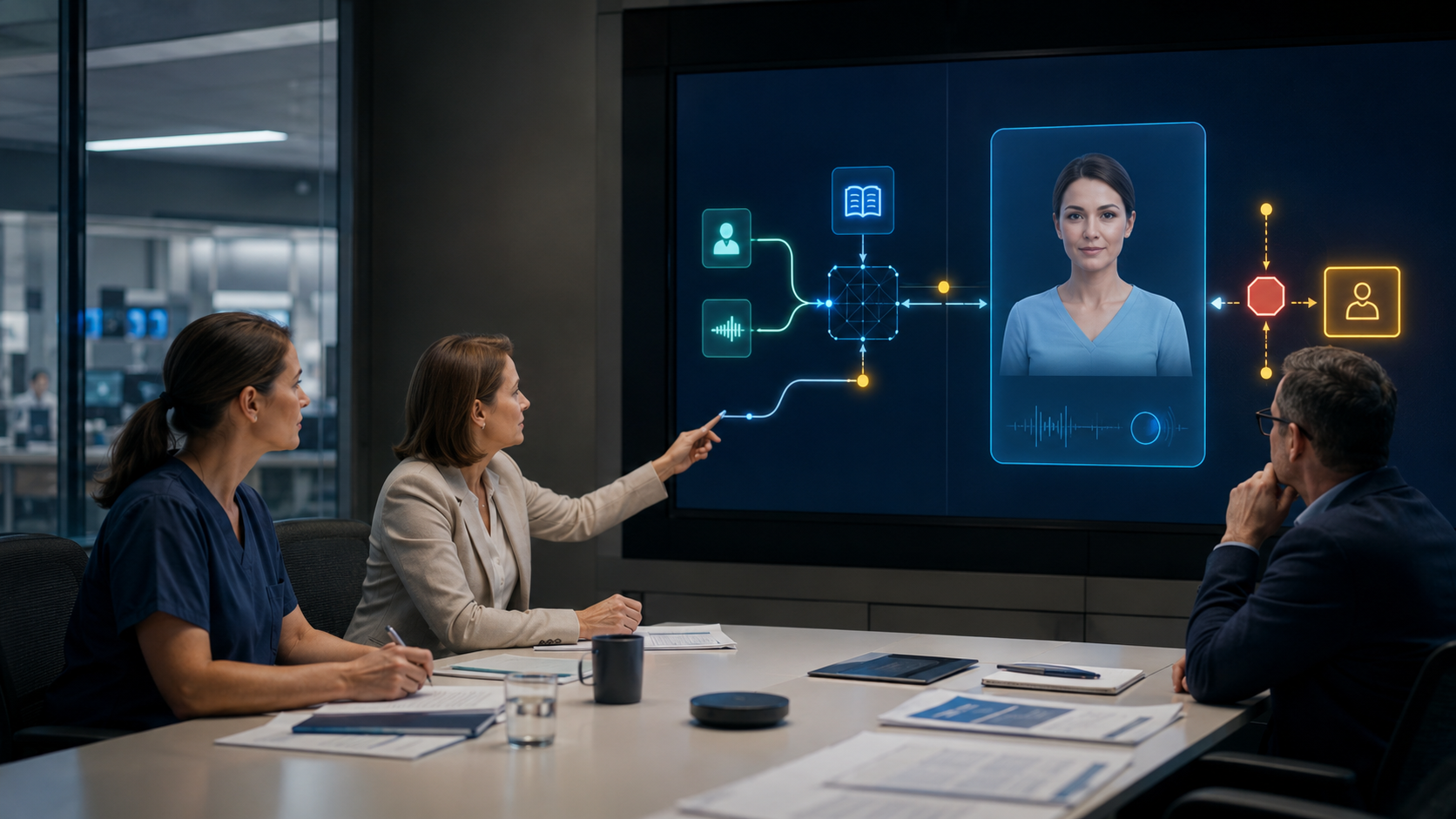
A useful implementation separates the conversational experience from the systems that decide what is true and what is allowed:
- Input layer: microphone, typed text or approved structured selections capture the question.
- Identity and context broker: binds the user, role, session, location and selected aircraft or component.
- Query policy: determines which repositories and functions are permitted for that purpose.
- Controlled retrieval: searches current, access-controlled data using configuration and revision filters.
- Evidence validator: checks source identity, applicability, currency and completeness before generation.
- Response policy: constrains the model to cite, qualify or refuse based on the evidence state.
- Avatar delivery: explains the result through voice, captions and visual references while keeping the controlled source available.
- Workflow handback: sends any draft, escalation or confirmation to the approved maintenance system and authorised person.
- Audit layer: records the request, policy result, sources, model and prompt version, response and human disposition.
The model is one component in this chain. Replacing it, moving it on-premise or changing the avatar renderer should not bypass the evidence and authority gates.
Design for the hangar, not the demo room
Aviation maintenance creates interaction conditions that ordinary chatbot testing misses. Background noise can damage speech recognition. Gloves can make small controls unusable. Acronyms, part numbers and similar-sounding terms can be misheard. Connectivity may be constrained inside a hangar or at an outstation.
Production testing should therefore include:
- representative machinery and ventilation noise;
- speech from the accents and languages used by the workforce;
- part numbers, abbreviations and ambiguous component names;
- push-to-talk, typed input and repeat-back alternatives;
- clear microphone and recording states;
- large touch targets suitable for the expected protective equipment;
- captioning and a persistent transcript where policy permits; and
- safe behaviour during slow, intermittent or unavailable connectivity.
For a critical identifier, the avatar should read back the value or display it for confirmation. It should not silently normalise an uncertain transcription into the nearest plausible part number.
The FAA’s AI Safety Assurance Roadmap makes a relevant broader point: human–automation integration should be addressed through established human-factors thinking, with AI-specific controls added where AI creates additional risk. An avatar project should treat workload, over-reliance, error recovery and automation surprise as design inputs rather than post-pilot usability issues.
Choose on-premise, edge or cloud by operating constraint
A private or customer-hosted deployment can keep technical documents, maintenance history, speech, retrieval and inference inside the organisation’s environment. It can reduce dependence on external services and integrate with private identity and maintenance systems. Yepic can scope proprietary real-time avatar technology for customer GPUs and controlled environments, subject to component selection, hardware validation and implementation work.
That control creates operational obligations. The organisation needs a secure route for model and application updates, current maintenance data, signed artefacts, monitoring, incident response and rollback. The on-premise model-update framework explains why the full stack—not only the language model—needs a version manifest and regression process.
Edge processing may suit speech or rendering at a hangar or outstation, while retrieval and records remain in a private data centre. Cloud can be sensible for elastic training, non-sensitive content or organisations already operating approved cloud identity and data services. The right answer may be hybrid. The requirement is that every component’s data flow, availability dependency and update owner is explicit.
What Yepic’s aviation work proves—and what it does not
In the Abu Dhabi Aviation and Oracle integration, Yepic helped turn complex operational data into an interactive avatar experience. The system queried enterprise data at different levels according to role and clearance, returned charts and narrated explanations, and was supported through API integration, separate development and production environments, browser and network testing, cybersecurity work and ongoing maintenance.
That is relevant evidence for controlled access, data interpretation and enterprise delivery in aviation. It is not evidence of a deployed maintenance-instruction assistant, a particular aviation approval or a completed customer-hosted installation. A maintenance use case would require its own scoping, safety analysis, source governance, testing and approval by the responsible organisation.
Run these 12 production acceptance tests
- Does the system refuse to answer when aircraft or component configuration is unresolved?
- Can it distinguish current operational data from training, historic and informal material?
- Does a superseded document disappear from retrieval promptly and predictably?
- Can every answer show the exact source, revision and relevant section?
- Does the avatar expose conflicts rather than blending them into one response?
- Can a user retrieve information outside their role, fleet or organisation through indirect prompts?
- Are part numbers, measurements and negations tested under representative hangar noise?
- Does low confidence trigger confirmation, typed input or refusal rather than guesswork?
- Can the user open the controlled original without relying on the generated summary?
- Does every draft or suggested next step return to the approved workflow for human action?
- Do network, identity, retrieval and model failures produce a safe, visible degraded mode?
- Can an auditor reconstruct the user, sources, versions, response and human disposition?
The best first milestone is not “the avatar answered every question”. It is a bounded task where the organisation can prove that every answer came from the right data, for the right aircraft, at the right revision, for the right person—and stopped at the right authority boundary.
Yepic works with aviation and regulated-enterprise teams to scope real-time avatar systems across cloud, private-cloud and customer-hosted environments. Begin with one maintenance knowledge journey, map its approved sources and decision rights, then test the complete human–AI workflow under operational conditions.