AI Incident Response: A Containment Playbook for Avatar Systems

An AI incident response plan for a real-time avatar should let an enterprise contain one unsafe capability without immediately losing the entire service or the evidence needed to understand what happened. The practical design is a containment ladder: revoke actions first, restrict knowledge and modalities next, drain affected components, and stop the service only when the remaining risk justifies it. Every step needs a named owner, a technical control and a tested route back to a known-good state.
This is different from ordinary outage management. A system can be available and still be unsafe: it may retrieve a document the user was not allowed to see, call an API with excessive authority, speak through an unapproved identity, or behave differently after a compromised model or configuration update. Equally, taking the whole avatar offline may unnecessarily remove a useful citizen, customer or employee service.
The goal is therefore controlled degradation, not a single theatrical “kill switch”. Banks, governments and regulated enterprises should decide in advance which functions can be isolated, which evidence must survive containment, who can authorise each action and what proof is required before service returns.
What counts as an AI-avatar incident?
An incident is not limited to a conventional cyber intrusion. It is any event that threatens the confidentiality, integrity, safety, identity or authorised operation of the avatar service and requires a coordinated response. Teams should define categories before deployment because each category needs different evidence and containment.
- Knowledge incident: the avatar exposes restricted content, cites a poisoned source or answers from an unapproved knowledge version.
- Action incident: a tool call exceeds the user’s authority, repeats an action, bypasses approval or reaches the wrong downstream system.
- Identity incident: an avatar, voice or operator account is used without valid authority, or a likeness asset is replaced or misconfigured.
- Model or policy incident: a component update changes behaviour, guardrails fail, or a policy configuration is altered without approval.
- Privacy incident: audio, video, transcripts, retrieved records or diagnostic data are retained, exported or disclosed outside the intended boundary.
- Availability incident with safety impact: latency, partial failure or network instability causes duplicated speech, broken turn-taking, stale answers or failed human handover.
A failed GPU is usually an availability event. A failed GPU that causes sessions to resume against the wrong tenant configuration is also an integrity and privacy incident. The classification should follow impact, not merely the component that raised the alert.
Use a containment ladder, not one kill switch
A binary shutdown control is necessary for severe cases, but it is a poor first response to every event. Build progressively stronger controls that can be invoked independently and audited.
Level 1: revoke actions
Disable tool calling, payment initiation, record updates, email sending and other state-changing functions while keeping read-only conversation available. Revoke short-lived credentials and downstream tokens rather than relying only on a prompt instruction. Yepic’s guide to an AI action gateway explains why execution authority should sit outside the language model.
Level 2: restrict knowledge and response mode
Remove affected indexes or collections from retrieval, pin the system to an approved knowledge snapshot, or switch from generative answers to a bounded set of reviewed responses. If the incident concerns permission leakage, denying retrieval is safer than asking the model not to reveal what it has already received.
Level 3: disable an affected modality
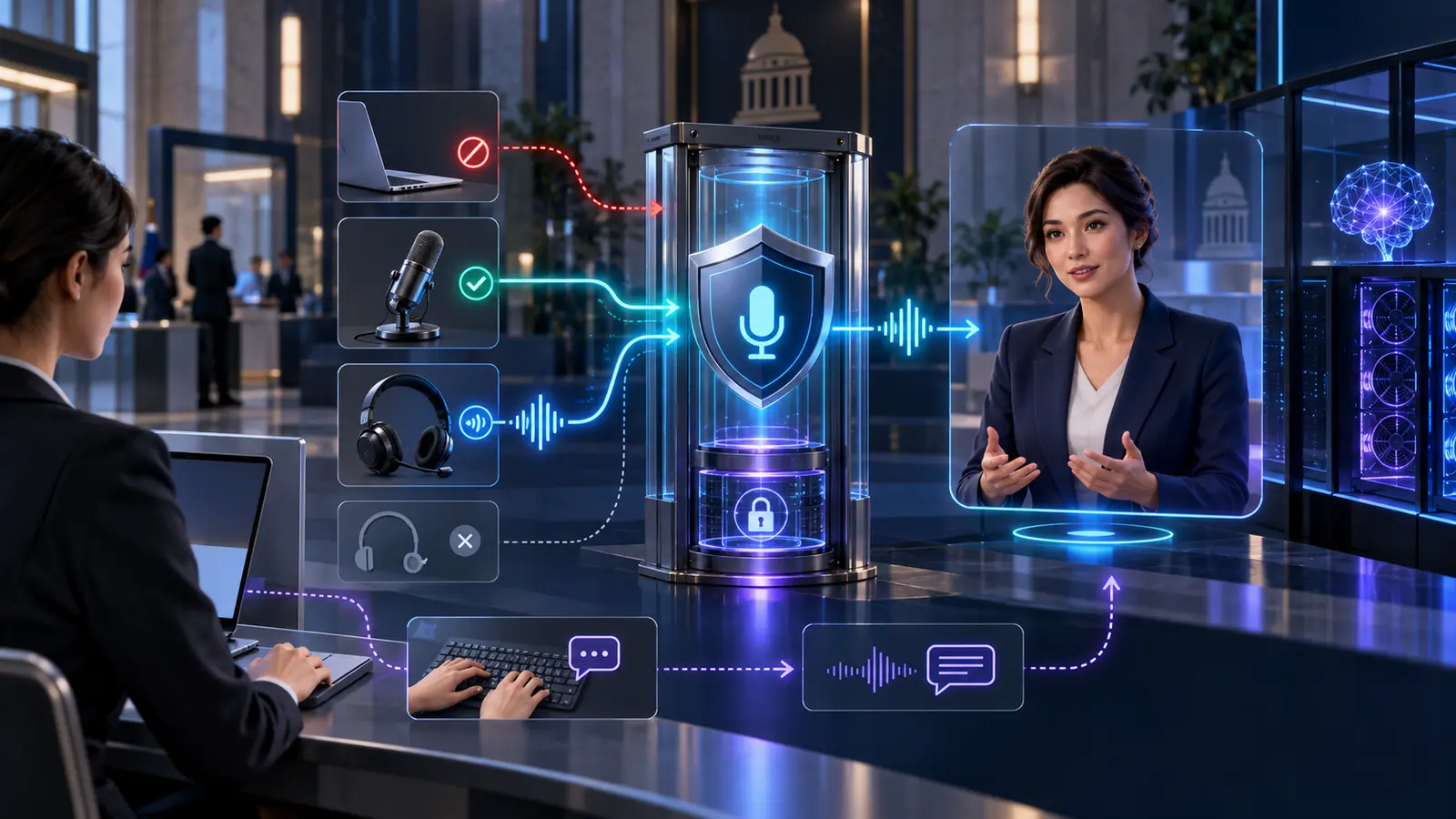
Turn off camera input, microphone capture, voice cloning or a particular rendering identity while preserving a text channel or human callback route. A multimodal avatar has more than one input and output surface; containment should not assume they must all remain coupled.
Level 4: isolate and drain a component
Stop new sessions from reaching the suspect speech, retrieval, LLM, TTS or rendering service. Allow safe sessions to end where appropriate, quarantine the component and route new traffic to a verified version or reduced service. The rollback path should use the dependency and version records described in an AI bill of materials.
Level 5: stop sessions or the channel
Prevent new sessions, terminate active sessions using a clear customer message, and disable the affected website, kiosk, branch or API channel. This is appropriate when identity, content, credentials or the control plane itself cannot be trusted. The shutdown mechanism must sit outside the component it controls and remain operable when the avatar stack is degraded.
Separate the control plane from the conversation
The response team cannot safely contain an avatar if the same model, credentials and network path control both the conversation and the emergency action. A production architecture needs an independent control plane with:
- an inventory of deployed components, versions, tenants, channels and identities;
- feature flags or policy controls for tools, retrieval sources, modalities and avatars;
- credential revocation and rotation outside the model runtime;
- session draining and termination controls at the gateway or orchestration layer;
- role-based approval for high-impact containment and recovery actions;
- a protected status channel that does not depend on the affected service; and
- an evidence store that responders cannot silently rewrite.
For customer-hosted deployments, these controls may sit inside the customer environment and integrate with existing identity, SIEM, secrets-management and incident platforms. That can improve direct control of data and infrastructure, but it also gives the customer more operational responsibility. Private deployment is not incident response by itself.
Preserve enough evidence without copying every conversation
Containment often changes the very systems investigators need to inspect. Before rotating credentials, rebuilding an index or rolling back a model, capture the relevant configuration identifiers, policy decisions, retrieval references, tool receipts, session boundaries and infrastructure state.
That does not mean retaining raw audio, video and complete transcripts by default. A privacy-minimised AI audit trail can record who acted, which approved configuration ran, what authority was used and what outcome occurred. Content should be added only when a defined investigation, legal or service requirement justifies it, with access and deletion controls applied.
Preservation should also be deliberate. Record who placed evidence on hold, the source and time range, the collection method, integrity checks, access history and the condition that will end the hold. Do not let an emergency export become an unmanaged archive that defeats the organisation’s zero-retention policy.
A six-phase AI incident response playbook
The final NIST SP 800-61 Revision 3, published in April 2025, treats incident response as part of wider cybersecurity risk management rather than an isolated clean-up activity. The UK NCSC secure-AI deployment guidance specifically recommends AI-related incident, escalation and remediation procedures, trained responders, useful audit logs and offline backups. An avatar playbook can turn those principles into six operational phases.
- Prepare: assign service, security, privacy, model, communications and supplier roles; map dependencies; pre-authorise containment levels; and rehearse them.
- Detect and validate: correlate user reports, safety signals, identity events, retrieval anomalies, tool receipts and infrastructure telemetry. Confirm the event without repeatedly exposing sensitive content.
- Classify and scope: identify affected tenants, identities, channels, sessions, data classes, models, tools and time windows. State what is known, unknown and assumed.
- Contain: choose the least disruptive control that reduces risk to an acceptable level. Record the decision, authoriser, time and expected side effects.
- Eradicate and recover: remove the cause, rotate compromised authority, rebuild from trusted sources, deploy a verified version and pass recovery gates before progressively restoring capability.
- Learn: complete a blameless technical review, update detections and runbooks, add regression tests and track corrective actions to closure.
The Coalition for Secure AI’s incident-response framework, released in 2025, is useful because it treats the whole AI ecosystem—models, data pipelines, retrieval, agents and human interactions—as the response surface. That is a better fit for real-time avatars than a playbook focused only on a model endpoint.
Recovery must prove more than uptime
Restoring a green health check is not enough. Before reopening a channel, require evidence that:
- the affected identity, credential, model, index or policy version is no longer in service;
- the clean configuration is signed off against the deployment inventory;
- permissions and tenant separation have been retested;
- high-risk tools remain disabled until separately approved;
- representative conversations pass safety, factuality, latency and handover tests;
- monitoring can detect recurrence without exporting unnecessary customer content; and
- the reduced-service and full-service states both have accountable owners.
Recovery can be progressive: text before speech, reviewed knowledge before broad retrieval, read-only before transactional tools, one internal channel before public kiosks. This is where incident response connects to—but remains distinct from—an AI avatar disaster-recovery plan. Disaster recovery restores availability; incident response restores trust.
Test these 12 conditions before production
- Can responders disable tool execution without asking the language model to comply?
- Can one knowledge source, tenant, identity or channel be isolated independently?
- Does the emergency control still work if the normal admin interface is unavailable?
- Can credentials be revoked without rebuilding the entire avatar stack?
- Can the service fall back to reviewed information or a human route?
- Are active sessions drained or terminated predictably, with a clear user message?
- Can investigators identify the exact component, configuration and policy versions used?
- Does evidence preservation avoid creating an uncontrolled transcript archive?
- Can a clean environment be rebuilt from trusted artefacts and sources?
- Do recovery gates test permissions, content, tools, media and handover—not only uptime?
- Are supplier and customer responsibilities explicit for cloud, private-cloud and on-premise designs?
- Has the team rehearsed a realistic incident and closed every resulting action?
What Yepic’s deployment experience contributes
Real deployments reveal incident surfaces that architecture diagrams miss. In the Abu Dhabi Aviation and Oracle enterprise-avatar integration, the work included separate development and production environments, API and iframe integration, real-time streaming, captions and microphone behaviour, WebRTC and network testing, browser remediation, cybersecurity support and ongoing maintenance.
That project is evidence of the operational breadth involved in integrating an enterprise avatar; it is not presented as a completed customer-hosted incident-response deployment. Yepic’s current private, on-premise and sovereign offer is scoped as a custom implementation. The appropriate containment controls, GPU topology, integrations, support boundaries and recovery procedures depend on the customer’s environment and risk model.
The useful starting point is a scenario workshop, not a generic uptime promise. Choose the three incidents that would matter most to the service, map the blast radius of each component, and demonstrate the containment ladder in the intended deployment environment before users depend on it.