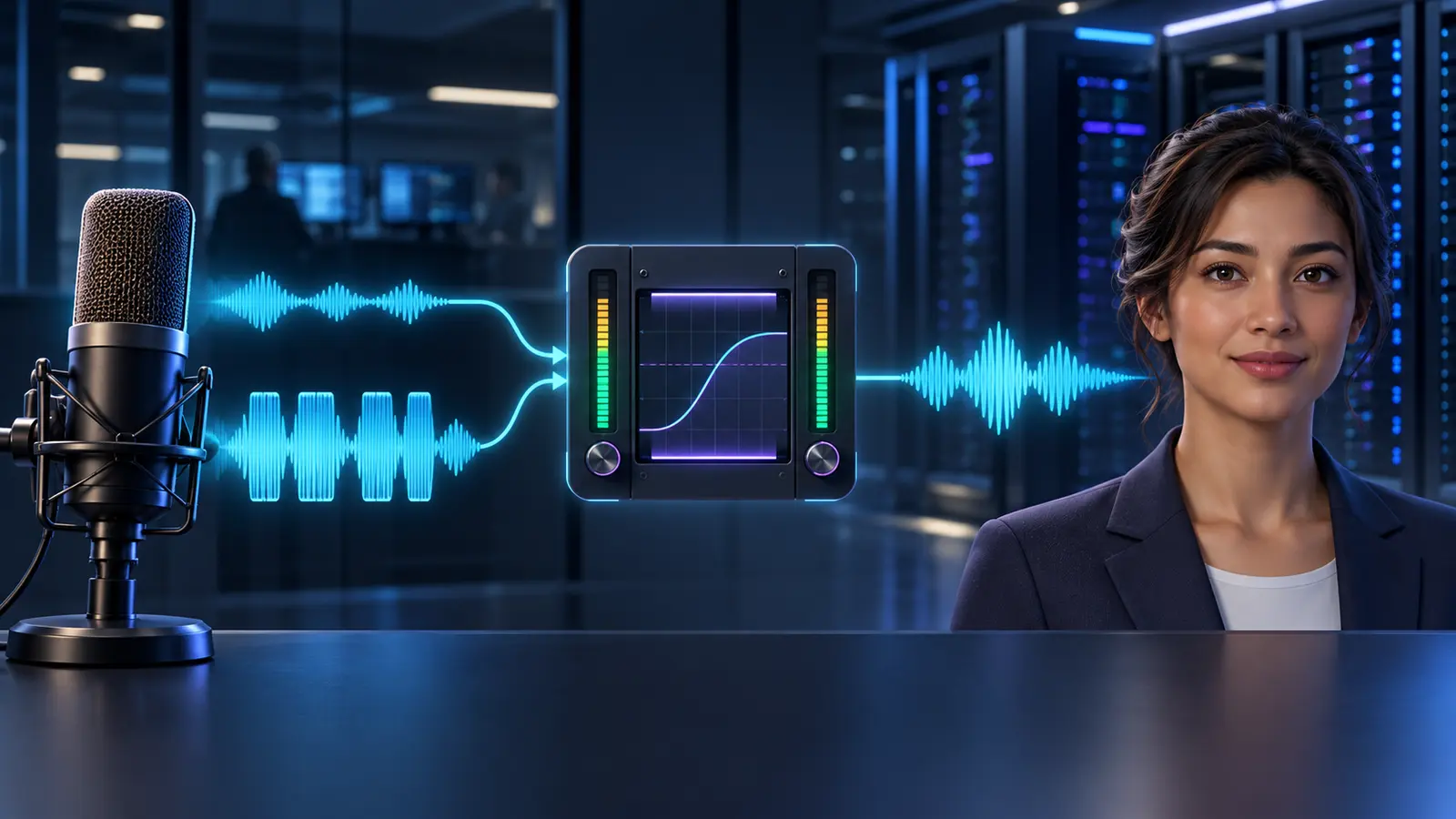
Emotion AI Regulation: Responsive Avatars Without Profiling

Emotionally responsive AI avatars do not need to infer a person's hidden emotional state. For most bank, government and regulated-enterprise services, the safer design is to adapt to explicit words, user choices and observable interaction events—such as interruption, silence or a request for help—without assigning labels such as angry, distressed, deceptive or engaged.
That distinction is now a procurement requirement, not a semantic debate. The EU AI Act prohibits certain emotion inference in workplaces and education, requires transparency for permitted emotion-recognition systems and raises wider questions about accuracy, fairness and biometric data. Private or on-premise deployment can contain data and models, but it does not turn a prohibited or unjustified inference into an acceptable one.
This guide gives architecture, risk and procurement teams a practical boundary: make the avatar expressive and context-aware, but require a separate, evidenced decision before it is allowed to infer emotion from a person's face, voice or body.
Separate five capabilities that vendors often blur
“Emotion AI” is used for several technically and legally different things. An evaluation should split them into five layers.
- Expressive output: the avatar changes its own facial movement, vocal delivery or conversational tone according to an approved persona and response policy.
- Dialogue adaptation: the system responds to what a person explicitly says, the task in progress and facts already supplied in the conversation.
- Observable interaction-state detection: the system detects events such as overlapping speech, a long pause, repeated failed attempts, a raised volume level or loss of eye contact, without claiming to know the person's inner state.
- Emotion or intention inference: the system converts facial, vocal, physiological or behavioural features into a label or score such as frustration, confidence, engagement or deception.
- Consequential use: an inferred label changes access, priority, price, eligibility, employment feedback, assessment or another material outcome.
The first two can create an empathetic interaction without analysing the user biometrically. The third can improve turn-taking or accessibility if it is narrowly designed and honestly described. The fourth is the regulatory fault line. The fifth creates the greatest risk because an uncertain inference becomes a decision about a person.
Marketing language should preserve these differences. “The avatar pauses when the user interrupts” is testable. “The avatar understands frustration” may conceal an emotion classifier, a text-sentiment model, a simple conversation rule or merely expressive output. Procurement should ask which one it is.
What the EU AI Act means by emotion recognition
The Act defines an emotion-recognition system as an AI system intended to identify or infer the emotions or intentions of natural persons on the basis of biometric data. Its Recital 18 distinguishes this from merely detecting readily apparent expressions, gestures, movements or vocal characteristics—unless those observations are used to infer emotions.
That creates an important architecture question: what happens after the signal is detected? A microphone service may detect that speech has started or that two people are talking at once. An avatar may notice a long silence and ask whether the user needs more time. Neither necessarily requires a claim about emotion. If the same signals are converted into “anxious”, “dishonest” or “disengaged”, the purpose and risk have changed.
The classification is fact-specific. Text sentiment, turn detection, biometric identification and emotion recognition are not interchangeable categories. Legal teams should assess the purpose, inputs, outputs and actual use rather than relying on a feature name.
Workplace and education prohibition
Article 5(1)(f) prohibits placing on the EU market, putting into service for that purpose or using AI systems to infer a natural person's emotions in workplaces and education institutions, except where the use is intended for medical or safety reasons. The European Commission confirms that these prohibited-practice rules have applied since 2 February 2025.
A disclosure screen does not cure a prohibited use. An interview avatar should not score a candidate's confidence from facial movement; a training agent should not rate an employee's engagement from voice; and an education coach should not infer attention from a camera merely because the user clicked “accept”. The narrow medical and safety wording requires case-specific legal review, not a generic wellbeing label.
Transparency for permitted systems
Where emotion recognition is permitted, Article 50(3) requires the deployer to inform exposed people about the operation of the system and to process personal data under the applicable data-protection rules. This obligation has applied since 2 August 2026. The information must be clear, distinguishable and accessible.
Permitted emotion-recognition applications can also fall within the Act's high-risk classification. The official AI Act Service Desk guidance on biometric systems points buyers to requirements including risk management, data governance, documentation, record-keeping, human oversight, robustness, accuracy and security. Classification and implementation dates should be confirmed for the actual system and jurisdiction.
Why accuracy claims need unusual scepticism
Emotion is not a stable object printed on a face. A smile can express amusement, politeness, discomfort or social convention. A raised voice may indicate anger, hearing difficulty, background noise or a microphone problem. Expression varies across people, cultures, disabilities, contexts and the same individual over time.
The AI Act's Recital 44 cites serious concerns about the scientific basis, reliability, specificity and generalisability of emotion inference. The UK Information Commissioner's Office similarly identifies systems that infer emotions or intentions from physical or behavioural characteristics as speculative, with acute risks of bias and discrimination, in its AI and biometrics strategy.
A vendor accuracy percentage is therefore incomplete without:
- the exact label being predicted and its operational definition;
- how the “ground truth” label was produced;
- the population, languages, cultures and conditions tested;
- false-positive and false-negative rates for relevant groups;
- performance with disability, neurodiversity and atypical speech or expression;
- the consequence when the inference is wrong;
- whether the output is stored, combined or used to make a decision.
Do not let an emotion score become a fact in a customer record. If a permitted inference is retained at all, it should remain clearly identified as a probabilistic output with its model version, purpose, confidence limits and expiry—not a permanent description of the person.
Use the minimum-signal ladder
For each desired behaviour, choose the least intrusive signal that can achieve it.
- Explicit instruction: the person selects “repeat”, asks for a slower explanation or says “I do not understand”.
- Task state: the transaction failed twice, the knowledge source returned no answer or the session is approaching a timeout.
- Conversation event: interruption, silence, overlapping speech or an incomplete turn triggers a neutral interaction rule.
- Content classification: approved analysis of the words identifies a request, complaint or prohibited topic, without treating it as biometric emotion recognition.
- Perceptual inference: face, voice, movement or physiology is used to infer emotion or intention.
Start at level one and move down only when the service cannot meet a documented need otherwise. A banking avatar does not need to label a customer “angry” to recognise three failed authentication attempts and offer human support. A citizen-service agent can respond to “I am confused” without estimating distress from the camera. A healthcare interface may need a different analysis, but clinical purpose and safety controls must be established independently.
Build a seven-control architecture
1. Purpose register
Record every adaptive behaviour, the user benefit, the permitted signals, the prohibited inference and the owner. “Improve empathy” is too vague. “After two failed steps, offer a slower explanation or human help” can be reviewed and tested.
2. Input gate
Enable camera, microphone and derived features only for approved purposes. A microphone needed for speech recognition does not authorise secondary vocal-emotion analysis. Make optional sensors genuinely optional and provide an equivalent route where practical.
3. Feature separation
Keep turn-detection, accessibility, identity, safety and emotion features separate. Do not reuse a voice embedding created for authentication to infer mood, or retain facial features because another model may find them useful later.
4. Inference policy
Place an enforceable policy before any perceptual classifier. It should evaluate jurisdiction, context, user group, purpose and feature state. Workplace and education configurations should not merely hide a dashboard; prohibited inference should not execute.
5. Response policy
Translate approved events into bounded behaviours: pause, acknowledge, clarify, provide an alternative mode or offer handover. The avatar should not tell someone “you seem anxious” unless that conclusion and disclosure are explicitly justified. Neutral phrasing—“Would you like more time?”—often serves the person better.
6. Decision boundary
Keep perceptual and sentiment outputs away from eligibility, employment, education, fraud, credit, clinical priority and other consequential decisions. Yepic's guide to keeping an avatar outside government eligibility decisions shows how to preserve a hard boundary even when the interface is conversational.
7. Evidence and deletion
Log the feature version, policy result and response route without routinely storing raw face, voice or inferred labels. Define retention per data class and test deletion across caches, telemetry and support exports. The AI-avatar data-flow mapping method helps expose hidden copies.
What private deployment changes—and what it does not
A properly scoped customer-hosted architecture can keep camera and microphone streams, derived features, models and audit evidence inside the organisation's environment. It can prevent unapproved calls to external perception services and give the customer direct control over feature flags, retention and access.
Those are meaningful controls. They do not establish lawful purpose, scientific validity or fairness. An inaccurate emotion classifier running on the customer's own GPU remains inaccurate. A prohibited workplace inference remains prohibited. Sovereignty answers where processing occurs and who operates it; it does not answer whether the processing should happen.
Where diagnostic evidence must remain private, use the content-minimising patterns in Yepic's on-premise avatar observability guide. Red-team the feature-off state as well as the feature-on state: Yepic's multimodal red-teaming framework covers cameras, microphones, policy bypass and cross-component leakage.
What Yepic's expressive-avatar work demonstrates
At MADFest, Yepic created a live persona of Rory Sutherland designed for humour, challenge and follow-up conversation. The Rory Sutherland live-persona case study shows how a recognisable avatar can select an appropriate performance—curious, amused, sceptical or playful—inside a defined audience format.
That is evidence of expressive behaviour and persona design, not proof of a regulated biometric emotion-recognition deployment. The useful enterprise lesson is that emotional quality can be designed into the avatar's own behaviour. It does not have to depend on making unsupported claims about the person in front of it.
Twelve production tests
- Can the team list every input used for adaptation and the purpose of each?
- Does disabling emotion inference prevent execution, feature extraction, logging and export?
- Can the service deliver its core task with camera analysis disabled?
- Are observable events kept separate from inferred emotional labels?
- Does any label affect eligibility, access, priority, assessment, price or employment?
- Are workplace and education configurations blocked at policy and runtime level?
- For a permitted system, is the required notice clear before exposure?
- Can a person decline, correct or contest the inference and use another route?
- Has performance been tested across relevant languages, cultures, disabilities and conditions?
- Are outputs recorded as probabilistic, versioned and time-limited rather than factual traits?
- Do raw media and derived features stay within the approved boundary and retention schedule?
- Does a failed or uncertain signal trigger a neutral response or human handover?
Write the boundary into procurement
Ask vendors to demonstrate the signal path, not merely show an empathetic demo. The contract and architecture pack should identify which behaviours are expressive, which use conversation content, which analyse biometric signals, which classifications apply and which features are disabled by jurisdiction and context.
There is no universal legal answer for every emotion-related feature, and this guide is not legal advice. But there is a strong engineering default: respond first to what people explicitly communicate and what the service can directly observe. Infer hidden emotion only where the purpose is permitted, necessary, evidenced and governable—and never confuse private hosting with permission.