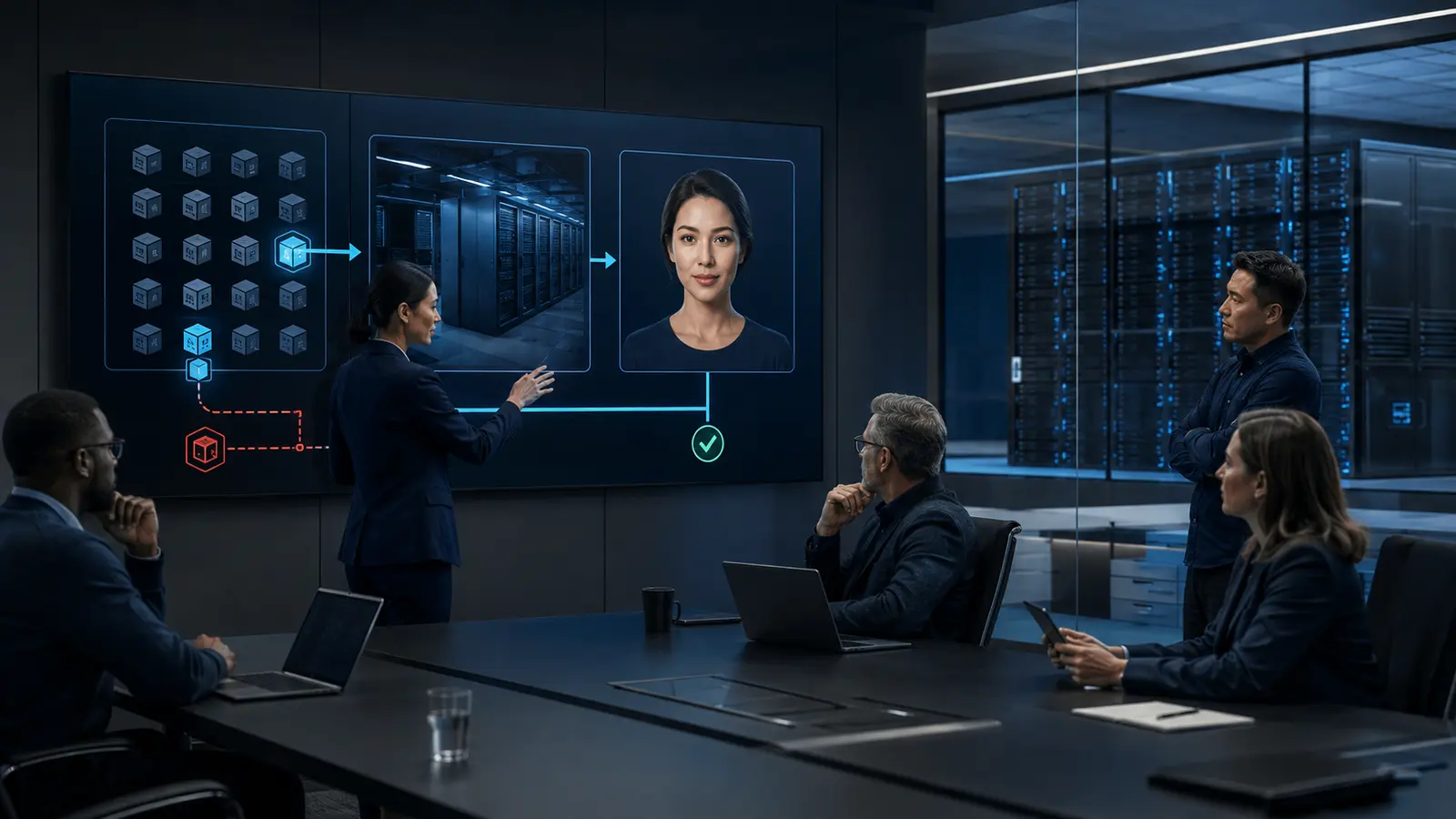
AI Network Segmentation: Seven Zones for Private Avatars
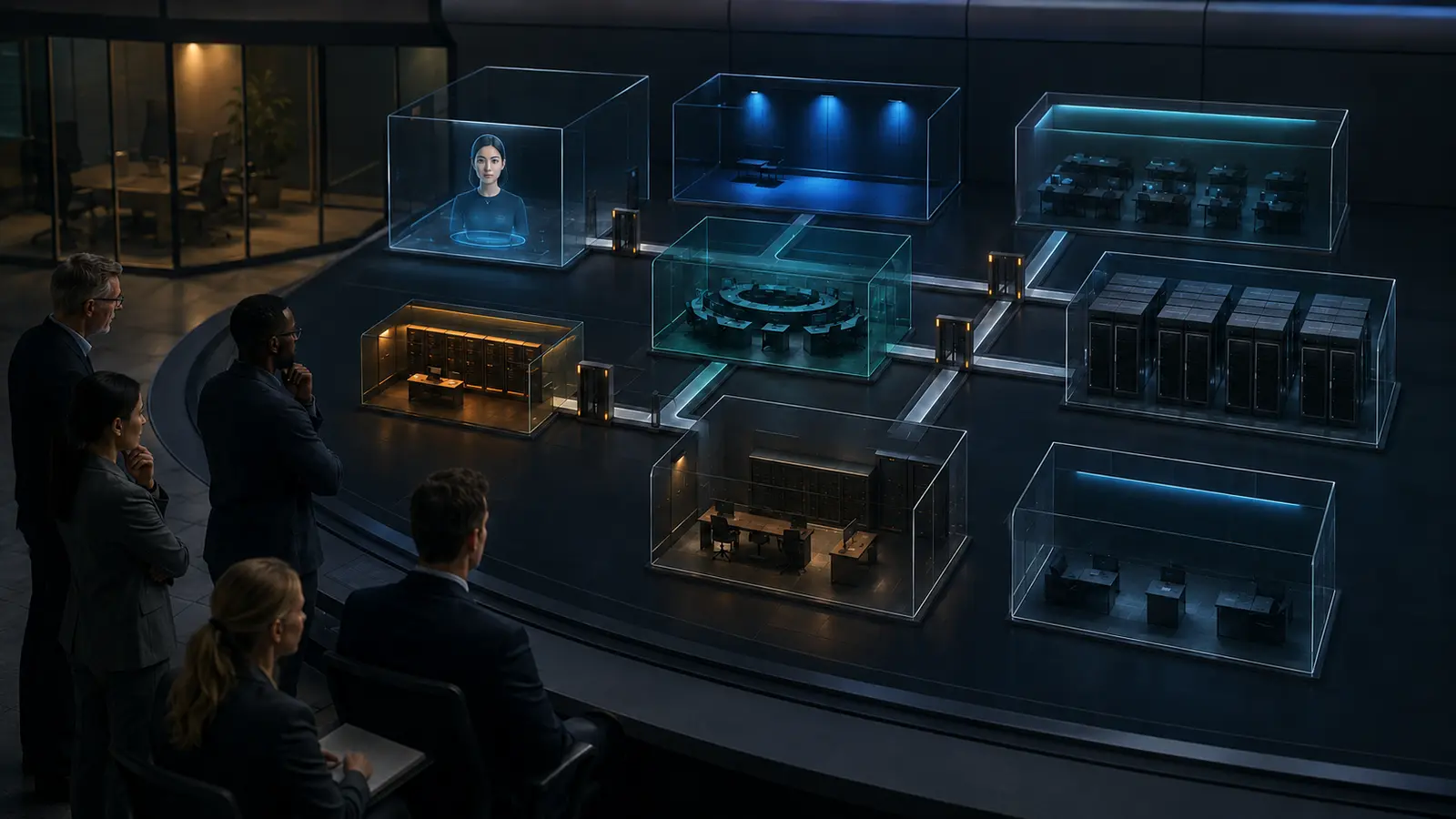
AI network segmentation for a private avatar should separate the public interaction edge, live media, session orchestration, inference, protected data, administration and security evidence into distinct trust zones. Permit only the named flows that the service needs. Then authenticate and authorise each workload as well: an internal IP address is not proof that a request is legitimate.
This gives a bank, government department or regulated enterprise a practical design target. If an internet-facing browser, compromised speech service or misconfigured model is breached, it should not gain a flat route to customer records, model stores, administrator interfaces or security logs.
The useful deliverable is a network-flow contract. It records every permitted connection, the identities involved, the data carried, the control point, the failure behaviour and the test that proves the rule works.
Segmentation solves a different problem from egress control
Several related controls are often collapsed into one firewall diagram:
- Network segmentation controls traffic between security zones and workloads, including east–west movement inside the environment.
- Egress control decides what may leave the controlled environment and where it may go.
- Tenant isolation prevents one customer, agency or business unit from accessing another’s resources, even when infrastructure is shared.
- Application authorisation decides whether a verified user or workload may perform a particular operation on a resource.
These controls reinforce one another but are not substitutes. A private subnet can still contain an over-privileged service. A perfectly authenticated workload can still have an unnecessarily broad network route. Yepic’s guides to AI egress controls and multi-tenant avatar isolation address the adjacent questions.
The UK National Cyber Security Centre describes segmentation as breaking a network into smaller networks so that traffic and access between them can be controlled. It also says management interfaces deserve specific protection. NIST’s Zero Trust Architecture adds an important limit: physical or network location must not create implicit trust. Segmentation reduces reachability and blast radius; identity and policy decide whether the reachable request is allowed.
Start with flows, not VLAN names
A diagram of boxes labelled “trusted”, “DMZ” and “AI” is not enough. Trace one representative conversation from the user’s microphone to the rendered reply, including retrieval, tool calls, telemetry and update dependencies. For each connection, capture:
- source workload and destination service;
- direction, protocol, port or service identity;
- business purpose and initiating event;
- data classes carried, including audio, transcripts, retrieved passages and tokens;
- user, tenant, session and workload context required;
- authentication, authorisation and encryption method;
- latency, bandwidth, concurrency and availability needs;
- logs or metrics created at the boundary;
- owner, expiry and review route; and
- what the avatar does when the route is denied or unavailable.
Observed traffic can help discover dependencies, but it should not automatically become policy. A test environment may contact diagnostics, repositories or public endpoints that production must not use. Build an allow-list from approved service design, then compare it with production-like observations to find omissions and surprises.
Use seven trust zones for the reference design
Seven zones are a useful review model, not a universal prescription. A small private-cloud service may combine some of them; a sovereign or restricted-network deployment may divide them further.
1. Channel and interaction edge
This is where browsers, kiosks, mobile applications or embedded pages enter the service. Terminate only the protocols required for session establishment and media. Apply origin controls, request limits, denial-of-service protection and session admission before traffic reaches expensive GPU workloads.
The edge should not have a general route to a vector database, model registry or administrative API. It should call a narrowly defined session service.
2. Real-time media
Signalling, STUN, TURN, audio and video have different network behaviour from ordinary web requests. WebRTC may prefer direct UDP paths and use relays when those paths fail. Forcing all media through a generic proxy can increase latency, break connectivity or hide useful transport evidence.
Define approved signalling endpoints, relay placement, candidate policy, media ranges, certificate ownership and fallback behaviour. Yepic’s enterprise WebRTC guide for firewalls and private media paths explains this layer in detail.
3. Session and orchestration
This zone binds the authenticated user, channel, tenant, avatar identity and conversation state. It coordinates speech, retrieval, reasoning, voice and rendering, but it should not inherit unrestricted access to each component.
Use a distinct workload identity and short-lived session context. The orchestration service may request a named inference operation; it should not be able to administer the model runtime. The accompanying secure avatar SSO architecture separates human, device, session and workload identity.
4. Inference services
Speech recognition, language reasoning, text-to-speech and avatar rendering may share commercial GPUs or use separate pools. Permit the minimum service-to-service paths required by the pipeline. A renderer normally needs approved audio, timing and avatar assets; it does not need access to customer account APIs. A language model needs selected context; it does not need a route to every enterprise database.
Separate development, evaluation and production inference where their data or change authority differs. Do not assume that a namespace, container or GPU scheduler creates the confidentiality boundary required by the threat model.
5. Knowledge and enterprise services
Place vector stores, document services and transactional APIs behind policy-enforcing gateways. Retrieval should receive verified permission context, not a department name extracted from the conversation. Tool calls should use explicit schemas, narrow operations and deterministic approval outside the model.
A useful pattern is to let inference reach a retrieval or action gateway, while only that gateway can reach the protected source systems. This turns many uncontrolled routes into a few inspectable contracts.
6. Administration, supply chain and updates
Management interfaces, model stores, container registries, deployment controllers, certificate services and secret custody deserve a separate plane. They can change what runs in production and therefore represent more authority than an ordinary user session.
Keep inbound support access closed by default. Use customer-approved, time-bound administration through controlled workstations or proxies where appropriate. Runtime workloads should pull only approved artefacts; they should not be able to publish a new release or modify the registry.
7. Observability and security evidence
Metrics, traces, audit events and security alerts should leave each workload through a defined collection path. Production services should not be able to alter the protected evidence store. Conversely, a monitoring platform rarely needs raw microphone audio or full conversation transcripts.
Send the minimum evidence necessary to operate and investigate the system. A separated logging network that receives unrestricted content merely creates a second sensitive data estate.
Enforce identity-aware, default-deny flows
The NCSC’s network security fundamentals, updated on 6 February 2025, recommends allow-lists for least privilege and notes that segmentation can reduce the impact of compromise and improve detection. Its cloud-platform guidance describes micro-segmentation and zero-trust networking as complementary approaches and says each service should access only the services and data it needs.
Apply that discipline at several layers:
- Coarse zones: use subnets, virtual networks, security groups or equivalent controls to separate major trust domains.
- Workload-level policy: constrain service-to-service flows by verified workload identity or tightly governed labels, not only changing IP addresses.
- Application policy: authorise the user, tenant, resource and operation at the destination.
- Payload reduction: send structured, purpose-limited data rather than copying the complete conversation everywhere.
- Boundary evidence: record accepted and rejected connections with policy version and workload identity, while excluding secrets and unnecessary content.
A service mesh, host firewall, network policy engine, cloud security group or physical firewall can implement parts of this design. No single technology is mandatory. The critical requirement is that enforcement remains effective across replicas, failures, autoscaling and updates.
Design for latency and failure
A real-time avatar is more sensitive to extra network hops than an asynchronous AI job. Every gateway, inspection point and relay can add connection setup, buffering or processing delay. That does not justify a flat network; it means controls must be included in the end-to-end latency budget.
Test direct and relayed media, warm and cold inference, certificate checks, name resolution, policy lookup and peak concurrent sessions. Place tightly coupled services close enough to meet the interaction target, while keeping the required enforcement boundary. Inspecting encrypted media content may be unnecessary or inappropriate; metadata, identity, destination and application-layer controls may provide a better balance.
Define safe failure at every boundary. Loss of a retrieval service might produce a clearly limited public-information mode. Loss of an action gateway should remove transactional capability, not cause the model to call a database directly. A policy-engine outage should not silently create an allow-all route.
Cloud, private cloud and on-premise need different controls
Public cloud can provide mature private endpoints, managed firewalls, workload identity and automated policy enforcement. It also introduces provider-managed control planes and shared-responsibility questions.
Private cloud may combine dedicated boundaries with elastic infrastructure, but teams still need to understand provider access, control-plane dependencies and cross-tenant separation.
Customer-hosted deployment gives an organisation direct control over routes, GPUs and administration. It also transfers responsibility for policy distribution, firewall lifecycle, certificates, DNS, time, logging and emergency access. On-premise does not mean air-gapped, segmented or zero trust by default. Hybrid designs can be valid when every external route and data class is explicit.
The NCSC’s secure AI deployment guidance calls for appropriate access controls around APIs, models, data and processing pipelines, plus segregation of environments holding sensitive code or data. The precise implementation should follow the deployment’s threat model rather than a vendor-neutral diagram.
Build a network-flow contract
For each allowed connection, record the source and destination zone, verified identities, purpose, data class, protocol, control point, encryption, rate limit, owner, approval, expiry, logging and failure behaviour. Link the entry to the infrastructure rule and the production test.
Review the register when a model, speech service, knowledge source, tool, observability destination or deployment method changes. An unused rule should expire. An emergency exception should carry an owner and removal time. Compare desired policy with effective runtime routes so configuration drift does not reopen an old path.
Twelve tests before production
- An internet-facing edge workload cannot connect directly to the knowledge store or business APIs.
- A compromised renderer cannot query customer records or model-administration services.
- A language-model workload can use only the approved retrieval and action gateways.
- A session for one tenant cannot route to another tenant’s dedicated service or data zone.
- WebRTC works through the approved direct and relay paths without opening a broad internal range.
- A blocked east–west connection produces attributable evidence without logging sensitive payloads.
- A development service cannot reach production data, secrets or inference controls.
- A production workload can retrieve an approved artefact but cannot alter the registry.
- Revoking a workload identity or flow rule takes effect within the agreed operational window.
- Loss of the policy, retrieval or action gateway produces the documented fail-closed or reduced-service state.
- Autoscaling, restart and failover do not place workloads in a broader default network policy.
- The team can reconstruct every permitted production flow from the register and identify every observed flow that lacks approval.
Turn the diagram into an operating control
The Abu Dhabi Aviation and Oracle enterprise avatar integration involved development and production environments, API and iframe integration, real-time streaming, captions and microphone behaviour, WebRTC and network testing, browser remediation, cybersecurity support and ongoing maintenance. Those layers show why a real avatar service cannot be represented as one trusted “AI server”.
The case study is not evidence of a completed customer-hosted network-segmentation implementation. Yepic’s private, sovereign and on-premise deployments are custom projects. The final zones, protocols and enforcement points depend on the chosen speech, language, voice, rendering, data and operational components. Yepic’s proprietary real-time avatar technology can run on commercial GPUs in appropriately scoped customer environments, while cloud and private-cloud designs remain valid when they better fit the risk, capacity and operating model.
Start the architecture review with one practical test: if the public interaction edge were compromised today, which exact systems could it reach? If the answer comes from a broad subnet assumption rather than a short, versioned list of justified flows, the avatar is not yet meaningfully segmented.