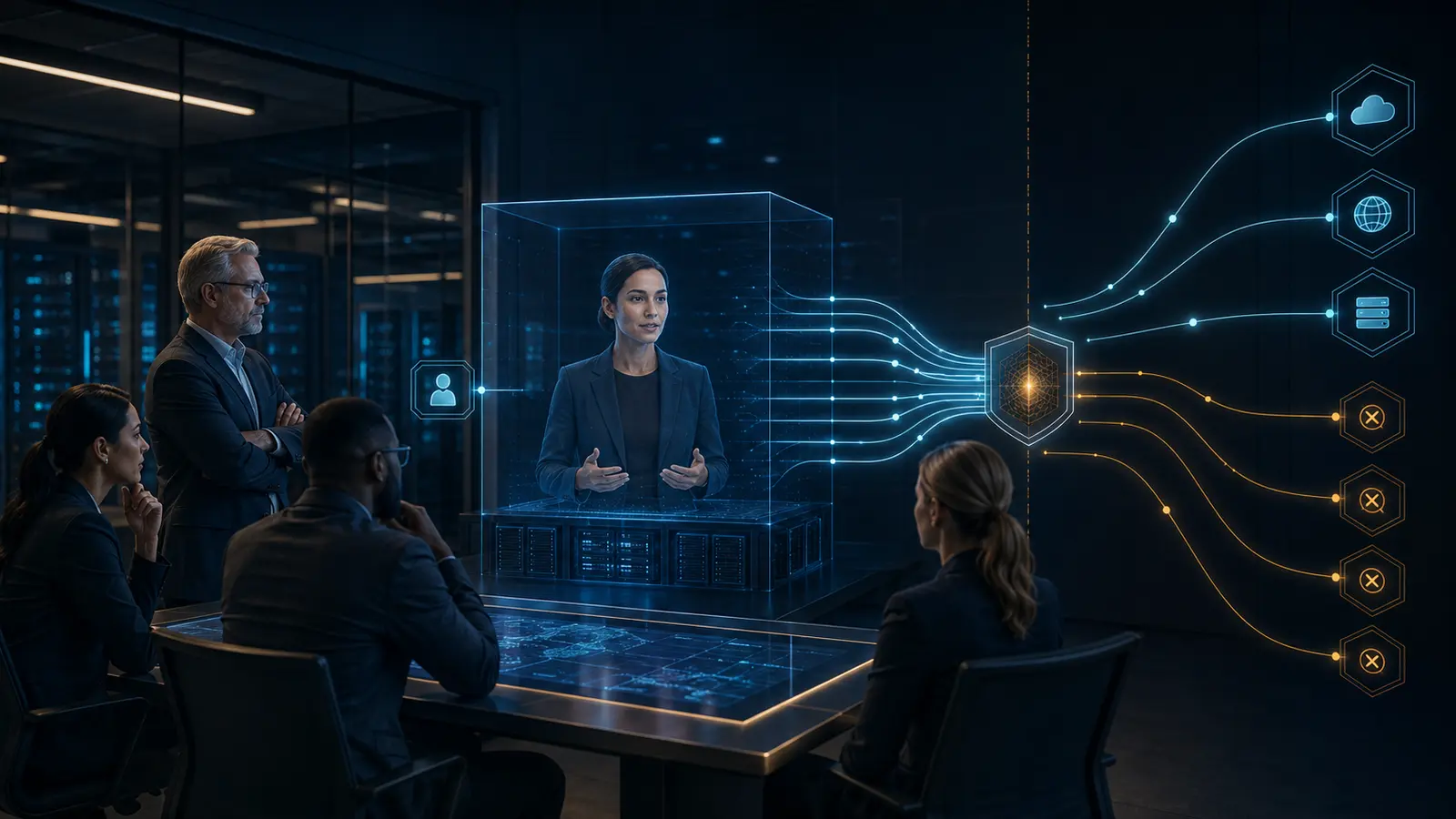
AI Privileged Access Management: A Break-Glass Design

Private AI needs a private administration path, not permanent supplier access. For an on-premise or sovereign AI avatar, every human with the power to inspect, change or restart the service should receive a named, narrowly scoped role for a limited time, through a customer-controlled access point. Routine support should work from content-minimised telemetry. Exceptional access should require approval. Emergency access should expire automatically and leave evidence.
The practical deliverable is a privileged-access register covering the avatar application, speech and language models, retrieval, voice, rendering, GPUs, orchestration, secrets, logs and deployment tooling. It should say who can cross each administrative boundary, why, through which route, for how long and how the customer proves the access ended.
This is the difference between hosting an AI system inside your environment and actually controlling it.
Why an AI avatar needs its own privileged-access review
A real-time avatar joins several systems that are often administered by different teams. An operator may restart a rendering worker. A platform engineer may alter GPU scheduling. A knowledge administrator may rebuild an index. A security analyst may inspect an incident. A supplier engineer may need diagnostic access during a support case.
Those roles do not need the same authority. They also do not need routine access to the same content. A GPU problem can often be diagnosed from utilisation, queue depth and error codes without exposing a citizen's question, a bank customer's transcript or a model prompt.
The UK National Cyber Security Centre describes privileged access management around two useful ideas: just-in-time administration and just-enough administration. The first removes standing access; the second limits what an activated role can do. Both are directly applicable to private AI operations.
Customer-hosted deployment can place inference and sensitive context under the customer's control. It does not automatically remove default accounts, shared consoles, remote-support software, emergency credentials or over-privileged service administrators. Those paths must be designed and tested.
Separate four kinds of authority
Do not put every powerful actor into one “admin” group.
- Service operations can view health, drain sessions, restart approved components and manage capacity, but should not alter models, policies or knowledge.
- Application and AI maintenance can stage signed releases, configuration or model changes through the approved deployment route, but should not bypass production approval.
- Security and investigation can review access events, isolate components and preserve evidence, with content access granted separately when an investigation justifies it.
- Supplier support receives temporary access to a named environment and task only after customer approval. Supplier employment does not create automatic authority inside the customer's estate.
Human administrator identity is also different from AI workload identity and secrets management. A speech service, retrieval worker or deployment agent may need machine authority, but no human should borrow that service identity for interactive administration. Likewise, an avatar's customer-facing SSO session must not become an administrator session through conversation.
Choose the least powerful access mode that works
1. Content-free operational support
Make this the default. Give operators dashboards for availability, GPU pressure, latency stages, media quality, dependency status and version health. Use correlation identifiers and controlled diagnostic codes instead of complete prompts or recordings. If the support team can solve most incidents without entering the sensitive environment, every later exception becomes easier to defend.
2. Customer-operated change
The supplier provides a signed package, runbook or diagnostic instruction. Customer staff validate and execute it through their normal change process. This suits restricted networks and organisations that do not permit external interactive access, although it increases the need for local skills and clear operational documentation.
3. Approved just-in-time support
A named engineer requests a specific role against a specific component, environment, ticket and time window. A customer approver validates the request. Strong authentication and device policy are checked, the temporary role is activated, and access is removed when the window ends or the ticket closes.
Microsoft's current Privileged Identity Management documentation is one implementation example of time-based and approval-based role activation. It is not a required product choice. An enterprise can enforce the same outcome with an existing PAM platform, bastion, identity system or locally engineered control.
4. Break-glass access
Break-glass is for a defined emergency in which the ordinary access path is unavailable or too slow to prevent material harm. It should not be a shared password used whenever support is inconvenient.
Define the permitted trigger, accountable owner, authentication route, maximum duration, notification recipients, commands allowed, evidence captured and post-event review. Store emergency material under dual control where appropriate. Test it without waiting for a real incident, then rotate or reseal it after use.
Build an administration plane outside the conversation
The safest pattern is a dedicated management route that is independent of the public avatar interface and of the model's generated output.
- Enter through a managed control point. Route interactive administration through a customer-approved PAM gateway, bastion or equivalent boundary. Avoid direct access to workers, databases and GPU hosts from an engineer's everyday device.
- Verify a named human. Federate supplier and employee identities where possible, require strong authentication and block shared administrator accounts.
- Check the device and source. High-risk access may warrant a dedicated privileged access workstation. The NCSC's 2025 PAW principles describe a trusted, restricted and audited device for protecting high-risk access.
- Activate a narrow role. Bind the role to the task, component, environment and time window. Read-only diagnosis and production change should be separate permissions.
- Keep production approval independent. An engineer may prepare a change, but a separate customer-controlled gate should authorise promotion where risk warrants separation of duties.
- Record control events. Capture the requester, approver, ticket, role, target, start, expiry, commands or change identifiers, result and revocation. A privacy-minimised AI audit trail can preserve accountability without copying every conversation into a support store.
- Terminate and verify. Expire the role, close active connections, revoke temporary credentials and confirm that the same route can no longer be used.
The control plane should not depend on the language model. A prompt, retrieved document or spoken request must never be able to grant administrator access, approve a maintenance window or expose a support credential.
Minimise content exposure during diagnosis
“Session recording” sounds reassuring, but indiscriminate screen, terminal or network capture can create another store of sensitive content. Decide separately which evidence is necessary for accountability and which customer data the support role may see.
Use a diagnostic ladder:
- aggregated health and capacity metrics;
- content-free event codes and component traces;
- synthetic reproduction in a non-production environment;
- customer-redacted examples;
- approved access to a narrowly selected production record; and
- live production content only when the incident, policy and legal basis require it.
This approach complements, rather than replaces, a defined retention policy. Zero retention for conversation content cannot be credible if remote-support tools silently create screenshots, clipboard histories, terminal transcripts or exported bundles.
Map the deployment model to control ownership
In public cloud, managed identity, PAM and logging services can reduce implementation work, but some management planes and provider administrators remain outside the customer's direct operation. Contractual controls, provider evidence and tenant configuration matter.
Private cloud can offer dedicated tenancy and familiar managed controls. It still requires clarity about which provider staff can administer the underlying platform and which records the customer can review.
Customer-hosted deployment can keep the administration boundary, logs and approval system inside the customer's environment. It also transfers more responsibility for PAM availability, identity federation, privileged workstations, patching, time synchronisation and emergency recovery. On-premise is not safer if operations rely on a permanent shared account because the controlled support path was never funded.
In restricted or disconnected networks, customer-operated change may be the normal mode. The restricted-network design guide explains why updates, trust material and support evidence need planned transfer routes. Full disconnection is a scoped engineering decision, not a universal property of private inference.
Create a privileged-access register
For every administrative interface and high-risk function, record:
- the component, environment and data classification;
- permitted human and machine roles;
- actions allowed and explicitly prohibited;
- normal, elevated and break-glass access routes;
- identity, authentication and device requirements;
- customer approver and separation-of-duties rule;
- maximum duration, expiry and revocation mechanism;
- content visibility and diagnostic ladder level;
- events, commands, changes and outcomes retained;
- supplier offboarding and periodic access review; and
- the production test and named owner.
This turns “vendor support access” into an auditable set of decisions. The NCSC's Cyber Assessment Framework specifically treats temporary, time-bound rights for privileged and third-party support access as a stronger practice than unmanaged standing access. NIST SP 800-53 likewise provides a broad control catalogue covering least privilege, remote access, audit, maintenance and separation of duties. Neither source prescribes one universal architecture for every AI system.
Twelve tests before production
- A supplier engineer with no active ticket cannot enter the management plane.
- An approved engineer receives only the named role, component and environment.
- Access fails from an unapproved identity, device or route.
- A read-only diagnostic role cannot change configuration, models, policies or data.
- A model prompt, retrieved document or avatar tool call cannot activate privileged access.
- The role expires during an active connection and the connection is actually terminated.
- Closing a ticket or revoking the identity removes access before the original window ends.
- Operations can diagnose a realistic GPU, media or dependency failure without viewing conversation content.
- A controlled content exception exposes only the approved record and produces evidence.
- Break-glass works when the ordinary identity or PAM service is unavailable, triggers immediate notification and is resealed after use.
- Development credentials and approvals cannot administer production.
- An auditor can reconstruct the requester, approver, role, target, changes, result and revocation without relying on a shared account.
The NCSC's secure AI operation and maintenance guidance places monitoring, updates and lessons learned inside the deployed system lifecycle. Privileged access should therefore be retested after changes to identity, orchestration, models, infrastructure and support tooling, not approved once and forgotten.
Apply the control to the whole service
Yepic's Abu Dhabi Aviation and Oracle enterprise avatar integration included separate development and production environments, API and iframe integration, real-time streaming, captions and microphone behaviour, WebRTC and network testing, browser remediation, cybersecurity support and ongoing maintenance.
That is relevant evidence for the operational work surrounding an enterprise avatar. It is not presented as proof of a completed customer-hosted PAM implementation, a particular break-glass design or unrestricted supplier access. Yepic's private, on-premise and sovereign deployments are properly scoped custom implementations, with the access model fitted to the customer's identity, network, GPU estate and operating responsibilities.
Start the architecture review with a blunt question: who can change the production avatar at 02:00, and what stops them at 02:30? If the answer is a permanent account, an informal support channel or “the system is on-premise”, the administration boundary is not finished.