Audio Sample Rates for Voice AI: Stop Hidden Resampling

For a reliable voice AI avatar, define a canonical audio format for each direction of travel, expose every conversion point and reject audio whose declared format does not match its bytes. Do not make “16 kHz” or “48 kHz” a platform-wide slogan. The right rate depends on the source, model, codec and endpoint; the control is knowing exactly where and why it changes.
Sample-rate failures rarely look like a clean outage. They appear as speech that runs too fast, slow drift between voice and face, clipped utterances, poor recognition, excess CPU use or intermittent latency on one browser. A team may blame the speech model while an SDK, browser or media gateway has silently converted the signal twice.
This guide gives bank, government and enterprise architects a practical format contract for microphone capture, acoustic processing, speech recognition, text-to-speech, WebRTC and avatar rendering.
A sample rate is not an audio format
A rate such as 16,000 or 48,000 samples per second describes only one property. A usable interface contract must also state:
- sample representation: signed integer or floating point;
- bit depth: for example, 16-bit PCM or 32-bit float;
- channel count and layout: mono, interleaved stereo or separate channels;
- byte order: little-endian or big-endian for multi-byte samples;
- framing: raw samples, a container such as WAV, or encoded packets such as Opus; and
- timestamps: their clock rate, origin and relationship to the first sample.
Headerless PCM is particularly unforgiving. The bytes do not announce their own rate, channel count or endianness. Google’s current troubleshooting guidance, for example, says that LINEAR16 is signed, little-endian 16-bit audio and must be played with the correct rate and channel count. A wrong declaration can be accepted as data and still produce the wrong sound.
Draw the audio path before choosing a rate
A real-time avatar has at least two audio paths.
- Input path: microphone → browser or device processing → media transport → decode → acoustic echo cancellation, noise suppression and voice activity detection → speech recognition.
- Output path: text-to-speech → decode → avatar animation and caption timing → media transport → endpoint buffer → loudspeaker.
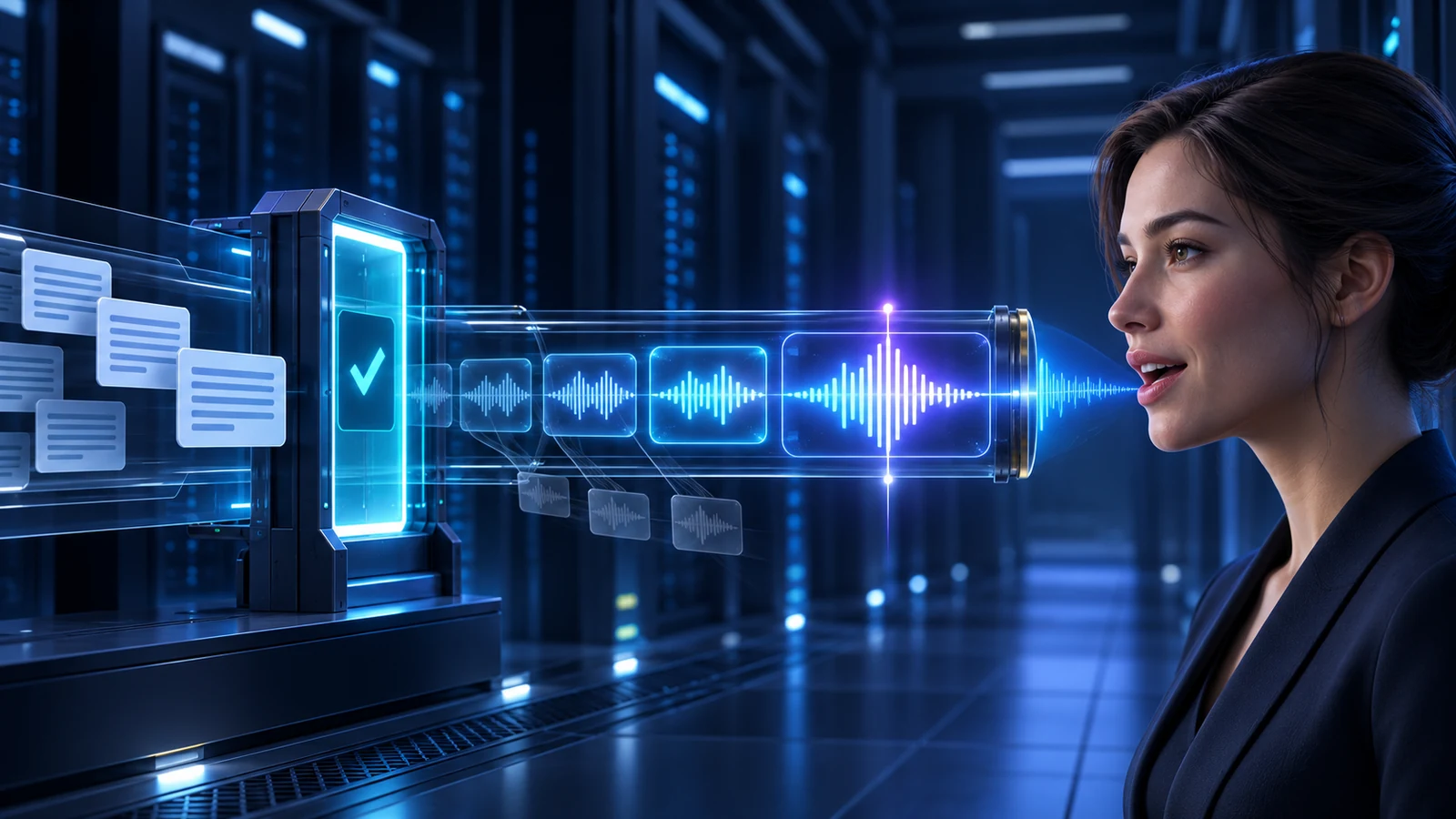
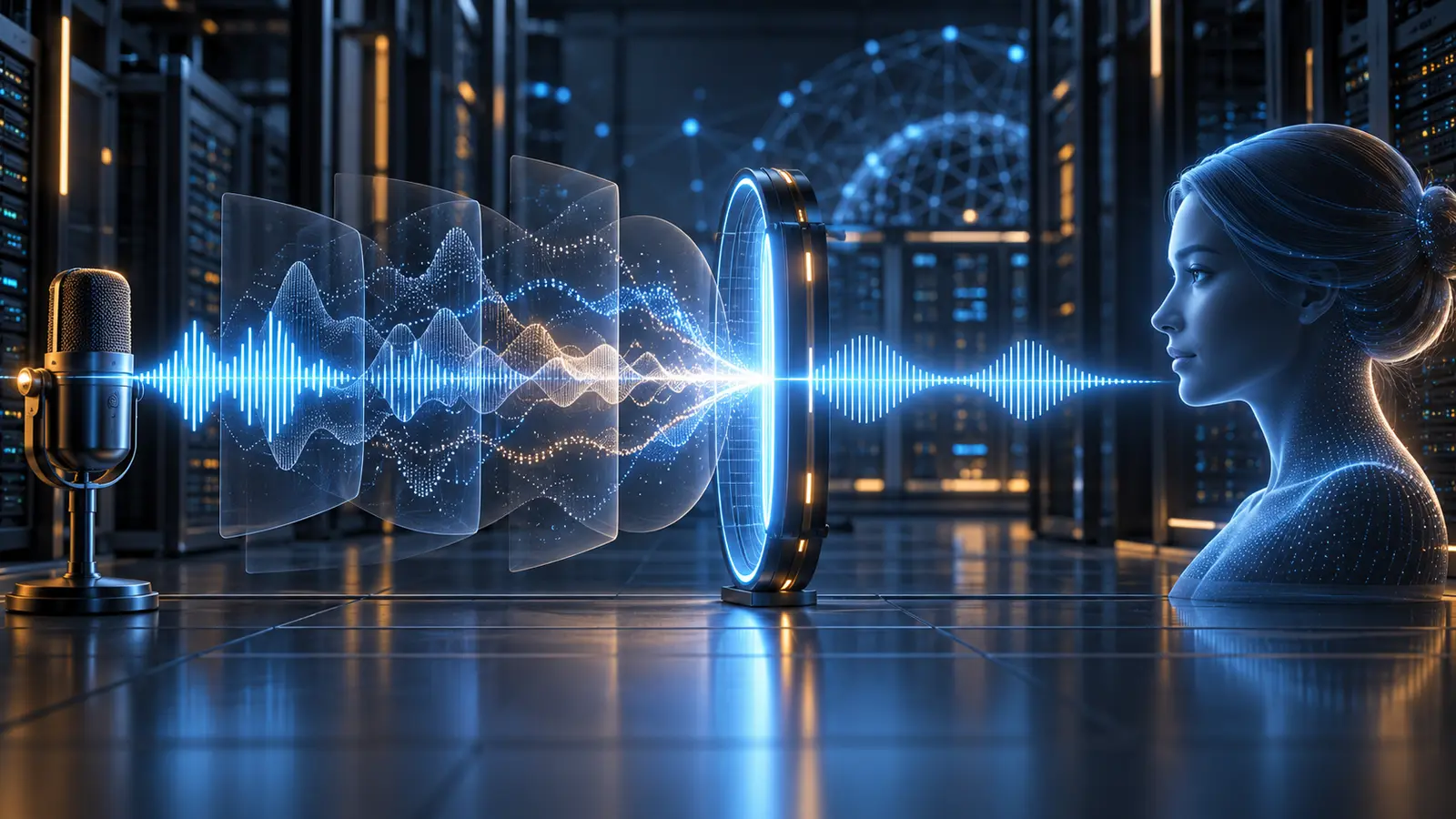
Each arrow can hide a conversion. The microphone may capture at one device-native rate, the browser may expose another, WebRTC may packetise Opus against a 48 kHz RTP clock, the recogniser may expect a different input, and the audio output device may impose its own rate.
Keep a format ledger with one row for every boundary. Record the actual input format, required output format, conversion owner, algorithm, buffering, timestamp treatment and metrics. “SDK default” is not an acceptable production value.
Do not confuse the Opus clock with captured bandwidth
WebRTC commonly transports speech using Opus. RFC 7587 specifies a 48,000 Hz RTP timestamp clock for all Opus modes and sampling rates. That does not prove the microphone captured 48 kHz of useful information, nor that the speech model should receive 48 kHz PCM.
The transport clock tells receivers how timestamps advance. Signal bandwidth describes what frequencies the encoded source actually contains. A narrowband telephone source can travel through a 48 kHz RTP clock without acquiring missing high-frequency information. Keep these concepts separate in diagrams, logs and procurement questions.
Prefer the native source; convert once when necessary
Higher is not automatically better. More samples consume more memory, network bandwidth and processing. Upsampling an 8 kHz telephone recording to 48 kHz creates more numbers but cannot recover frequencies that were never captured.
Google Cloud Speech-to-Text recommends 16 kHz or higher for new capture but says existing audio should remain at its native rate rather than be resampled merely to reach 16 kHz. Its model and interface are one implementation, not a universal rule, but the principle is useful: preserve real source information and match the declared rate to the bytes.
Conversion is sometimes unavoidable. A 48 kHz browser stream may feed a recogniser whose approved profile accepts 16 kHz mono PCM; a TTS engine may produce 24 kHz while the playback graph runs at 48 kHz. In that case:
- convert at one named boundary;
- use a tested sample-rate converter with anti-alias filtering;
- carry forward timestamps based on duration, not byte count alone;
- measure conversion time, queue depth and output duration; and
- do not convert down and then up again later in the same path.
Treat the browser as an active media component
A web application can request audio constraints, but a request is not proof of the delivered format. The W3C Media Capture specification defines sampleRate and sampleSize as constrainable audio properties. Production code should inspect the track’s active settings where available, record the browser and device, and test the samples that actually enter the pipeline.
Web Audio can add another conversion. The specification permits user agents to resample buffers and requires media-element audio to be resampled when it differs from the associated AudioContext. Therefore, adding an AudioContext for metering, mixing or playback can change the processing path even when application code never calls a resampler explicitly.
This matters for kiosk and branch devices because operating-system updates, USB headsets and browser versions can alter the selected hardware rate. Capture the negotiated setting in session telemetry without retaining conversation content.
Give input and output separate canonical formats
One global rate is often the wrong abstraction. Define one canonical working format for the input path and one for the output path, then justify any difference.
Input working format
Choose this around the approved speech-recognition model, acoustic-processing components and captured source. Mono may be appropriate for a single user, while separate channels can matter when microphone and echo-reference signals must remain distinct. Do not mix channels prematurely if a downstream component uses their separation.
Output working format
Choose this around the TTS model, avatar-animation interface, codec and endpoint. If the animation model consumes audio, verify whether it requires the synthesiser’s native rate or accepts a converted stream. Captions and visemes should follow timestamps derived from the same audible playout timeline.
The purpose of a canonical format is not to ban alternatives. It is to stop every component inventing its own conversion.
Protect timing when the rate changes
At 16 kHz, 1,600 mono samples represent 100 milliseconds. At 48 kHz, the same duration contains 4,800 samples. If code mistakes a sample index in one domain for an index in another, duration, captions and facial motion drift.
Every chunk should carry:
- conversation, turn and segment identifiers;
- sample rate, representation, channels and frame count;
- start timestamp and timestamp clock rate;
- source and conversion-stage identifiers;
- the cumulative input and output duration; and
- a cancellation generation so stale audio cannot reach a later turn.
When a converter changes the number of samples, preserve media duration and establish a new, explicit sample domain. Do not repeatedly round per chunk; retain sufficient precision and reconcile cumulative duration over long utterances.
This contract extends Yepic’s guidance on keeping avatar audio and motion on one presentation clock. Lip sync can be correct at the model output and still drift after an unrecorded conversion.
Measure conversion as part of latency and capacity
A high-quality resampler can consume CPU, allocate memory and buffer enough input to filter correctly. Under concurrency, those costs can produce audio gaps or delay the first recognised and audible words.
Track at least:
- conversion count per direction;
- input and output frames and duration;
- conversion wall time and queue wait;
- buffer fill, underrun and overrun events;
- cumulative duration error;
- clipping, silence and invalid-sample counts; and
- ASR accuracy and TTS quality by source format.
Segment results by device, browser, language, codec, model version and concurrency. The average can look healthy while one 44.1-to-48 kHz device route fails at the tail.
Choose the deployment boundary honestly
Customer-hosted speech and avatar components can keep selected audio and inference inside the organisation’s environment. They do not remove format negotiation. In fact, the customer may now own audio libraries, container builds, CPU allocation, GPU scheduling, browser compatibility and regression testing that a managed service previously absorbed.
Public or private cloud can simplify model operations and elasticity, but external hops and provider-specific formats still need a contract. A hybrid design may preserve browser-quality audio through a private media gateway, convert once for a customer-hosted recogniser, and use a separately governed voice or rendering service.
Yepic can scope public-cloud, private-cloud, sovereign and customer-hosted real-time avatar deployments, including operation on customer-controlled GPUs. The chosen speech engines, supported formats and exact conversion points remain implementation decisions; customer hosting should not be interpreted as proof that every component uses one native rate or that no engineering is required.
Write a twelve-field audio format contract
- source device and actual captured format;
- codec, container and packet duration;
- sample representation, bit depth and endianness;
- channel count, layout and mixing policy;
- timestamp clock, origin and rollover rules;
- canonical input and output working formats;
- every conversion point and its owner;
- resampler, filter, buffering and quality setting;
- ASR, TTS and animation format requirements;
- mismatch, malformed-data and fallback behaviour;
- telemetry, retention and access controls; and
- versioning, regression tests and rollback ownership.
Connect this to the wider streaming ASR commit policy and streaming TTS audio contract. Format correctness is the substrate beneath both: a perfect commit policy cannot rescue samples played at the wrong rate.
Run ten production acceptance tests
- Format mismatch: declare the wrong rate, channel count and endianness; prove the boundary rejects rather than guesses.
- Device matrix: test approved laptop, kiosk, headset and mobile combinations.
- Browser update: compare active capture and audio-context settings before and after upgrade.
- Native-rate comparison: evaluate recognition using genuine 8, 16, 44.1 and 48 kHz sources without artificial upsampling.
- Impulse and sweep: detect filtering, aliasing, clipping and channel mixing.
- Long utterance: measure cumulative duration and audio-to-avatar drift.
- Chunk boundary: prove the converter produces no clicks, gaps or duplicate samples.
- Concurrent load: measure conversion cost, underruns and tail latency at production concurrency.
- Fallback and reconnect: ensure a route change cannot switch format mid-turn without a new contract.
- Golden conversation: compare ASR entities, voice quality, captions, facial motion and interruption as one observable journey.
Use delivery evidence without overstating it
In the Abu Dhabi Aviation and Oracle enterprise avatar integration, Yepic worked across development and production environments, APIs and iframe integration, real-time streaming, captions, microphone behaviour, WebRTC and corporate-network testing, browser remediation, cybersecurity support and ongoing maintenance. Those layers show why audio cannot be treated as an isolated model input.
That case study is not presented as a completed customer-hosted audio-resampling deployment. It is evidence of the integration discipline a regulated service needs. Yepic’s proprietary real-time avatar technology and private deployment capability still require the complete audio path to be scoped against the customer’s devices, models, GPUs, networks and operating responsibilities.
Start with a one-page format ledger
For the next architecture review, take one real journey and write down the format at every boundary from microphone to recognition and from synthesis to loudspeaker. Highlight any value that is assumed, inherited from a default or converted without a named owner.
Then run the same journey on the noisiest approved device, through the intended network and at concurrent load. If the team can explain every sample, timestamp and conversion—and reproduce the result after an upgrade—the audio path is ready to support a governed real-time avatar. If not, choosing a larger model or faster GPU will not solve the hidden resampling problem.