Real-Time Avatar Lip Sync: Keep Audio and Motion on One Clock
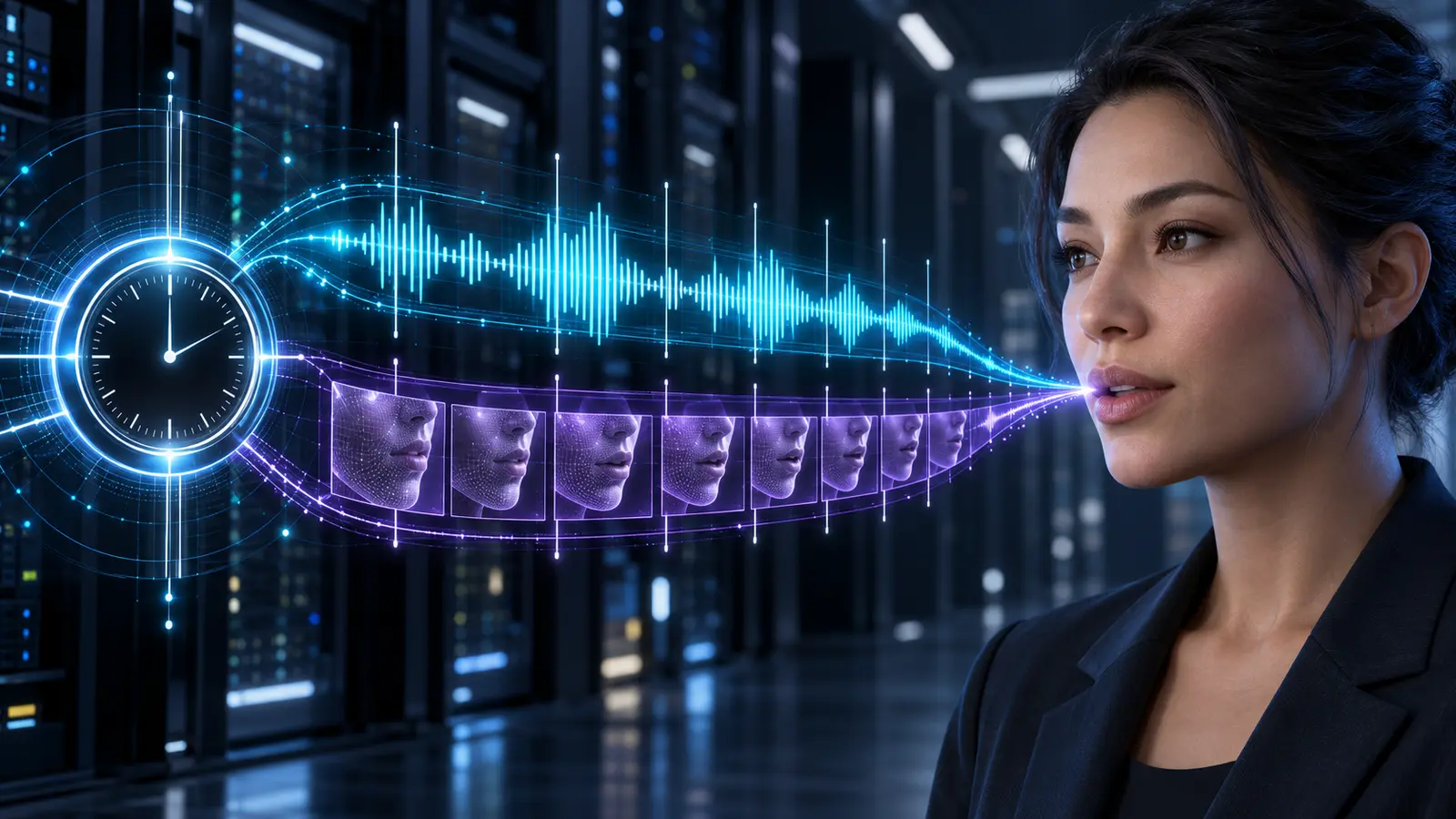
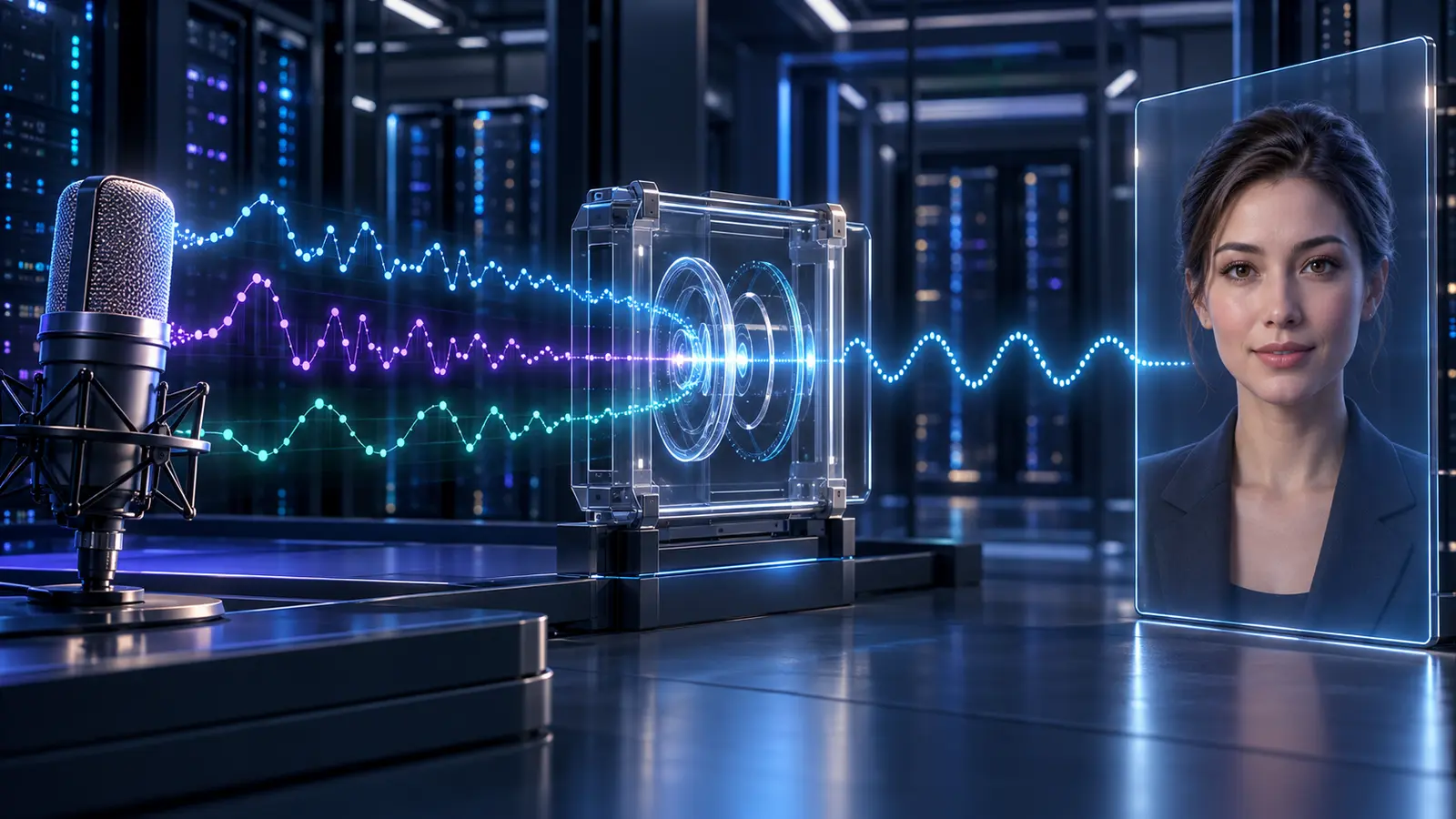
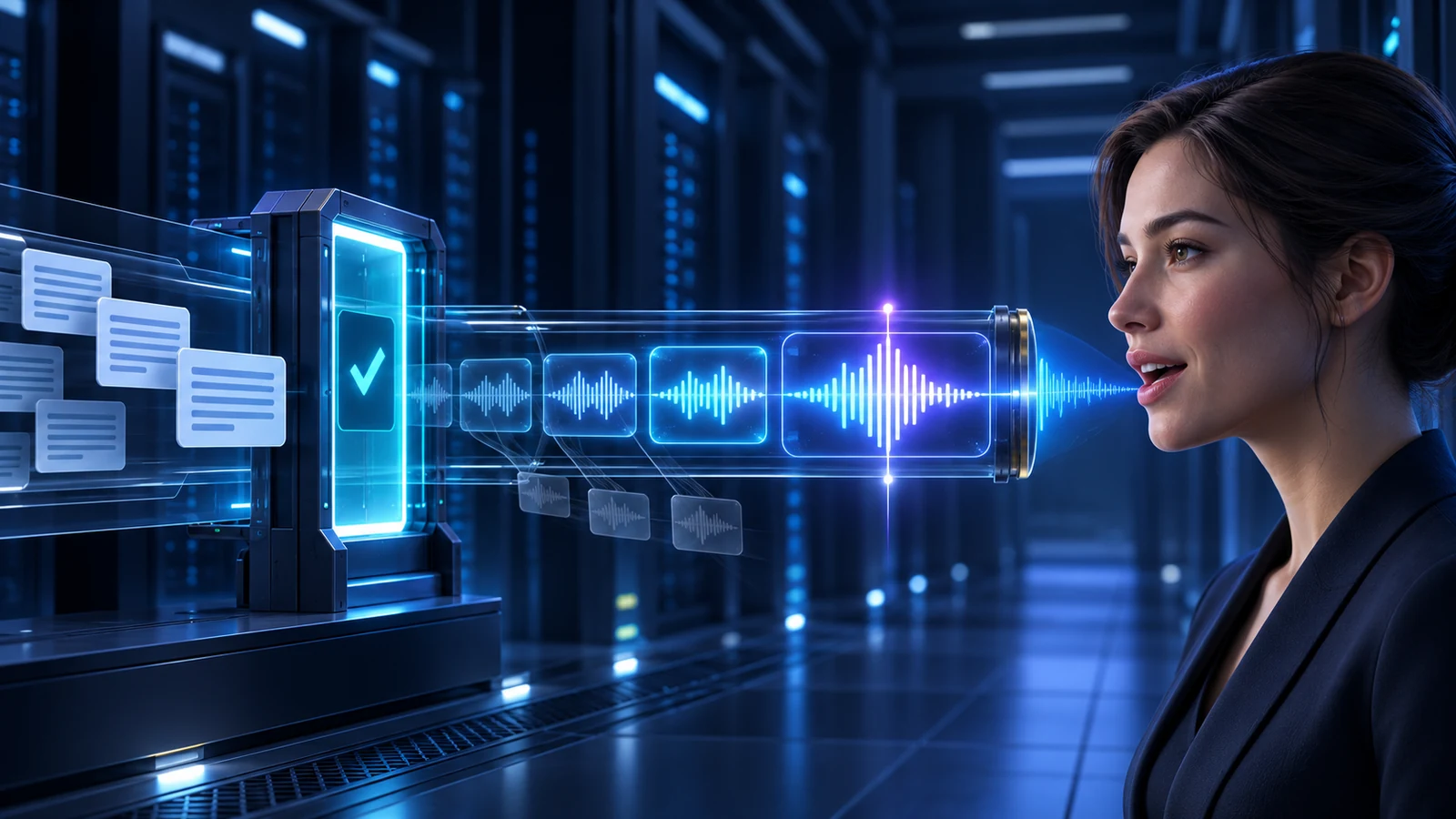
For reliable real-time avatar lip sync, make the audible audio timeline the master clock. Every viseme, blend shape and rendered frame should carry a timestamp relative to that clock, and every cancelled turn should invalidate its queued audio and motion together.
The mistake is to judge lip sync only by watching a polished demo. In production, the harder questions are architectural: where mouth motion comes from, how it is time-stamped, what happens when audio buffering changes, whether animation can arrive late, and how the system proves what the user actually saw and heard.
This matters to banks, governments and regulated enterprises because a speaking face makes timing errors unusually visible. A technically correct answer can still feel untrustworthy when the mouth moves before the voice, trails it, freezes mid-word or continues after an interruption.
Define lip sync as an alignment contract
Lip sync is not simply “the mouth moves while audio plays”. A production definition should cover four relationships:
- Speech-to-mouth alignment: visible mouth shapes correspond to the phonemes being heard.
- Audio-to-video alignment: the face and voice remain on the same presentation timeline.
- Expression coherence: facial movement does not contradict the tone or conversational state.
- Lifecycle alignment: speech, captions and animation start, pause, resume and stop as one turn.
These are related but separable. An avatar can have accurate visemes while the complete video stream is delayed behind the sound. It can also keep audio and video perfectly aligned while producing the wrong mouth shapes. Test both timing and visual accuracy.
Choose the source of mouth motion
Real-time systems normally use one of three approaches.
TTS-generated visemes or blend shapes
The speech synthesiser emits time-aligned visual events with the audio. Microsoft documents viseme IDs, audio offsets and 3D blend-shape frames alongside synthesised speech. Amazon Polly can return word, sentence and viseme speech marks with millisecond offsets, although its speech-mark operation returns metadata rather than audio in the same response. Provider behaviour and language support therefore need to be verified for the exact interface and voice.
This approach can provide precise linguistic alignment, but it couples animation capability to the chosen TTS mode. A voice or deployment route may not expose the same events as another.
Audio-driven facial animation
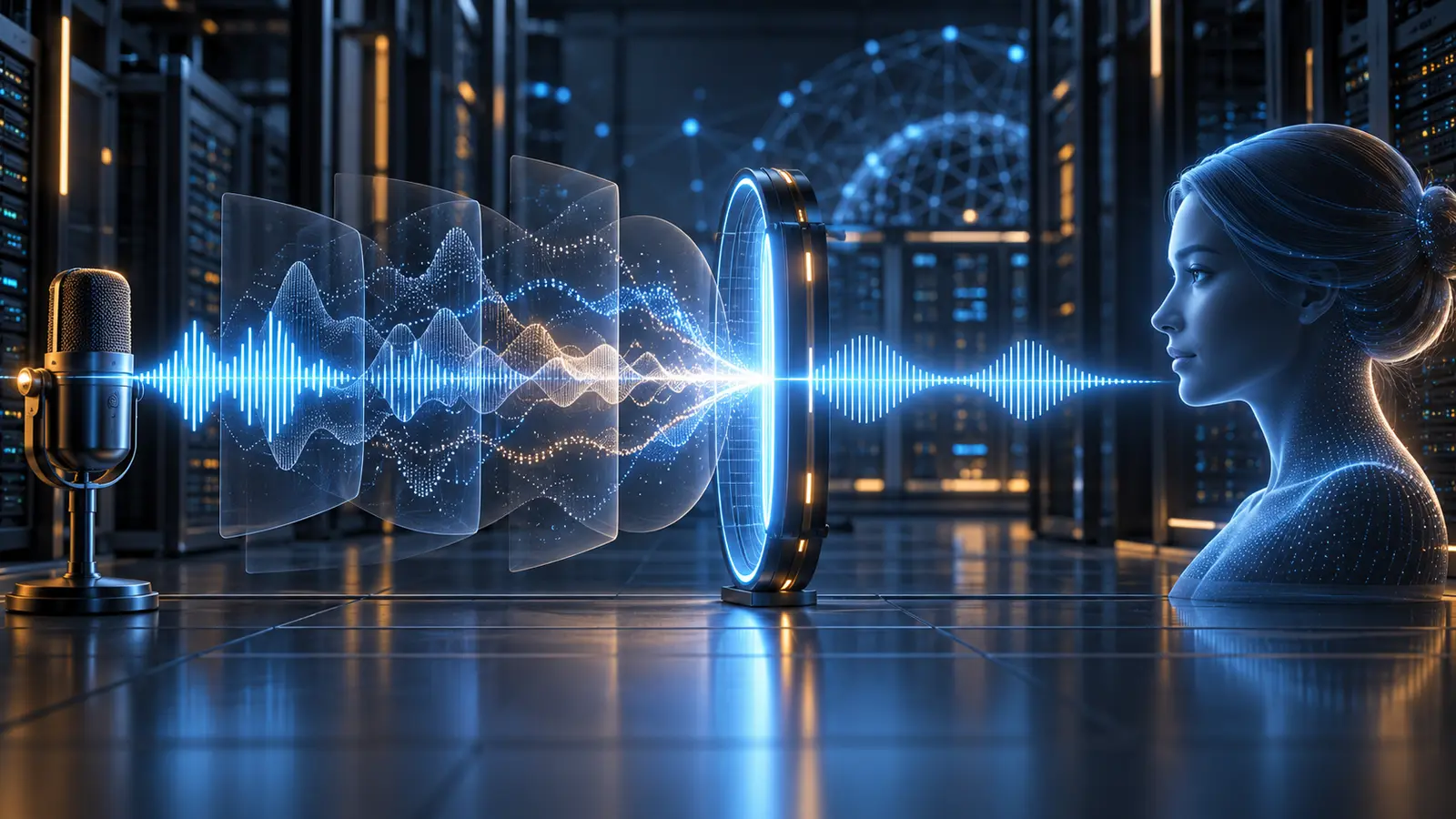
An audio-to-face model infers mouth and facial movement from the waveform. It can work with voices that do not provide viseme metadata and can add expression beyond a small mouth-shape vocabulary. It also adds another inference stage, compute demand and buffer to the latency path.
NVIDIA’s Audio2Face interface is one implementation example. Its animation data format can carry time-coded audio, blend-shape weights and joint movement through a streaming pipeline. It is not a required Yepic dependency, and different renderers expose different controls.
Text or phoneme alignment
The application derives phonemes from approved text and schedules mapped mouth shapes. This can be efficient, but spelling is not pronunciation. Names, abbreviations, loan words, silent letters and code-switching expose naive character-to-mouth mappings quickly.
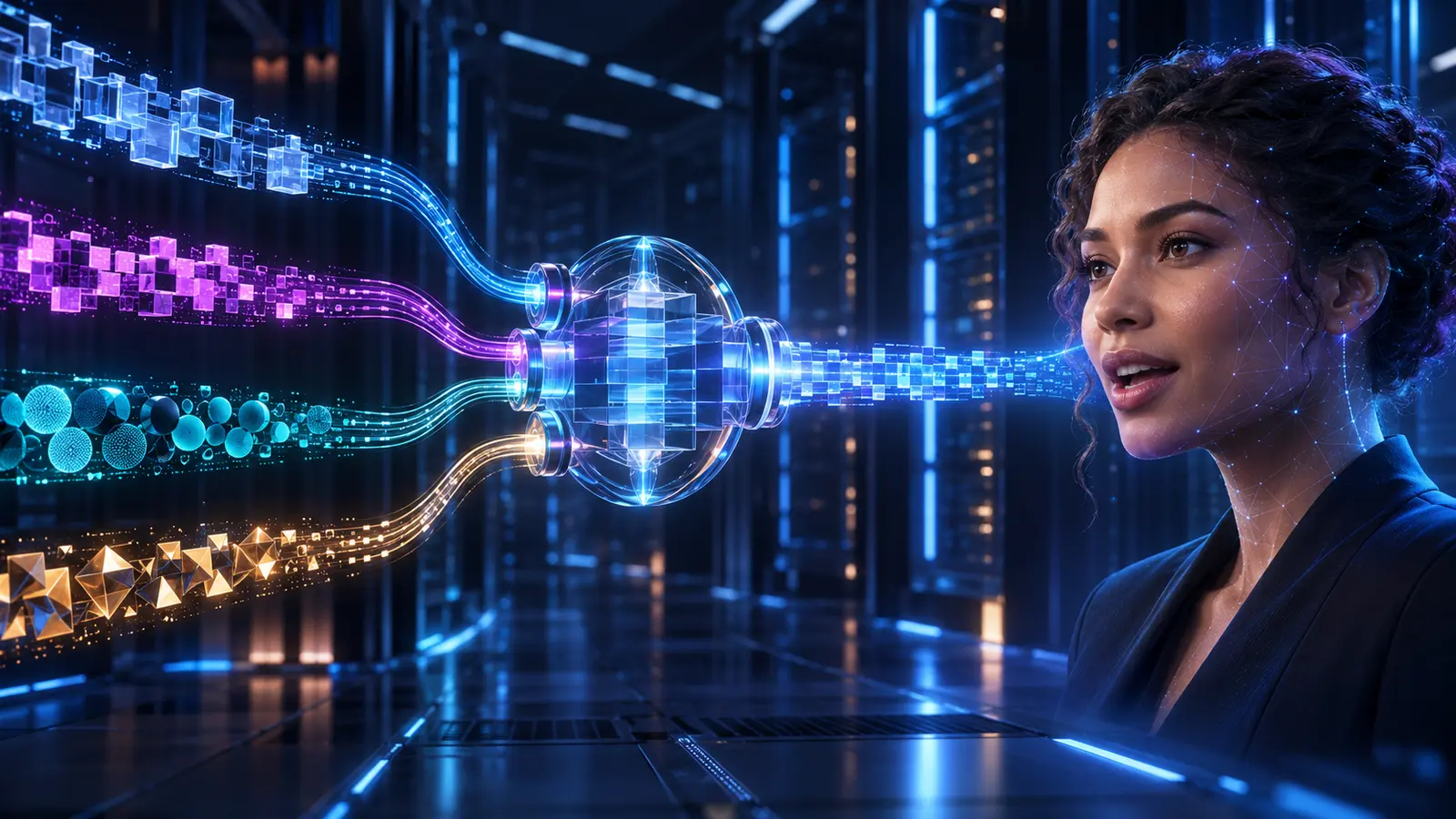
The correct choice depends on languages, avatar type, latency budget, voice flexibility and deployment boundary. Hybrid designs are legitimate: use TTS timing when available, fall back to audio-driven motion for unsupported voices, and keep both behind the same output contract.
Put the audio playout clock in charge
Text-generation time, TTS-generation time, server time, browser time and display-refresh time are not one clock. Even on a single device, browser media and page rendering may progress through different paths. The W3C’s work on media-timed events explicitly describes the difficulty of synchronising web content to a media timeline.
The robust rule is simple: schedule visible motion against the audio that is actually due to play, not against the moment text was generated or a network message arrived.
Each audio chunk and animation batch should carry:
- a conversation, turn and segment identifier;
- a monotonically increasing presentation timestamp;
- duration and sequence information;
- the clock origin and time unit;
- the voice, language and animation-profile version; and
- a cancellation generation or epoch.
Do not continually schedule the next mouth shape from “now”. Small timing errors then accumulate. Recalculate against the media timeline, and treat late events according to an explicit policy.
Measure five different delays
A single “lip-sync latency” number hides the cause. Capture at least:
- Speech commit to first audio: approved text to first playable sample.
- Speech commit to first motion: approved text to first usable animation event or frame.
- Animation lead: how far motion is prepared ahead of audible playout.
- Presentation skew: the difference between the audio and matching visual state at the endpoint.
- Drift: how presentation skew changes during a long utterance.
Report distributions, not just averages. Segment by language, voice, response length, device class, transport, concurrency and recovery event. There is no universal acceptable skew or lead buffer: the target should be derived from perceptual testing and the business context.
Do not confuse generation alignment with transport synchronisation
There are two separate jobs. First, create the right facial motion for each point in the speech. Second, deliver audio and video so the receiver presents them together.
When audio and video are sent as RTP media, WebRTC uses RTP timestamps and RTCP sender reports to correlate streams to a common clock. RFC 8834 requires correct synchronisation information so receivers can implement lip synchronisation. The WebRTC statistics specification also defines estimatedPlayoutTimestamp, which can help estimate the difference between audio and video playout for tracks from the same source.
That transport support does not repair animation that was generated against the wrong phoneme or timestamp. Conversely, accurate server-side mouth motion can still look wrong if the endpoint buffers audio and video differently. Keep model-quality tests and transport-synchronisation tests distinct.
Yepic’s guide to WebRTC jitter-buffer policy explains how receiver buffering changes what the user experiences. Lip-sync tests should run with those realistic buffer conditions, not only on a local low-jitter connection.
Define a late-data policy
Animation may arrive before, with or after its audio. A production system needs a bounded response for each case.
- Motion early: hold it until the matching audio presentation time.
- Motion slightly late: decide whether to catch up, shorten transitions or use a neutral mouth state.
- Motion too late: drop stale events rather than replaying obsolete mouth shapes.
- Audio missing: do not animate unheard speech.
- Sequence gap: record it and enter a defined degraded mode.
The threshold between “slightly late” and “too late” must be validated. A system that hides every gap through aggressive time compression may preserve timing while making the face visibly unstable.
Smooth motion without erasing articulation
People anticipate and blend speech sounds; mouths do not jump through isolated poses. Interpolation, co-articulation and a controlled neutral return make animation feel continuous. Too little smoothing produces mechanical snapping. Too much smoothing smears short consonants, weakens closures and makes different words look alike.
Version smoothing parameters by model, avatar and language. Treat them as production configuration, not an artist’s hidden workstation setting. A model or renderer update should trigger regression tests for closures, transitions, pauses and long vowels.
Test every language as its own visual system
Viseme inventories are many-to-one reductions of phonemes, and phoneme sets vary across languages. A mapping that looks plausible in English may mishandle Arabic emphatics, non-English vowels, code-switched product names or a regional pronunciation.
Build a visual speech set for every supported language and dialect. Include names, numbers, dates, currencies, acronyms, borrowed words, rapid speech, long pauses and mixed-language utterances. Review with native speakers and retain both audio and rendered output for comparison.
Do not infer coverage from a provider’s headline language count. Confirm whether the chosen voice and streaming mode return the timing or animation data your renderer needs.
Make interruption cancel the face as well as the voice
When a user interrupts, stopping only the loudspeaker leaves the avatar silently mouthing abandoned words. Stopping only the renderer leaves the voice playing through a frozen face.
One cancellation event should invalidate queued text, synthesis, audio, visemes, captions, gestures and frames for that turn. The client must reject late packets carrying the old cancellation epoch. Measure both interruption-to-silence and interruption-to-neutral-face.
This implements the wider decision described in Yepic’s avatar interruption policy. It should also share identifiers with the streaming TTS contract, so the system can reconstruct which words and movements reached the user.
Choose the deployment boundary honestly
Customer-hosted facial animation can keep selected audio, motion data and model execution inside the customer environment. It may also remove a network hop and give the organisation tighter control over versioning. It does not automatically improve lip sync.
On-premise execution transfers responsibility for GPU capacity, scheduling, drivers, rendering compatibility, observability and upgrades. Public or private cloud services can simplify elasticity and model maintenance, but may add data-transfer and residency questions. A hybrid design might retain the language and knowledge layers privately while using a separately governed rendering service.
The decision should follow data classification, concurrency, latency measurements, operating capability and recovery requirements. Yepic can support cloud, private-cloud and customer-hosted avatar architectures through a properly scoped implementation; the exact component boundary must be validated for the chosen models and infrastructure.
Write a ten-field lip-sync contract
Before procurement or pilot approval, document:
- source of visemes, blend shapes or audio-driven motion;
- supported languages, voices and avatar types;
- timestamp origin, units and monotonicity rules;
- audio and animation chunk formats;
- buffering, scheduling and permitted lead;
- late, missing, duplicated and reordered event behaviour;
- smoothing and neutral-state rules;
- interruption and cancellation propagation;
- metrics, logs and retained evidence; and
- versioning, rollback and fallback ownership.
If a vendor cannot expose every internal signal, require observable input, output and acceptance behaviour. The contract is about control and evidence, not forcing one implementation.
Run nine production acceptance tests
- Plosives and closures: test words rich in p, b and m sounds.
- Language coverage: run the governed set for every production language and dialect.
- Long response: detect cumulative drift across an extended explanation.
- Network variation: introduce jitter, reordering and bandwidth changes.
- CPU and GPU contention: test the endpoint and renderer under realistic load.
- Interruption: interrupt at the start, middle and final word of a segment.
- Fallback: remove timing metadata or the animation service and verify the degraded mode.
- Reconnect: ensure old motion cannot leak into a new session.
- Upgrade regression: compare the same audio and test set before and after each component change.
Capture the rendered result, source audio, timestamps, model versions and operating conditions together. A reviewer should be able to distinguish a pronunciation error, animation error, transport delay and display-frame problem.
Ask these questions in the architecture review
- Which clock owns presentation, and where is it observed?
- Are mouth events derived from text, audio or the TTS engine?
- Does the exact streaming mode expose timing data for every required language?
- How are audio and animation correlated across retries and reconnections?
- What happens when motion is late, missing or duplicated?
- Can the system prove audio-video skew at the endpoint?
- How quickly do sound and facial movement stop after interruption?
- Which parameters change when a voice, language, avatar or renderer changes?
- What remains inside the customer environment in each deployment option?
- Who owns regression testing and rollback?
Connect the contract to real delivery evidence
Yepic’s Kwebbelkop AI twin combined recognisable likeness, cloned low-latency voice, movement, persona and live conversation in one week. That project demonstrates the integration challenge: believable delivery depends on the voice, face, behaviour and conversational loop working together. It is not presented as a completed customer-hosted lip-sync deployment.
Yepic has spent years building proprietary talking-photo and real-time avatar technology, with optimisation for commercial GPUs and support for custom private, on-premise and sovereign architectures. For a regulated pilot, the useful next step is not another scripted demo. Bring one production voice, two priority languages, the intended endpoint and realistic network conditions. Then measure the complete audio-to-face contract before selecting the deployment boundary.