Automatic Gain Control for Voice AI: Keep Speech in Range
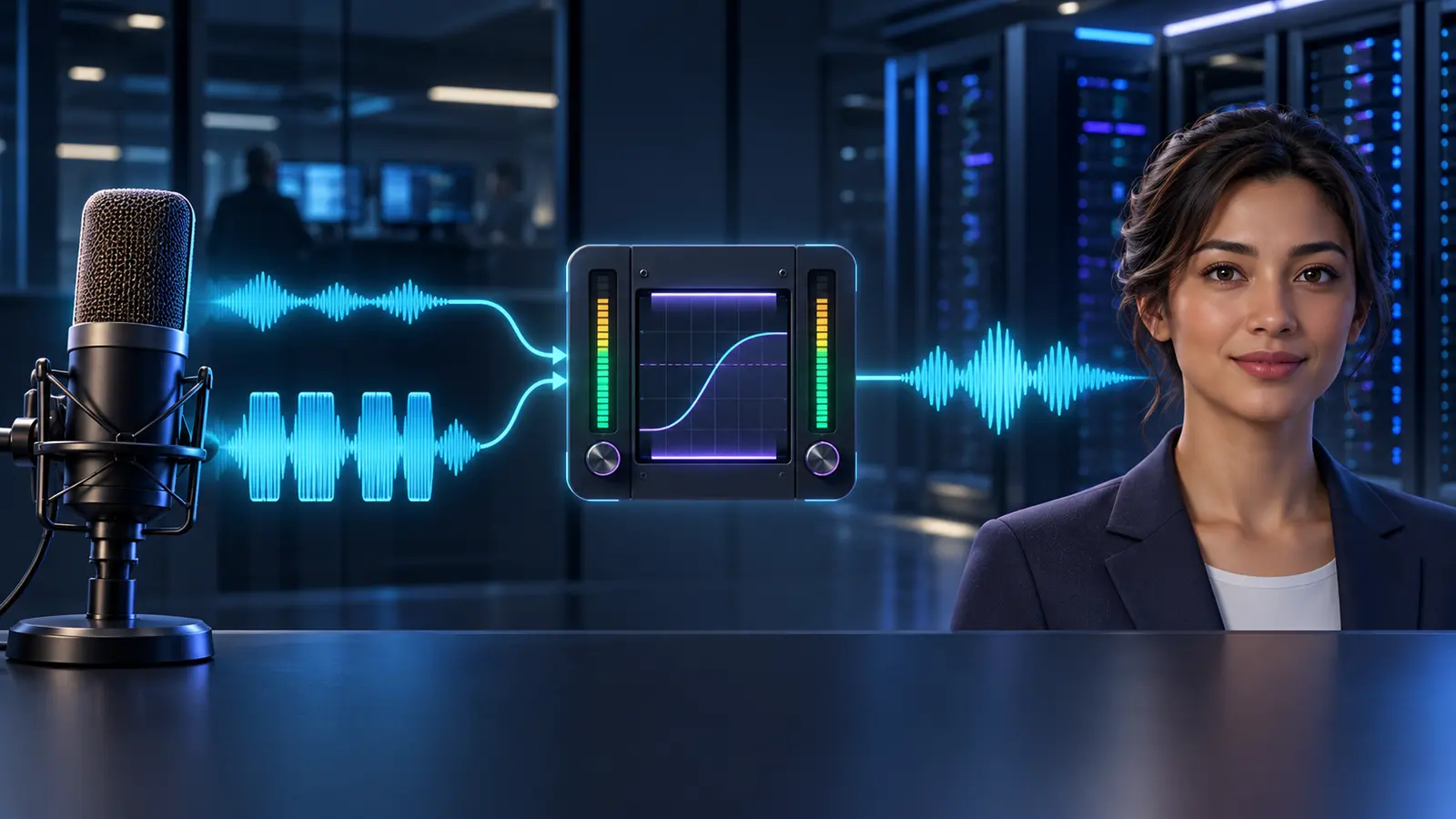
Automatic gain control (AGC) should keep speech usable, not make every microphone equally loud. For a real-time AI avatar, the safe design is to assign one accountable gain-control stage, verify what the endpoint actually applied, detect clipping before audio reaches speech recognition and test the complete capture path across devices and rooms. Turning on every available “audio enhancement” is not a policy; it is how organisations create double gain, pumping background noise and faults that disappear in the lab.
This matters because poor level control does not remain an audio-quality problem. A quiet signal can reduce speech-recognition accuracy and delay turn detection. A saturated signal can destroy consonants before any model sees them. Gain changes can also alter the input to echo cancellation, noise suppression and voice activity detection. The result may be a plausible but incorrect transcript, an avatar that interrupts, or a session that repeatedly asks the user to speak again.
What automatic gain control actually controls
AGC measures an incoming signal and changes gain over time to keep it within a useful operating range. That simple description hides several different controls:
- Microphone or analogue gain changes the signal before analogue-to-digital conversion. If it is set too high, the converter may clip. Later digital processing cannot reconstruct the lost waveform.
- Fixed digital gain multiplies samples by a constant amount. It can lift a quiet signal, but it lifts the noise floor too.
- Adaptive digital gain changes amplification according to recent level estimates. Its attack and release behaviour can make noise audibly rise between words.
- Compression reduces the difference between quieter and louder speech. It may improve consistency, but excessive compression flattens emphasis and can expose breathing, keyboard noise or nearby conversations.
- A limiter prevents the processed signal exceeding a ceiling. It protects headroom; it does not repair clipping that happened at the microphone or operating-system input.
- Playback volume affects what the user hears. It is not capture gain and should not be used to compensate for a weak microphone path.
Keep these terms distinct in an architecture review. “AGC enabled” is otherwise too vague to tell a supplier what is required or to explain why one laptop behaves differently from another.
Map every place that can change level
A browser-based avatar may encounter gain control in the microphone firmware, operating-system driver, conferencing middleware, browser capture stack, WebRTC audio processor, application code and speech-recognition front end. A kiosk may add a USB audio interface or digital signal processor. A mobile app introduces another device-specific capture path.
The W3C Media Capture and Streams specification defines autoGainControl, echoCancellation and noiseSuppression as separate constrainable properties. Crucially, a requested constraint is not proof of the active behaviour. The same specification says applications should use getSettings() to determine which settings are currently in effect, while noting that a setting is still a target rather than a measurement of performance.
Record three things at session start: what the application requested, what the track reports, and what the signal measurements show. If those disagree, the operational record should expose the disagreement without storing conversation content.
Avoid double AGC
Two adaptive stages can chase each other. The endpoint raises gain during a pause, the server hears more background noise and reduces it, then both react again when the user speaks. The audible symptom is pumping; the functional symptom can be unstable voice-activity detection and inconsistent recognition.
Choose an owner for level control. Browser AGC may be the sensible owner for unmanaged laptops because it is close to the microphone. A controlled kiosk may instead use calibrated local hardware or an application-managed processor. Server-side gain may provide a final bounded adjustment, but it has no access to samples that clipped upstream. Do not allow ownership to emerge accidentally from defaults.
Define a gain contract, not a magic target
There is no credible universal input level for every microphone, language, room and speech recogniser. A procurement document that specifies one number without a measurement window, meter definition, headroom rule and device matrix invites false compliance.
Use a ten-field gain contract instead:
- Capture owner: the component authorised to change analogue or digital gain.
- Operating range: the acceptable speech level band, defined with the meter and time window used to measure it.
- Peak ceiling: the level above which the limiter or rejection rule acts.
- Clipping rule: how full-scale samples, clipped-frame ratio and repeated saturation are detected.
- Maximum correction: the bounded gain that may be added or removed in one step and across a session.
- Response timing: attack, release and any hold period, tested against short answers and long pauses.
- Noise-floor guard: the condition that stops AGC amplifying an empty or noisy room.
- Processing order: the declared relationship among high-pass filtering, echo cancellation, noise suppression, gain control, limiting and encoding.
- Fallback: what the interface asks the user to do when software cannot recover a poor signal.
- Evidence: the metrics, device settings, software versions and test cases retained for diagnosis.
The WebRTC Audio Processing Module illustrates why these fields matter. Its public interface distinguishes adaptive analogue, adaptive digital and fixed digital modes, and its implementation includes clipping detection and gain limits. That is not a recommendation to copy any particular default. It is evidence that production gain control is a coordinated system of policies rather than a single on/off switch.
Measure the signal before judging the model
When recognition deteriorates, teams often compare models before checking whether the samples reaching them are intact. Establish a minimal measurement path at the capture boundary and again at the speech-recognition boundary.
Useful content-free metrics include:
- short-window and session-level audio energy;
- peak level and crest factor;
- clipped-sample or clipped-frame ratio;
- time below the usable speech band;
- gain applied and limiter activation;
- noise-floor estimate during confirmed non-speech;
- reported device, browser and capture settings;
- speech-recognition confidence or error category, where the chosen service exposes an appropriate signal.
The W3C WebRTC Statistics specification defines audioLevel, totalAudioEnergy and totalSamplesDuration, including a method for calculating average RMS over a chosen interval. These metrics can show that a path is persistently quiet, but they do not by themselves prove intelligibility or diagnose upstream clipping. Combine them with explicit saturation detection and controlled test utterances.
Do not routinely retain raw customer audio just to monitor levels. A private or on-premise design can calculate bounded telemetry inside the customer environment and export only approved aggregates. Hosting speech recognition and avatar rendering locally may reduce external data movement; it does not automatically control the microphone, operating system or browser on the user’s device.
Test gain control with the rest of the conversation
AGC cannot be approved in isolation because the downstream consequences are behavioural. Run at least these nine tests:
- Quiet speaker: confirm the system lifts usable speech without turning room noise into false speech.
- Loud speaker: confirm headroom remains before conversion and that the limiter is not active on most words.
- Distance change: have the user move towards and away from the microphone during one turn.
- Long pause: check that background noise does not surge and trigger turn detection.
- Avatar playback: test while the avatar is speaking and during interruption. Pair this with the acoustic echo cancellation design; AGC must not simply amplify residual playback.
- Adverse noise: use steady ventilation, transient keyboard noise and nearby speech separately. They stress different parts of the processor.
- Device matrix: cover approved headsets, laptop arrays, USB microphones, kiosks, browsers and operating-system versions.
- Language and speaker range: include the languages, speaking styles and accessibility needs the service will actually support.
- Recovery: unplug the microphone, change the input device and reconnect a session. Verify that settings are re-read rather than silently assumed.
Score the complete outcome: clipped frames, recognition errors, false speech starts, endpoint delay, interruptions and user recovery. The streaming speech-recognition commit policy explains why unstable input can become a premature or incorrect transcript. The voice-AI sample-rate guide covers another easily hidden capture mismatch. Together, these controls form one input contract.
Choose the control boundary for each deployment model
Public cloud
A managed service can standardise server-side processing quickly, but client variability remains. Ask which capture settings the SDK requests, which measurements are available, whether raw audio is retained and how processor changes are versioned.
Private cloud
Private networking and tenant controls may improve governance while preserving managed infrastructure. They do not make endpoints uniform. Require the same device evidence and establish whether telemetry crosses the customer boundary.
Customer-hosted or on-premise
Running avatar, speech and orchestration components on customer-controlled GPUs can keep selected processing and telemetry inside the environment, subject to a properly scoped implementation. It also transfers more responsibility for audio libraries, browser baselines, configuration management, regression tests and support diagnostics. On-premise is not inherently better; it is appropriate when the required control, residency and integration justify that operating burden.
What Yepic’s deployment work proves
Yepic has built proprietary talking-photo and real-time avatar technology and supports cloud, private-cloud and custom private or on-premise architectures. The Abu Dhabi Aviation and Oracle enterprise avatar integration included separate development and production environments, API and iframe integration, real-time streaming, captions and microphone behaviour, WebRTC and network testing, browser remediation, cybersecurity support and ongoing maintenance.
That work is relevant evidence for treating microphone behaviour as an integration concern rather than a model checkbox. It is not presented as proof of a completed on-premise AGC deployment, a universal hardware profile or a guaranteed recognition improvement. Those claims require measurements from the proposed environment.
Take this checklist into the architecture review
- Which component owns gain, and which other layers are explicitly disabled or bounded?
- Can we record requested settings, reported settings and measured levels separately?
- Where can clipping occur before the accountable gain stage?
- What prevents gain rising during silence or residual echo?
- Which metrics leave the customer environment, and do any contain content?
- Which devices, browsers, languages and rooms define the acceptance matrix?
- Do tests cover turn detection, recognition and interruption as well as perceived loudness?
- What user instruction or alternative input mode appears when the signal cannot be recovered?
- How are processing-library and browser changes regression-tested?
- Who can change the gain contract in production, and how is that change rolled back?
The next step is a capture-path workshop, not a microphone shopping list. Bring the endpoint, WebRTC, speech, security and operations owners together; map every gain-changing stage; agree the measurement contract; then test real devices against representative speech and rooms. Yepic can scope that work as part of a cloud, private-cloud or customer-hosted real-time avatar implementation.