Human Oversight for AI Avatars: Design the Operator Control Plane
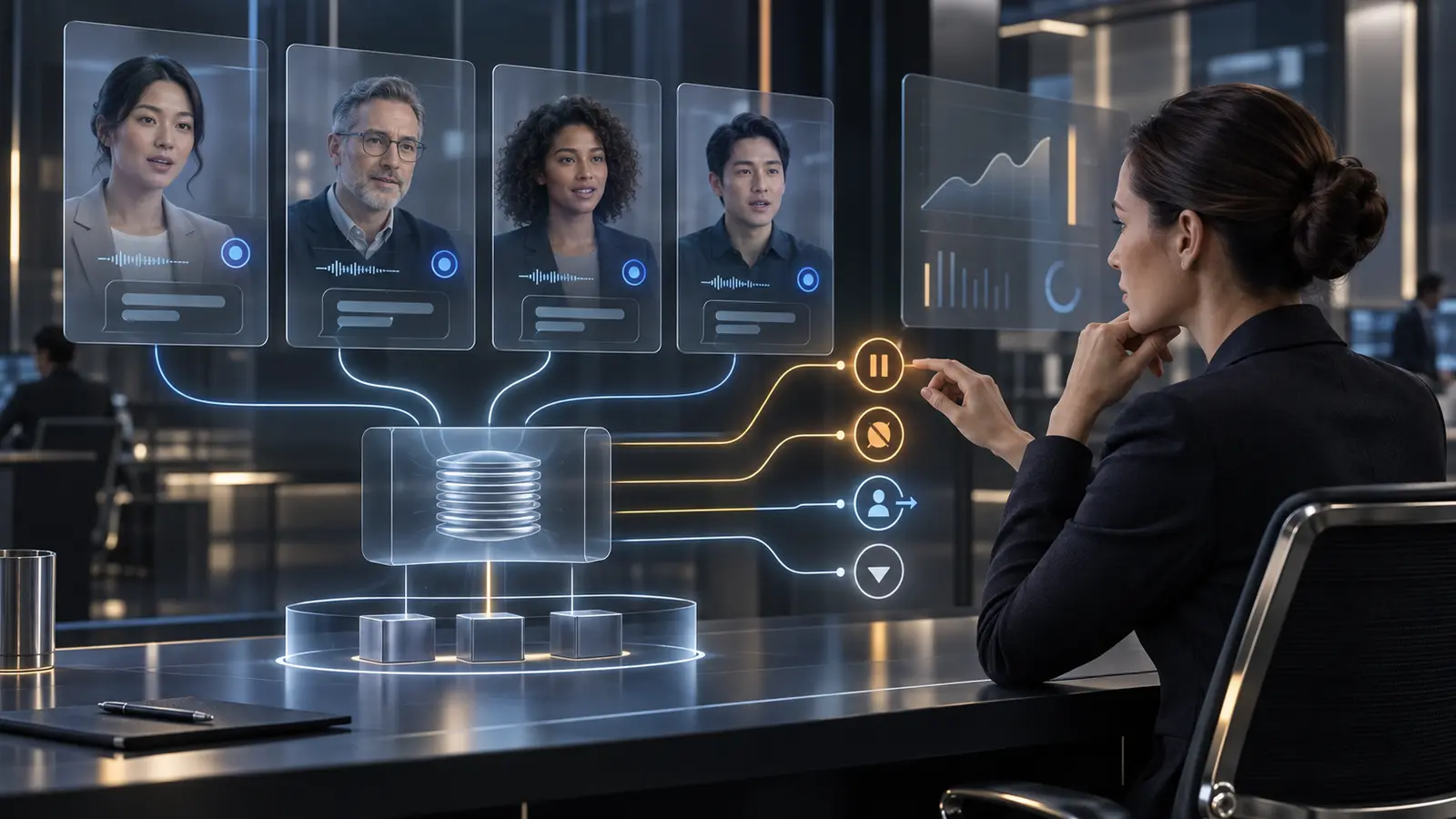
Human oversight for an AI avatar is effective only when a named person has enough information, authority and time to change what the system is doing. Writing “human in the loop” in a risk assessment is not a control. The operator needs a separate control plane that can inspect a session, restrict knowledge, revoke action permissions, take over the conversation and bring the service to a safe state.
That matters because a real-time avatar does more than generate text. It listens, retrieves enterprise information, speaks, displays captions, invokes tools and may continue across many simultaneous sessions. An operator who merely watches a dashboard cannot prevent harm if alerts arrive too late or every intervention depends on asking the same model to behave differently.
This guide gives banks, governments and regulated enterprises a practical design: four oversight modes, seven control-plane capabilities, an authority matrix and twelve production tests. It complements automated guardrails for AI avatars; human oversight is the layer that interprets uncertainty and exercises accountable judgement when automated policy is insufficient.
Start with the decision, not the dashboard
First identify what the avatar can affect. An information-only concierge, an authenticated account assistant and a system that submits a benefits application create different consequences. The oversight design should follow the most consequential permitted action, not the most impressive interface feature.
For each use case, list:
- the information the avatar may disclose;
- the recommendations it may make;
- the records or transactions it may prepare or execute;
- the people who could be affected;
- the time available to prevent or reverse harm;
- the safe service that remains when automation is restricted.
This produces an intervention boundary. It states which outcomes need prior approval, which can be monitored after the event and which must never depend on an avatar or language model alone.
Choose one of four oversight modes for each action
“Human oversight” covers several operating patterns. Treating them as interchangeable creates hidden gaps.
1. Human before the action
A person approves a proposed action before it becomes effective. This suits high-consequence, low-volume steps such as changing a protected record, approving an exception or releasing a formal decision. The reviewer should see the structured proposal, authoritative source and policy reason—not hunt through a long transcript.
2. Human on the loop
The service operates within defined limits while a person monitors exceptions and can intervene. This can suit higher-volume conversations, but only if the alert reaches someone before the relevant harm becomes irreversible. “Monitored” has little meaning without an alert owner, response target and tested intervention path.
3. Human after the action
A reviewer samples completed interactions, investigates complaints and corrects systemic problems. This is useful for quality improvement and lower-consequence errors. It is not adequate where a wrong answer or action cannot be repaired later.
4. Human in command
Service owners decide the allowed purpose, data, models, action tiers, deployment boundary and conditions for suspension. They can reduce autonomy or stop the service across sessions. This governance layer remains necessary even when individual interactions do not receive live review.
A mature system may use all four: human-in-command governance, on-the-loop operations, prior approval for specific actions and after-the-event assurance.
Build a separate operator control plane
The operator interface should be isolated from the avatar’s conversational instructions and protected with the organisation’s identity, access and audit controls. It needs seven capabilities.
1. Show the state that matters
Display the session identity state, selected language, active data classification, knowledge sources, current action request, policy version, detector or guardrail events and service health. Avoid dumping every internal token or raw model trace onto the operator. More data can conceal the fact that requires a decision and expose unnecessary personal information.
Use a compact explanation object: what the avatar proposes, which trusted data supports it, what rule or confidence condition raised the alert, who may be affected and how long the decision remains valid.
2. Route alerts by consequence and time
A slow speech response, an attempted unauthorised transaction and possible disclosure of protected data should not share one undifferentiated queue. Classify alerts by harm, reversibility and intervention deadline. Route them to the role with the correct competence and authority.
Set the deadline from the process. If a spoken disclosure begins in 300 milliseconds, a five-minute operations target cannot prevent it; the automated output gate must block first. Human oversight then decides recovery. Humans are appropriate for ambiguous judgement, not for compensating for controls that are physically too slow.
3. Give operators deterministic controls
An intervention must call a trusted control service, not append “please stop” to the model prompt. Useful controls include:
- pause speech or cancel an unspoken response;
- revoke tool and transaction authority;
- restrict the session to approved public information;
- remove a compromised knowledge source or model route;
- disable camera, microphone or another affected modality;
- transfer the conversation to a person;
- drain or suspend the service while preserving evidence.
The existing AI-avatar incident-response ladder explains how to contain progressively larger scopes. Human oversight defines who may invoke each control during ordinary operation, not only during a declared incident.
4. Make takeover explicit to the user
When a person joins, tell the user that the mode has changed. Decide whether the avatar stops speaking, relays the human’s words, remains visible but silent or leaves the channel. Avoid an ambiguous blend in which a person and model can both act under the same apparent identity.
Pass only the minimum context required for the handover. The operator may need the authenticated subject, task, last confirmed facts and unresolved question; they may not need the full conversation or camera history.
5. Bind approval to one immutable proposal
A human approval should identify the action type, parameters, target, policy version, session, expiry and a digest of the proposal reviewed. If any material field changes, approval expires. This prevents the model or an attacker from changing the beneficiary, amount, record or destination after the operator clicks approve.
The same principle applies to reversals. Record exactly which outcome was disregarded, overridden or reversed, and whether downstream systems actually accepted the change.
6. Stop into a defined safe state
A stop button is not useful unless every dependent component knows what “stopped” means. Define whether active speech ends, pending actions are cancelled, new sessions are refused, credentials are revoked, GPU work is drained and the user receives a safe explanation or alternative route.
The EU AI Act’s Article 14 on human oversight provides a useful design test for high-risk systems: assigned people should be able to understand limitations, monitor operation, avoid over-reliance, interpret outputs, disregard or reverse them, and interrupt the system into a safe state. Not every avatar is a high-risk AI system, and applicability is a legal and factual assessment; the control questions remain valuable beyond the provision’s scope.
7. Record the decision without creating surveillance
Keep the alert, evidence references, operator identity and role, action taken, reason code, timestamps, affected scope and resulting system state. Do not default to retaining every voice, face and transcript merely because a person might need to investigate later.
Evidence should answer who knew what, when they could act and whether the control worked. A privacy-minimised record can link to separately governed content when an investigation genuinely requires it.
Give the human competence, authority and support
An operator who is trained but lacks permission cannot intervene. A senior approver who has permission but cannot interpret the alert is equally ineffective. Maintain an authority matrix for each control:
- who may view a session and which content is visible;
- who may pause, restrict, take over or terminate it;
- who may approve each action tier;
- who may suspend a model, knowledge source or service;
- who may restore operation and under what evidence;
- who is accountable when the primary operator is unavailable.
For high-risk AI systems, Article 26 of the EU AI Act says deployers must assign oversight to people with the necessary competence, training, authority and support. The current UK Government Data and AI Ethics Framework similarly recommends naming responsible roles, recording the balance between automation and human control, and acknowledging that reviewing every conversational output is often impractical.
Support includes staffing, escalation, protected time, usable information and freedom to disagree with the system. If teams are rewarded only for throughput or penalised for intervention, the nominal human control will be bypassed.
Design against automation bias and alert fatigue
A friendly, fluent avatar can make weak evidence feel convincing. Operators also become less attentive when most alerts are false or most recommendations are accepted. Counter this by showing source quality and uncertainty before the model’s persuasive narrative, requiring a reason for consequential approval, rotating repetitive monitoring work and measuring disagreement rather than rewarding automatic acceptance.
Track alert volume per operator, time to acknowledge, time to effective intervention, override rate, later reversal, missed-event rate and outcomes by user group. Do not impose a universal operator-to-session ratio: it depends on alert frequency, decision complexity, harm deadline, language coverage and the controls that run automatically.
Place oversight inside the deployment boundary
Customer-hosted oversight can keep operator consoles, session evidence and control APIs inside the customer environment. It can support private or sovereign requirements, but the customer must operate identity, staffing, monitoring, updates and recovery. Local hosting does not make an understaffed control room effective.
Managed cloud oversight may simplify product updates, support workflows and cross-service monitoring. It can introduce another administrative boundary and may expose session metadata or content to a provider. Contract, access, data location and support arrangements must match the use case.
Hybrid oversight can keep content and action control with the customer while sharing health signals or de-identified incident evidence with a managed service. Define which side has final authority and how intervention works when the network link is unavailable.
Yepic can scope cloud, private-cloud, sovereign and customer-hosted avatar architectures, including deployment on customer-controlled GPUs where appropriate. Human oversight must be designed around the chosen operating model; it is not automatically supplied by a hosting label.
Run twelve production tests
- Every consequential output and action has an assigned oversight mode.
- Each alert has an owner, severity and intervention deadline.
- The operator sees source, identity, policy and action context without excessive content.
- Pause, restrict and revoke controls work without cooperation from the language model.
- An approval cannot be reused after the proposal, session or expiry changes.
- Human takeover is clear to the user and transfers only necessary context.
- The stop control reaches a documented safe state across speech, actions and sessions.
- A backup operator can act when the primary owner is unavailable.
- Network loss does not remove the customer’s essential intervention capability.
- Alert fatigue, automation bias and accessibility needs are included in operator testing.
- Override and reversal are confirmed in downstream systems, not only in the console.
- Evidence proves who acted, what changed and when the safe state was reached.
Make oversight operational before launch
Yepic’s five-metre real-time agent at the Global AI Summit combined live spoken interaction, summit knowledge, real-time rendering and on-site operation across three days. That project demonstrates the operational pressure of a visible, immediate avatar service. It is not presented as a regulated human-oversight deployment or a customer-hosted implementation.
For a production review, take one high-consequence journey and run it as a timed exercise. Trigger an uncertain answer, a prohibited action, a knowledge-source failure and an unavailable operator. Measure when the issue becomes visible, who has authority, whether intervention beats the harm deadline and what the user experiences afterwards. If the team cannot answer those questions, it has a human nearby—not human oversight.