AI Synthetic Monitoring: Test the Avatar Before Users Do

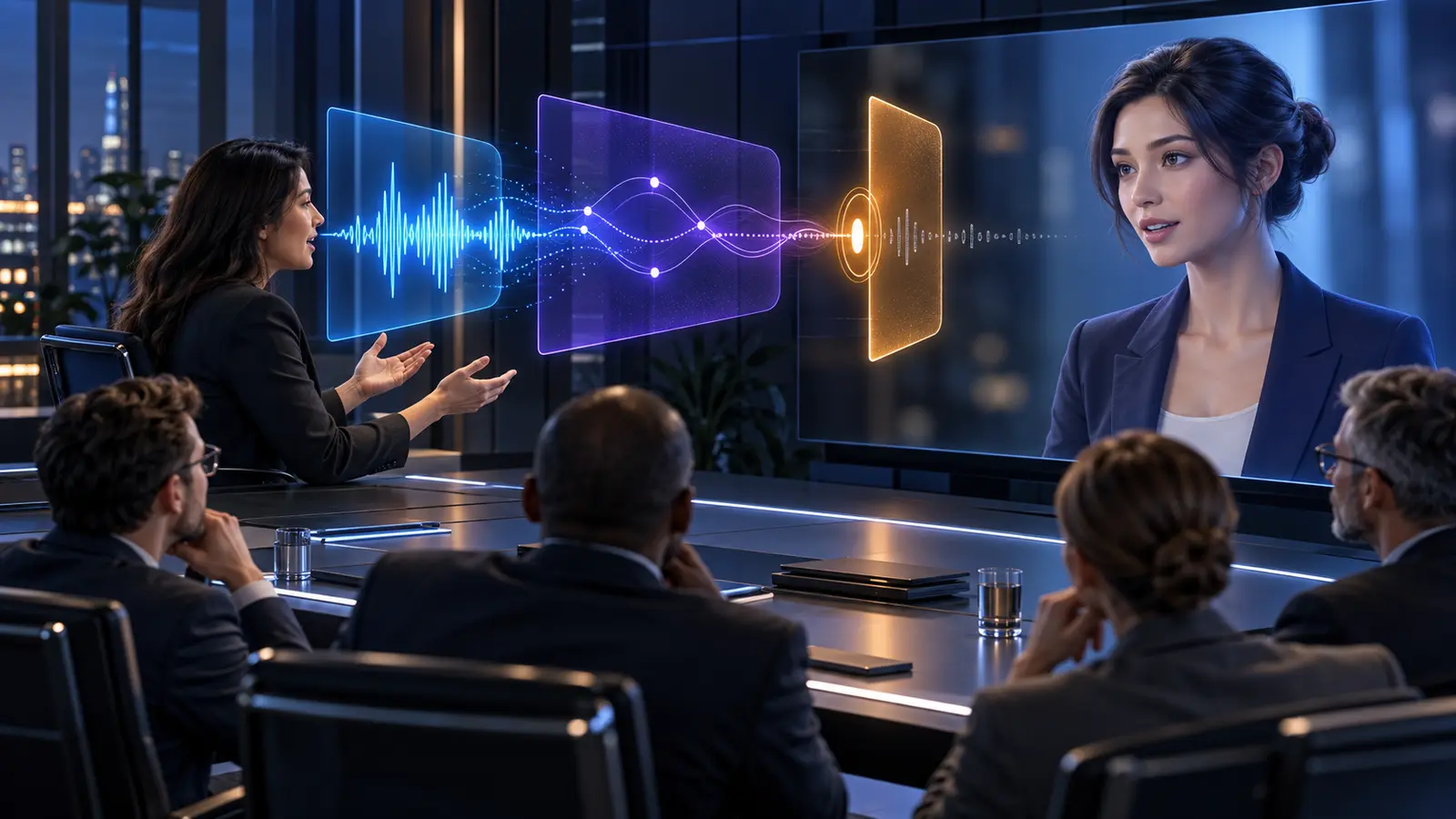
AI synthetic monitoring should make controlled conversations travel through the same production path as real users, then test whether the avatar was available, intelligible, grounded, authorised and safely presented. A useful probe does more than ping an API. It starts a session, supplies known speech, exercises retrieval or an approved action, receives the spoken and rendered response, and records a privacy-safe verdict.
That outside-in view matters for banks, governments and regulated enterprises. Every component can report healthy while the journey is broken: the browser cannot obtain media, speech recognition selects the wrong language, an authorised document is missing, the first audible response arrives late, captions drift or an action succeeds without a clear confirmation.
Synthetic monitoring detects those silent failures without waiting for a citizen or customer to report them. It complements privacy-preserving on-premise AI observability; it does not replace telemetry from real sessions, human evaluation, load testing or incident response.
What is AI synthetic monitoring?
AI synthetic monitoring runs scheduled, controlled interactions against a live or production-like AI service. The inputs, identities and expected boundaries are designed in advance. The resulting evidence answers a practical question: can a representative user complete an important journey now?
Google’s Site Reliability Engineering guidance calls this black-box monitoring: testing externally visible behaviour as a user would experience it. White-box monitoring inspects internal logs, metrics and traces. Both are needed. Internal telemetry can explain why a failure occurred; an outside-in probe establishes that the failure is visible at the service edge.
For a real-time avatar, the black box is unusually broad. A probe may need to traverse:
- identity, session admission and the client application;
- microphone or test-audio capture and turn detection;
- speech recognition and language selection;
- retrieval, policy checks, reasoning and approved tool calls;
- text-to-speech, captions and avatar rendering;
- WebRTC or another media-delivery path;
- handover, fallback and session teardown.
An HTTP 200 from the language-model gateway proves very little about that journey.
Define a synthetic conversation contract
Begin with a versioned contract for each probe. It should describe the route being tested, the authority granted to the test identity and the acceptable range of outcomes. A useful record contains ten fields:
- Purpose: the customer or citizen journey the probe represents.
- Origin: site, network zone, browser, device class and media route.
- Identity: a dedicated synthetic account with minimum permissions.
- Input fixture: approved audio, language, accent, background conditions and turn sequence.
- Knowledge fixture: a controlled document or fact with a known version.
- Permitted action: a reversible sandbox operation, read-only lookup or explicit no-action rule.
- Assertions: technical, semantic, policy and presentation conditions.
- Time budget: end-to-end and component thresholds for the probe class.
- Evidence: the minimum logs, traces, media statistics and result artefacts retained.
- Owner: the team receiving an alert and the runbook it should follow.
The contract prevents a common failure: a test script that gradually gains production permissions, depends on mutable content and alerts on a word match that no longer proves the journey works.
Use five probe classes
1. Session smoke probe
Start and close a minimal session from the intended client boundary. Confirm authentication, signalling, microphone state, first playable audio or video, captions where required and clean teardown. Run this frequently because it is cheap and catches basic routing or certificate failures.
2. Grounded-answer probe
Ask a stable question whose answer exists in a controlled knowledge fixture. Assert that the response cites or reflects the authorised source, does not invent a missing fact and changes when the fixture version changes. A semantic rubric is usually more robust than exact text matching because generative wording may vary.
3. Policy-boundary probe
Attempt a known restricted request using a test identity. Verify that the avatar refuses, narrows the answer or hands over according to policy. Also test the inverse: an authorised request should not be blocked merely because a safety filter is over-broad.
4. Safe-action probe
Exercise a read-only or reversible action through a dedicated test tenant. Check identity propagation, confirmation, idempotency and the authoritative result. Never let a scheduled probe submit a real payment, update a citizen record or trigger an operational workflow. If a real production action cannot be made harmless, test up to the final boundary and assert that execution is blocked.
5. Degraded-path probe
Use an approved test environment or bounded fault switch to make one dependency unavailable. Confirm that the avatar enters the intended reduced-service mode rather than guessing, silently changing data destination or repeatedly retrying an action. This is narrower than a full AI resilience-testing programme, but it verifies that a chosen fallback remains functional between larger exercises.
Assert behaviour without demanding identical words
A deterministic website check can look for a status code or DOM element. A generative conversation needs layered assertions.
- Transport: did the session start, stay connected and close correctly?
- Performance: did first audio, first frame, complete response and action acknowledgement arrive within the probe’s budget?
- Semantic: did the response contain the required meaning, use the correct evidence and avoid a known contradiction?
- Policy: was the response allowed for that identity, location, data class and task?
- Presentation: was speech intelligible, language correct, captions materially aligned and audio-video continuity acceptable?
- State: did the test leave no stale session, duplicate action, privileged token or synthetic record outside its expected lifecycle?
Use deterministic checks wherever possible: response schema, source identifier, policy outcome, action status and media statistics. Use calibrated semantic scoring only where language variation makes exact matching inappropriate. The avatar golden-set guide explains how to version representative cases and human-reviewed rubrics rather than trusting an uncalibrated model grader.
For media, the W3C’s WebRTC statistics model provides client-side signals such as round-trip time, jitter, packet loss, frames decoded and freeze counts. Choose only the fields needed for the test, because client and network telemetry can still carry privacy implications.
Place probes where users actually connect
A probe running beside the server validates a different path from a kiosk behind a branch firewall or a browser on a government network. Build a small coverage matrix across the failure domains that matter:
- internal and external network origins;
- direct and relay-based media paths;
- managed kiosk, desktop browser and approved mobile classes;
- primary languages and right-to-left presentation where relevant;
- anonymous, authenticated and accessibility journeys;
- primary site and failover site.
Do not multiply every dimension into an unmanageable test grid. Select the smallest set of probes that crosses distinct trust, media, language and infrastructure boundaries. Rotate deeper journeys on a slower schedule while keeping one light smoke probe frequent.
Keep the synthetic plane safe
Synthetic traffic is still production traffic. It consumes GPU capacity, appears in audit trails and can reach enterprise systems. Treat the monitoring plane as a controlled workload.
- Use unmistakable test identities and data. Never copy unrestricted customer transcripts into probe fixtures.
- Separate test tenants or namespaces. Prevent synthetic records from entering customer analytics, case queues or regulatory reports.
- Apply least privilege. A probe should possess only the authority needed for its intended assertion.
- Rate-limit and schedule deliberately. Probes must not distort capacity measurements or contribute to an outage.
- Protect fixtures and expected answers. If production components can read the assertion file, the test may pass for the wrong reason.
- Mark telemetry. Use a bounded probe identifier so synthetic results can be separated from real-user service indicators.
- Delete test state. Verify expiry for sessions, tokens, generated media and reversible actions.
The UK National Cyber Security Centre’s secure AI operation guidance recommends monitoring system behaviour and inputs, treating major data, model or prompt changes as new versions, and protecting logs from unauthorised access. Synthetic monitoring should follow the same discipline.
Correlate the probe with private telemetry
The synthetic verdict should carry a random correlation identifier through each authorised component. When a probe fails, operators can join its client observation to speech, retrieval, model, voice, rendering and network spans without storing a real person’s conversation.
OpenTelemetry’s May 2026 GenAI observability guidance describes standardised traces, metrics and events for model operations, while noting that prompt, completion and tool content are optional. That distinction is important: useful diagnostics do not require every probe—or every customer interaction—to be retained verbatim.
Keep the evidence proportionate. A successful smoke probe may need only timings, outcome codes, component versions and media statistics. A failed probe may temporarily retain its approved synthetic audio, response and rendered sample for diagnosis. Because the fixture is controlled, it offers richer evidence with less privacy risk than routinely recording customer sessions.
Choose deployment placement honestly
For a customer-hosted or sovereign deployment, probe runners, fixtures, result storage and alerting can remain inside the customer environment. That supports restricted networks and direct testing of private paths, but the customer must operate the runners, credentials, scheduling and evidence lifecycle.
A private-cloud design can place regional probes near users while keeping telemetry in an approved tenant. Public-cloud synthetics may be quicker to operate and provide geographically distributed origins, but they can be unsuitable for private endpoints or sensitive fixtures. Hybrid designs often work best: local probes validate protected journeys, while an external probe checks the public entry point without crossing into restricted content.
On-premise hosting is not automatically better monitored. It provides control over probe placement and data flow only if the organisation builds and owns the monitoring plane.
Turn failures into operational decisions
Do not page an operator for every variable response. Alert only when the failed assertion is actionable and the probe itself is healthy. Require repeated failure or a corroborating signal for noisy semantic checks; page immediately for loss of an essential journey, unsafe policy behaviour or an unexpected production action.
Each alert should name the probe contract, last known-good run, affected path, current component versions and an initial containment step. Link it to the relevant AI incident-response runbook. Review false positives as defects in the monitoring system, not as harmless inconvenience.
Yepic’s Abu Dhabi Aviation and Oracle enterprise avatar integration shows why end-to-end validation matters: development and production environments, API and iframe integration, real-time streaming, captions, microphone behaviour, WebRTC testing, browser remediation, cybersecurity support and ongoing maintenance all affected the working service. That project is evidence of integration and operational experience; it is not presented as a completed customer-hosted synthetic-monitoring deployment.
Twelve questions for the architecture review
- Which critical user journeys have an outside-in probe?
- Which network, browser, language and identity boundaries do the probes cross?
- Can every synthetic identity be recognised and revoked independently?
- Can a probe trigger a real business action or contaminate production records?
- Which assertions are deterministic, and which depend on calibrated semantic judgement?
- Does the test verify spoken, visual and captioned output—not merely generated text?
- How are probe results separated from real-user service indicators?
- What evidence is retained on success and on failure?
- Can operators correlate an outside-in failure across the complete component chain?
- Do probe frequency and depth fit the available GPU and network headroom?
- Who receives each alert, and what decision can they make?
- When was the monitoring plane itself last tested?
Make the avatar prove that it still works
The strongest synthetic monitor is a small, governed customer journey—not a model ping. It uses controlled inputs, restricted identities, safe assertions and the same client, media and enterprise boundaries that real users depend on. Combined with internal telemetry, representative load testing and human evaluation, it turns “the components look healthy” into evidence that the service can actually converse.
For a private, on-premise or sovereign avatar implementation, Yepic can help scope the production journey, probe boundary, evidence model and deployment trade-offs alongside the wider real-time avatar architecture.