Confess Your Marketing Sins to Rory Sutherland
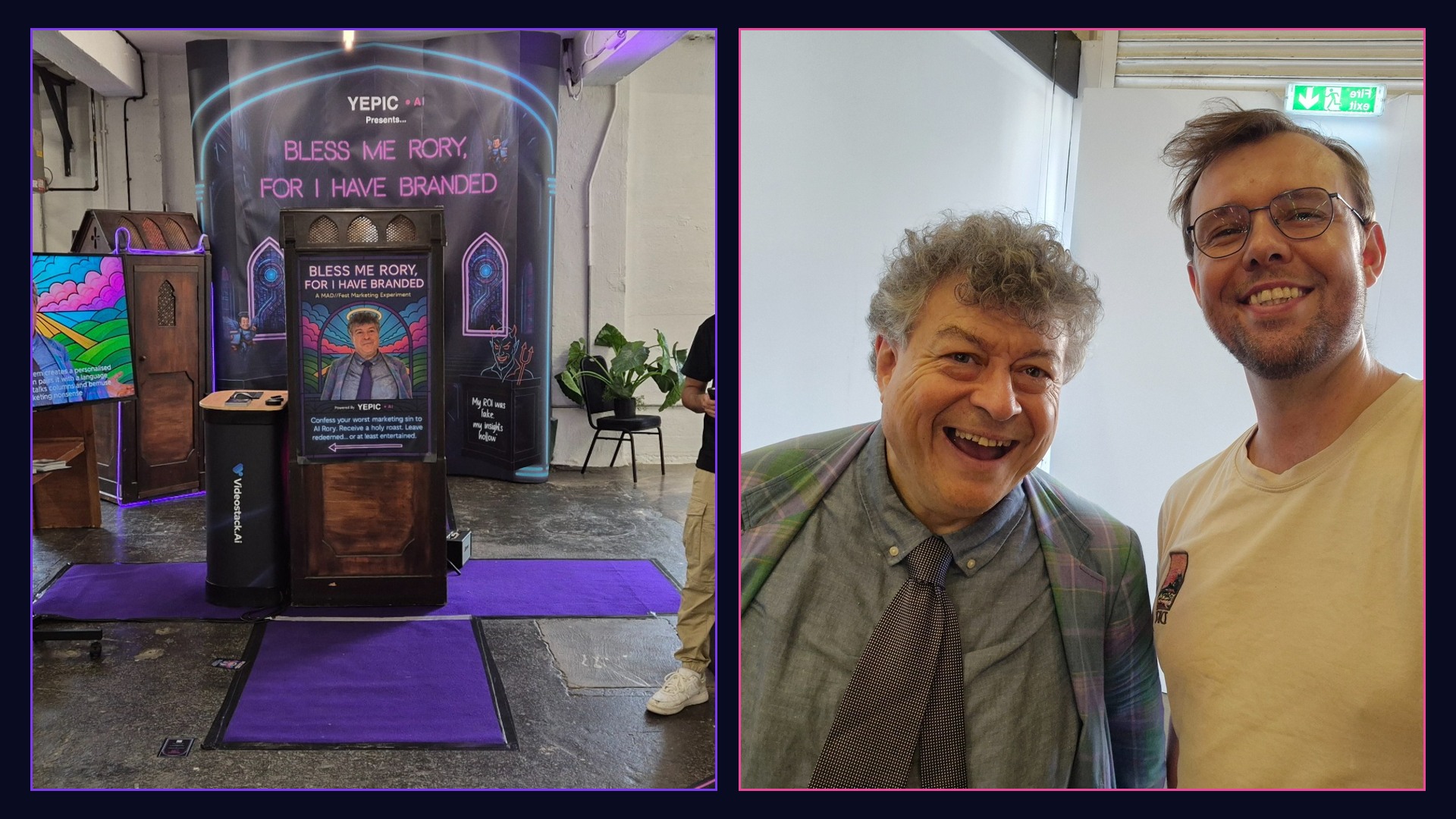
The finished “Bless Me Rory, For I Have Branded” experience running live at MADFest.
The customer value was audience behaviour
MADFest did not need another screen showing an AI demo. It needed an experience people would understand instantly, choose to approach and talk about afterwards. Rory’s recognisable personality removed the instruction barrier: attendees already understood the character, the humour and the premise. The confessional format then gave each person a simple role inside the story.
For an event, brand or enterprise, that changes the commercial value of an avatar. It becomes a programmable attraction that can welcome visitors, ask questions, react to context, explain products and create a memorable exchange — while preserving the tone and governance of the represented personality.
A proposition people understood in one glance
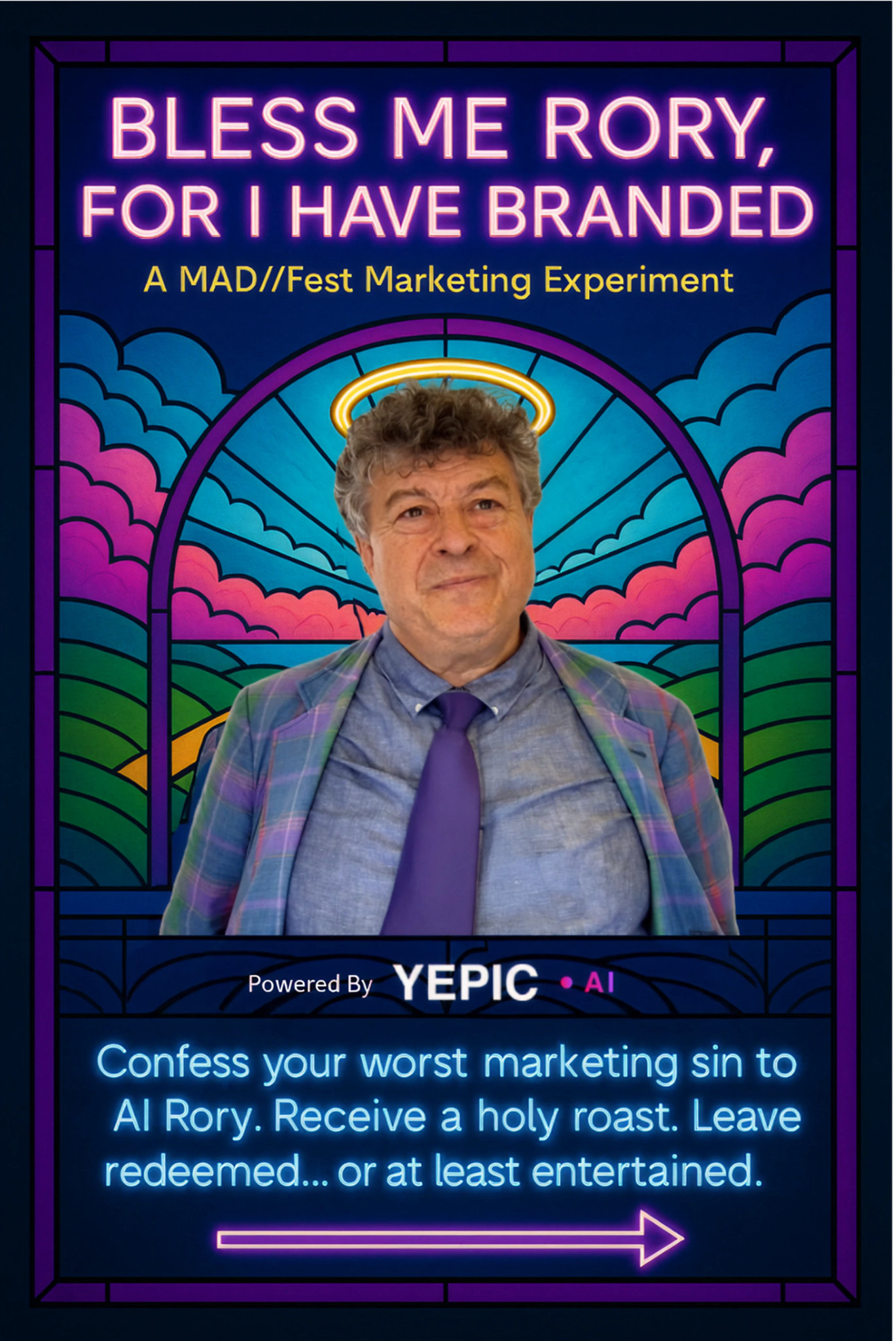
Confess your marketing sins
The flyer made the interaction legible before anyone reached the screen: confess your worst marketing sin, receive a holy roast from AI Rory and leave redeemed — or at least entertained.
That clarity matters commercially. The technology disappeared behind a strong invitation, giving MADFest a promotable experience and giving attendees an immediate reason to participate.
Making Rory: two days from capture to activation
Original smartphone footage used during the rapid production process.
Emotion was part of the product
Rory’s value is not a database of facts. It is the feeling of being challenged by an unexpected observation, teased for a weak assumption or rewarded with a characteristically sideways insight. The system therefore had to do more than produce plausible sentences. It had to read the conversational moment and choose an emotionally appropriate performance: curious, sceptical, amused or sharply playful.
That emotional layer made the exchange feel authored rather than retrieved. It is also what makes the architecture useful beyond entertainment: a training coach can encourage, a service agent can reassure, a brand host can delight and an expert persona can challenge — all within defined behavioural and safety boundaries.
Making a live avatar vape without breaking the illusion
Rory’s avatar could also vape as part of the performance. That sounds like a small visual flourish, but it was a difficult real-time engineering problem. A character-specific, non-verbal action had to coexist with live speech, facial animation, timing and low-latency responses without interrupting lip-sync or making the persona feel pre-recorded. Solving it showed that Yepic could orchestrate expressive behaviour — not just animate a talking head.
What Yepic built
- A consented, recognisable real-time visual and vocal likeness.
- A persona informed by Rory’s public talks, language patterns and distinctive worldview.
- An emotionally responsive conversational role designed for humour, challenge and follow-up questions.
- Character-specific performance behaviours, including the technically demanding vaping action.
- A low-latency live-event runtime able to operate in front of an audience.
- A format MADFest could programme as entertainment and audience engagement, rather than present as a technology demonstration.
What this creates for enterprise customers
The project demonstrates a repeatable way to turn trusted people — founders, experts, presenters, trainers or brand ambassadors — into governed interactive experiences. Customers gain more than a likeness: they gain a responsive digital representative that can carry knowledge, personality and emotional intent into events, learning, customer service and branded environments.