Microphone Access for Voice AI: Permissions and Recovery
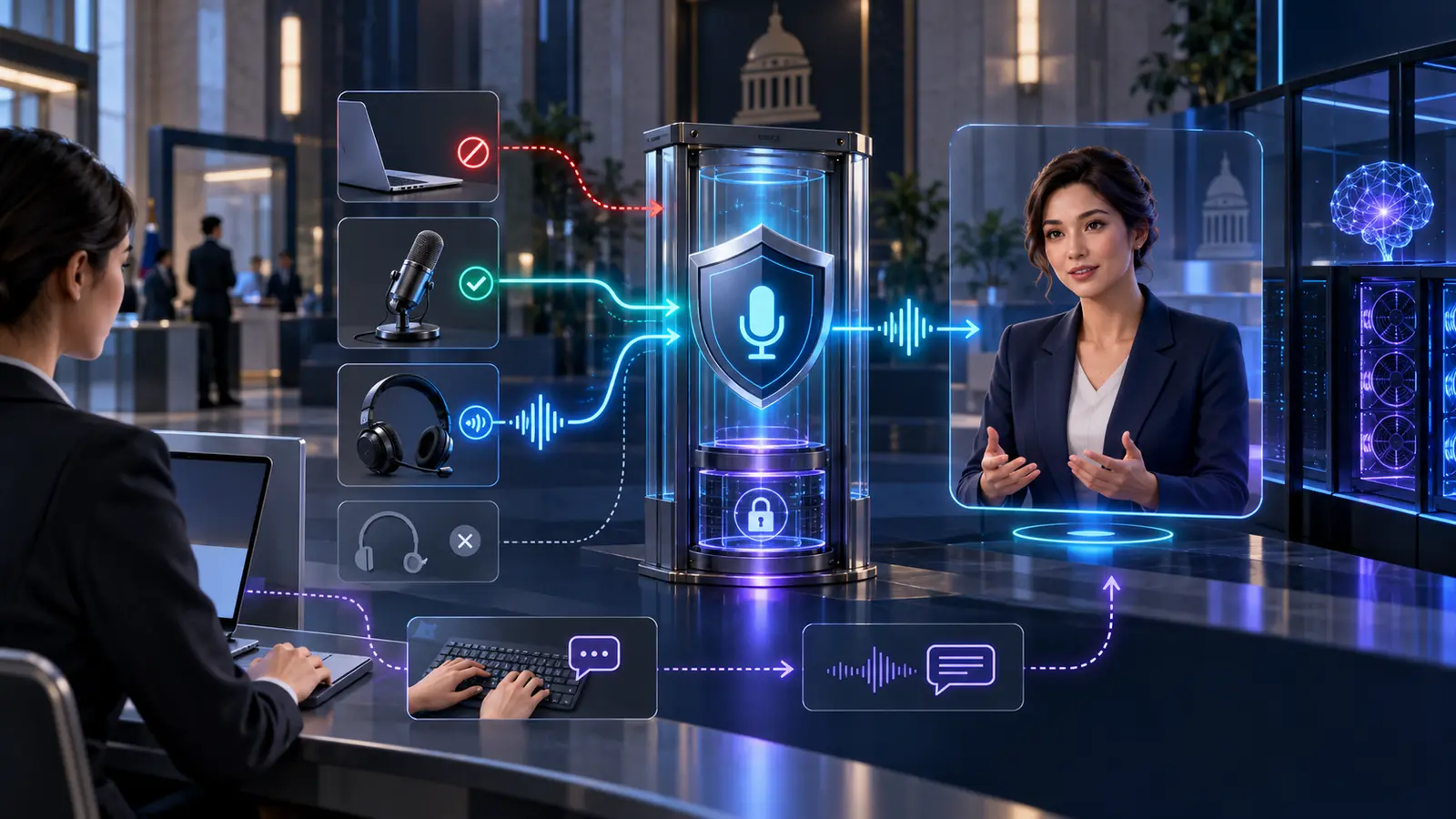
Microphone access for a browser-based AI avatar should be designed as a recoverable state machine, not treated as a one-off permission prompt. Permission may be allowed while the intended device is unavailable, locked by another application, muted by the operating system or replaced during the session. A production service must distinguish these conditions, explain the next action and preserve a non-voice route through the journey.
This matters in bank branches, citizen-service sites, airports and regulated workplaces because the endpoint is part of the service boundary. Hosting speech recognition and avatar rendering on private infrastructure can control where processing occurs, but it cannot make a browser grant access to a headset or stop an operating system from changing the default input.
Separate permission, device, track and signal states
“The microphone works” compresses four different questions:
- May the page ask? The browser context and Permissions Policy must allow microphone capture, including when the experience runs inside an iframe.
- May this origin capture? The user or managed browser policy may grant, deny or leave the request unanswered.
- Which device and track are active? A selected microphone must still exist, open successfully and remain connected.
- Is the signal usable? A live track can carry silence, clipping, the wrong room, Bluetooth degradation or the avatar’s own loudspeaker output.
The current W3C Media Capture and Streams specification makes the distinction explicit: a granted permission does not guarantee that getUserMedia() will succeed. Hardware, operating-system, application or page locks can still produce a NotReadableError. The specification also treats enabled, muted and ended as different track conditions.
Do not turn those technical states into one generic “microphone error”. They have different owners and different remedies.
Use a six-state microphone model
A compact production model gives the interface, support desk and telemetry the same vocabulary.
1. Unavailable or policy-blocked
The page is not in an approved secure context, the microphone feature is not delegated to an embedded experience, the browser does not expose the required API or endpoint policy prohibits capture. Retrying the same permission call will not fix the architecture. Show a deployment-specific remedy or continue by text.
2. Promptable
The application can request access, but should do so after an explicit user action and with a plain explanation of why voice is useful. A request can remain unresolved if the person ignores the browser prompt, so the interface needs a visible “waiting for permission” state, an escape route and a timeout policy that does not mislabel inaction as denial.
3. Denied
The person or managed endpoint has refused access. Repeated prompts are not recovery. Explain how to change the browser or system setting, offer text input immediately and avoid implying that permission is mandatory when the task can be completed another way.
4. Granted but unopened
Permission exists, yet no usable track was created. The requested microphone may have disappeared, failed a required constraint or be locked elsewhere. Keep NotAllowedError, NotFoundError, OverconstrainedError and NotReadableError separate in diagnostics, then translate each into a safe user instruction.
5. Live
A track is open from a known route and its effective settings have been read back. The application should show an unambiguous listening indicator, a persistent mute control and enough signal evidence to detect a flat line without retaining raw audio. “Live” still does not prove that speech recognition is accurate.
6. Interrupted or ended
The operating system may temporarily mute a source, a USB device can be unplugged, a Bluetooth route can change, permission can be revoked or a track can end. Temporary mute and permanent ended events need different handling. Recover without discarding the conversation, and require deliberate confirmation before switching to an unexpected room microphone.
Design the iframe permission boundary before go-live
Enterprise avatars are often embedded into an existing portal, kiosk shell or line-of-business application. That creates two control planes: the top-level document and the embedded origin.
The W3C specification defines microphone capture as a policy-controlled feature with a default allowlist of self. If the experience is cross-origin, the top-level application must deliberately delegate access with the appropriate Permissions Policy and iframe configuration. The child application still needs user permission; delegation only allows it to ask.
Record these items in the interface contract:
- top-level and embedded origins, including development and production;
- the owner of the response header and iframe
allowconfiguration; - content-security and browser-management policies that can block the flow;
- whether redirects, authentication or portal navigation change the origin;
- the approved user message for policy-blocked versus user-denied access; and
- a text-first path that works even when capture cannot be delegated.
Test the deployed portal, not only the avatar URL in a standalone tab. A successful isolated demo proves little about the final embedding boundary.
Select the actual device, not an assumed default
The system default is a sensible starting point, but it is not an enterprise device strategy. A laptop may prefer its internal array while the service desk expects a USB handset. A shared kiosk may expose a maintenance headset alongside the approved room microphone. A user can change the operating-system default after the page loads.
After permission, enumerate the inputs that the browser is allowed to reveal, let the person select from appropriate choices and confirm the effective track settings. Device labels and identifiers carry privacy and fingerprinting implications, so store them only when there is a clear operational need. A support-friendly product can usually persist a pseudonymous preference or device class rather than a raw hardware label.
Treat exact constraints carefully. Non-required preferences are not guarantees, while an unnecessary required constraint can reject an otherwise usable source. Request only what the experience needs, read back what was delivered and test the resulting signal. The separate endpoint audio contract for echo cancellation explains why the chosen microphone, playback route and browser processing must be evaluated together.
Recover safely when the route changes
The browser can emit a devicechange event when devices are added, removed or the system default changes. It is a prompt to reconcile state, not proof that the active source changed cleanly. Visibility and permission rules can limit enumeration, and user agents may combine or delay device-change notifications for privacy.
A robust handover sequence is:
- detect the track or device change and pause consequential voice actions;
- re-enumerate the devices the current document may see;
- determine whether the approved source still exists and whether the live track is muted or ended;
- ask before moving to an unexpected microphone, especially in a public or shared environment;
- open and validate the replacement track before switching the speech pipeline;
- stop the old track so that two microphones are not captured accidentally; and
- resume with the same conversation state, while requiring reconfirmation of any incomplete high-risk instruction.
Do not replay partially recognised speech as if it were authoritative after recovery. Yepic’s guide to a streaming speech-recognition commit policy separates provisional hypotheses from the immutable input that downstream systems may act upon.
Make no-microphone operation a first-class route
Voice may be efficient, but it should not become the only door to a public or regulated service. Users may decline capture for privacy, be unable to speak, work in a noisy environment or use an endpoint whose audio has failed.
Provide text input that reaches the same knowledge and workflow boundary, preserve captions and session context when the mode changes, and make human assistance available without forcing the person back onto an audio channel. The enterprise accessibility guide for AI avatars describes this as functional equivalence: changing mode should not erase the task or reduce the available outcome.
For a consequential journey, define what happens to an utterance interrupted by route loss. A partially heard payment amount, medical symptom or identity answer should be discarded or visibly reconfirmed, not silently continued.
Observe the state without exporting conversations
Support teams need evidence, but raw audio and transcripts are not the default diagnostic answer. A privacy-conscious event record can include:
- application, browser and operating-system versions;
- embedding origin and policy decision;
- permission outcome and time spent awaiting the prompt;
- requested device class and a pseudonymous selected-device reference;
- capture error category, without unnecessary human-readable hardware detail;
- track opened, muted, unmuted and ended timestamps;
- route-change detections, switch attempts and recovery result;
- effective channel, sample-rate and processing settings where exposed;
- signal-present or prolonged-silence measures; and
- whether the user continued by voice, text or human handover.
Set retention, access and regional boundaries for this metadata. A device fingerprint can become identifying even when no recording is stored.
Hosting choice does not remove the endpoint boundary
Public cloud, private cloud and customer-hosted deployment change where speech, language and rendering workloads run. They do not change who controls the physical microphone and browser permission.
- Public cloud can simplify managed scaling and upgrades, but captured audio leaves the customer environment unless the architecture says otherwise.
- Private or sovereign cloud can improve tenancy, locality and control while retaining managed infrastructure, subject to the actual service boundaries.
- Customer-hosted or on-premise can keep scoped components and data flows inside the customer environment, but transfers more responsibility for GPUs, networking, upgrades, monitoring and integration.
Yepic can scope cloud, private-cloud and customer-hosted avatar architectures, including operation on customer GPUs where the use case and environment support it. That is a custom implementation decision, not a claim that every component is universally air-gapped or runs on arbitrary hardware. In every model, endpoint capture still needs its own browser, device and recovery design.
Use a twelve-point microphone access contract
Before approving a pilot for production, architecture, security, product and operations teams should agree:
- supported browsers, operating systems and managed-device profiles;
- top-level and iframe origins, with the Permissions Policy owner;
- when permission is requested and how purpose is explained;
- the supported input devices and approved default-selection rule;
- requested constraints and how effective settings are verified;
- the meaning of live, muted, ended and signal-not-usable states;
- recovery behaviour for denial, locks, unplugging and route changes;
- what happens to an incomplete transcript or business action;
- equivalent text, caption and human-assistance routes;
- visible capture, mute and stop controls;
- telemetry, retention and access boundaries; and
- acceptance tests, owners and supported fallback.
Test that contract across fresh permission, stored permission, denial, ignored prompt, locked device, no device, unplug, Bluetooth change, operating-system mute, iframe policy failure, browser navigation and mode switching. Include real corporate policies and networks, not only clean developer laptops.
What Yepic’s enterprise work adds
For Abu Dhabi Aviation and Oracle, Yepic’s delivery included dedicated development and production environments, API and iframe integration, real-time streaming, captions and microphone behaviour, WebRTC and corporate-network testing, browser remediation, cybersecurity support and ongoing production support. The enterprise aviation avatar case study is useful evidence that the visible avatar depends on integration and endpoint behaviour, not only a rendering model.
It is not evidence of a completed on-premise microphone-permission deployment, and it should not be read as one. The transferable lesson is narrower: browser, network, embedding and interface states must be engineered and supported as part of the service.
Start with the state model
In the next architecture review, replace the box labelled “microphone” with six explicit states, their owners and their recovery paths. Then test those states in the real portal on the real managed devices. That modest change turns a fragile browser prompt into an operable voice channel—and shows exactly where private infrastructure helps and where endpoint engineering still decides the outcome.