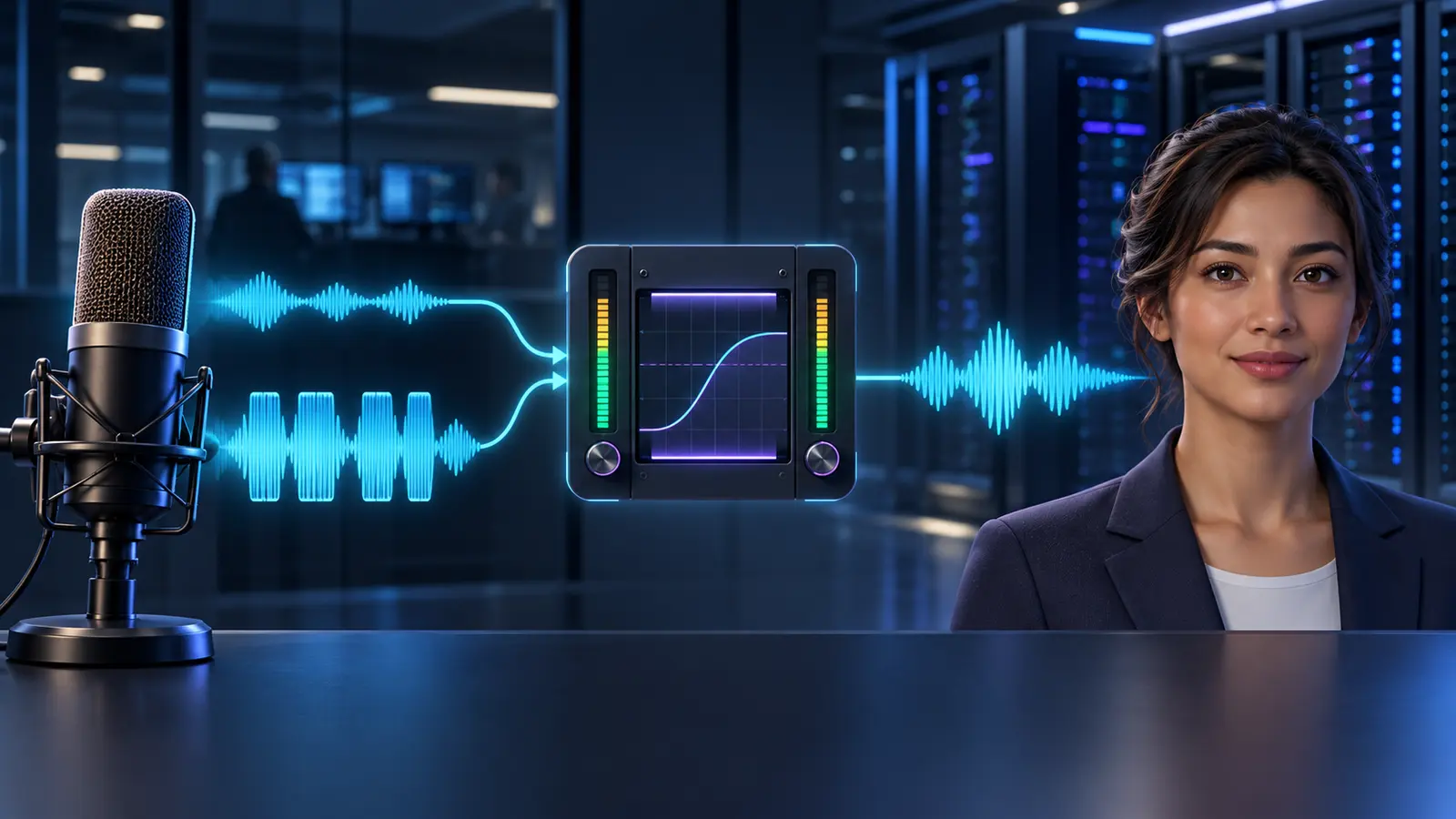
Microsoft Cut AI GPU Costs by 89%: What It Means for Private AI
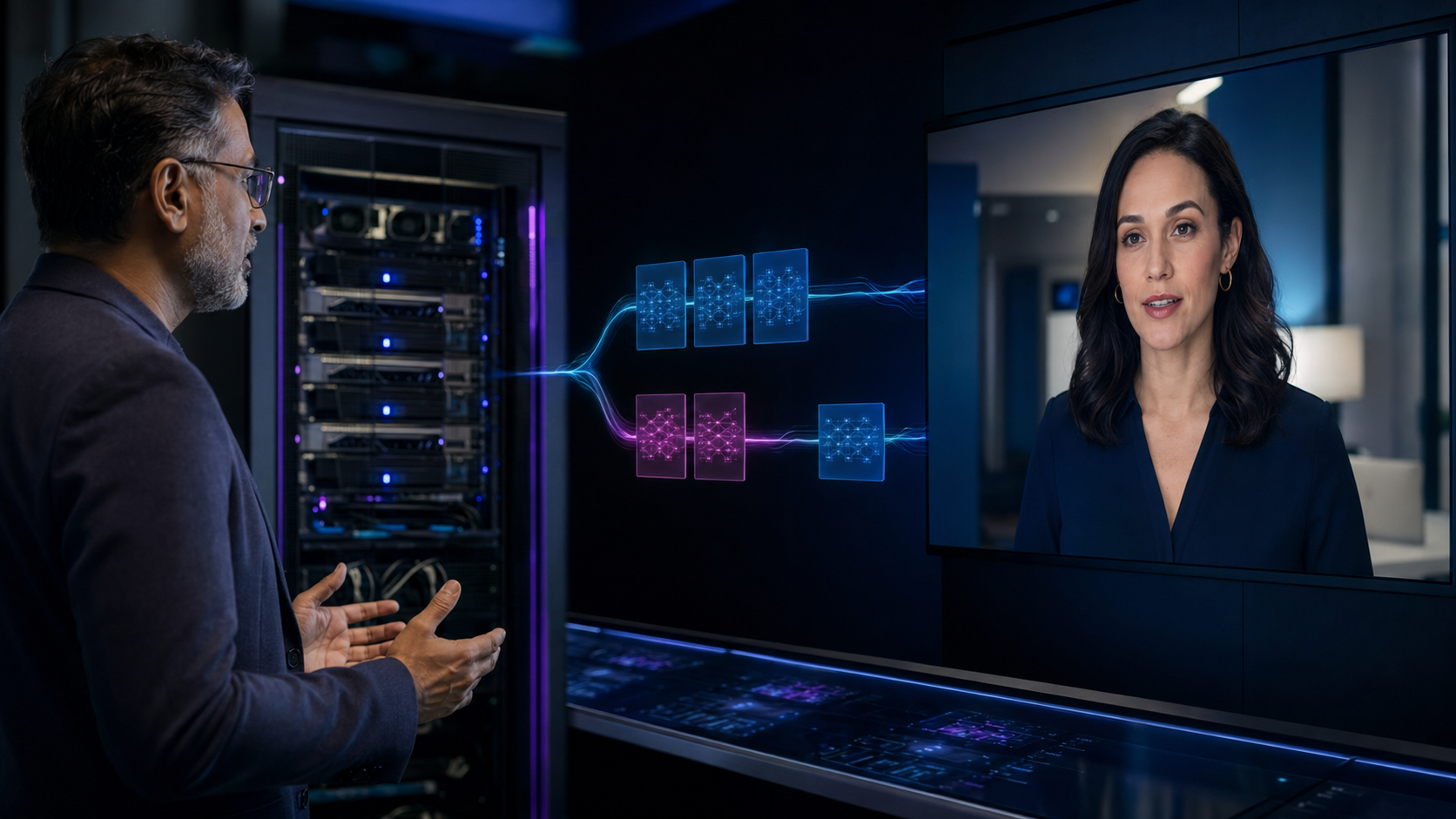
Microsoft says its new in-house AI models have reduced GPU costs by as much as 89% in a production contact-centre workload. The important lesson is bigger than Microsoft versus OpenAI: the economics of enterprise AI are moving from “use the biggest model available” to “use the right model for each part of the job”.
That shift matters enormously for real-time AI avatars. A useful video agent is not one model. It is a live system that may combine speech recognition, retrieval, reasoning, tool use, text-to-speech, facial animation, rendering, encoding and real-time media delivery. Sending every stage to the largest frontier model is rarely the fastest, cheapest or most controllable architecture.
For banks, governments and regulated enterprises considering private or on-premise AI, model efficiency is not a minor optimisation. It can determine how many conversations fit on each GPU, whether latency remains acceptable at peak demand and whether the business case survives beyond a pilot.
What Microsoft actually announced
On 23 July 2026, Microsoft introduced MAI-Image-2.5-Pro and MAI-Voice-2-Flash in public preview. The accompanying production figures are striking:
- MAI-Voice-2-Flash is described as twice as fast as MAI-Voice-2 and 32% cheaper, priced at $15 per one million characters.
- Microsoft says the voice model now powers Dynamics 365 Contact Center and has reduced GPU costs by up to 89% in that environment.
- MAI-Image-2.5 has become the default model across Bing Image Creator and selected PowerPoint and OneDrive experiences.
- Microsoft reports that PowerPoint reduced GPU costs by up to 84% compared with GPT-Image-2.
- For selected OneDrive image-editing scenarios, Microsoft reports a 26% increase in save rates, an approximate 25% reduction in P95 latency and 2.5 times greater efficiency under medium-utilisation workloads.
The headline was picked up by VentureBeat as an 89% cost reduction versus OpenAI. That is directionally useful, but the detail matters. These are Microsoft’s own measurements from particular production surfaces. They are not a promise that every organisation, workload or model substitution will achieve the same saving.
The 89% figure is not the most important part
A saving of up to 89% makes a magnificent headline. It also invites the wrong procurement question: “Which model is 89% cheaper?”
The better question is: what changed in the complete workload?
GPU cost can fall because a model requires less computation, produces output faster, batches requests more effectively, achieves higher utilisation or is better matched to a narrow task. Total service cost can still include engineering, hosting, networking, storage, monitoring, licences, idle capacity, failover and human support. A cheaper model that produces more failures or lower completion rates may cost more per successful outcome.
This is why Microsoft’s OneDrive figures are particularly interesting. They connect efficiency to latency and user behaviour rather than reporting infrastructure cost alone. Production AI should be judged by the experience it creates and the work it completes, not by the price of an isolated token or character.
A real-time AI avatar is a system of models
When a person speaks to an AI avatar, several operations may happen in a fraction of a second:
- The client captures audio and detects when the person has finished speaking.
- Speech recognition converts the request into text.
- Identity, permissions and conversation policy determine what the user may ask and receive.
- Retrieval finds relevant, approved enterprise information.
- A language model interprets the request and decides whether to answer, ask a question or call a tool.
- Text-to-speech generates an appropriate voice response.
- The avatar system animates, renders and encodes the speaker.
- A real-time transport layer delivers synchronised audio and video.
Each stage has a different quality, speed, security and cost requirement. A small specialist model may be excellent for turn detection, routing, content classification or pronunciation. A larger reasoning model may be justified for an unusually complex question. A deterministic workflow may be safer than any generative model for a regulated transaction.
The architecture should therefore select models by function and risk. “One enormous model for everything” is simple to explain in a demo, but it can become a very expensive way to detect that somebody has stopped talking.
The rise of model routing
Microsoft says its new models let builders choose a point on the quality, speed and cost curve. Enterprise architecture should extend that idea across the whole conversation.
A model-routing layer can evaluate the request, user permission, language, latency target and required capability before selecting an approved route. For example:
- A frequently asked policy question can use local retrieval and a smaller low-latency model.
- A sensitive customer request can remain entirely within a customer-controlled environment.
- A complex internal analysis can be sent to a more capable model after authentication and policy checks.
- A transaction can move into a deterministic workflow with explicit confirmation.
- A failure can trigger a safe fallback, clarification or human handover rather than a second, more expensive guess.
Routing is not simply a cost switch. It is a governance mechanism. It helps an organisation define which models may process which classes of data, in which locations, for which users and under which retention rules.
Why this matters more for on-premise AI
In a public API, inefficiency appears as a larger monthly bill. In an on-premise deployment, it appears as additional GPUs, power, cooling, rack space, support and failure reserve. The infrastructure makes the economics wonderfully difficult to hide.
A more efficient speech, language or rendering model can improve a private AI-avatar deployment in several ways:
- More concurrency per GPU: subject to validation on the complete workload, the same hardware may support more simultaneous conversations.
- Lower latency: a faster stage can shorten the delay between a person finishing a question and the avatar beginning its answer.
- Smaller infrastructure: a well-optimised system may need fewer or less expensive GPUs for the agreed service level.
- More resilience: saved capacity can be held as headroom for peaks, maintenance or node failure.
- Greater deployment flexibility: smaller components may fit sites or edge environments where a frontier-scale stack would be impractical.
None of these outcomes should be assumed from a model card. They must be measured with the target languages, avatars, integrations, client devices and network. Yepic’s GPU sizing framework for real-time AI avatars explains how to define a representative workload and test concurrency against latency, frame-rate and failure thresholds.
Private AI is not the same as building every model yourself
Microsoft’s move towards in-house models is strategically rational because Microsoft operates at extraordinary scale. Most banks, governments and enterprises do not need to train their own foundation models to gain more control.
Private AI can combine:
- customer-owned or customer-controlled GPU infrastructure;
- commercially licensed, open-weight or internally developed models;
- private-cloud services within an agreed data boundary;
- specialist speech, retrieval, policy and rendering components;
- approved external services for workloads where the risk and value justify them.
The important capability is substitution. An organisation should know which component performs each function, what data it receives and whether it can be replaced without rebuilding the whole user experience. Microsoft replacing third-party models within major product surfaces is a vivid demonstration of the commercial value of that modularity.
For a practical comparison of customer-hosted, private-cloud and public-cloud patterns, read On-Premise vs Private Cloud vs Public Cloud AI Avatars.
What Microsoft’s announcement does not prove
The new MAI models are available through Microsoft’s ecosystem, including Microsoft Foundry and Azure Voice Live. Microsoft’s announcement should not be read as evidence that these particular models can be downloaded and run on any customer’s own GPU, that they support every required language or that their reported savings will transfer to an unrelated avatar workload.
It also does not prove that private deployment is always cheaper. A low-volume service may be more economical in the public cloud because it can share infrastructure and scale to zero. Customer-hosted infrastructure becomes more compelling when control, residency, predictable utilisation, restricted connectivity or integration with local systems matters enough to justify the operating responsibility.
For highly restricted environments, every runtime dependency must be examined separately. Yepic’s air-gapped AI-avatar design guide covers local model assets, registries, licences, monitoring and secure updates. Installing a renderer locally while speech or authentication still calls the public internet is not an air-gapped service. It is a cloud service wearing an on-premise hat.
Measure cost per successful conversation
Token prices are easy to compare and surprisingly easy to misuse. The commercial measure should connect infrastructure to the outcome the avatar is expected to deliver.
A useful calculation is:
Total service cost ÷ successful, policy-compliant conversations at the required experience level
The numerator should include compute, hosting, licences, storage, network, monitoring, support and an appropriate share of implementation and maintenance. The denominator should exclude conversations that failed authentication, exceeded latency limits, produced an unsafe response, lost audio, froze on screen or required the user to start again.
Architecture teams should then track the stages that influence that result:
- time to first audio;
- P50, P95 and P99 latency by pipeline stage;
- GPU utilisation, memory pressure and queue depth;
- session completion and fallback rates;
- retrieval quality and grounded-answer rate;
- policy refusals, safety interventions and human handovers;
- cost by language, channel and interaction type.
Optimisation can then target the real bottleneck. Replacing the language model will not fix an overloaded video encoder. Buying a bigger GPU will not fix a corporate firewall interrupting WebRTC.
A procurement checklist for efficient private avatars
Microsoft’s announcement gives enterprise buyers a useful set of questions to ask any AI-avatar supplier:
- Which components run on the customer’s infrastructure, and which still require external services?
- Can speech, language and rendering models be selected or replaced independently?
- What representative workload was used to calculate concurrency and cost?
- Are savings measured per request, per minute or per successfully completed conversation?
- How do P95 latency and failure rates change under peak load?
- Which data reaches each model, and where is that model hosted?
- What happens when the preferred model, GPU node or network path fails?
- Can the system route low-risk tasks to efficient models and reserve larger models for complex work?
- How are model, prompt, knowledge and policy versions logged?
- What evidence is required before a new model replaces an existing one in production?
For banking environments, the Yepic private-GPU reference architecture places those model decisions within identity, data, network, observability and governance boundaries.
Where Yepic fits
Yepic has spent years building proprietary talking-photo and real-time avatar technology, optimising inference for commercial GPUs and integrating multilingual avatar experiences with enterprise systems. Banks, governments and regulated organisations can explore customer-hosted and sovereign implementations on their own infrastructure, subject to a properly scoped custom deployment.
The goal is not to force one model, one cloud or one answer onto every customer. It is to design the avatar as a modular interaction layer around the organisation’s approved models, knowledge, permissions and infrastructure.
That approach is informed by real integration work. For Abu Dhabi Aviation, Yepic connected a real-time avatar experience to Oracle-backed enterprise data and delivered separate development and production environments, role-aware information access, interactive visualisation, narration and extensive browser, network and WebRTC testing. Read the Abu Dhabi Aviation and Oracle case study.
It should not be presented as proof that every Yepic deployment is already on-premise or that any model can be made local without engineering. It is evidence that the avatar must be treated as part of a wider enterprise architecture rather than a decorative face placed over a chatbot.
The real AI race is moving into production economics
Frontier-model capability will continue to advance. But once AI enters millions of daily interactions, the winning architecture may be the one that knows when frontier capability is unnecessary.
Microsoft’s reported savings show what can happen when a company controls the product surface, measures the real workload and builds models for specific production needs. The lesson for enterprises is not that they should all become model laboratories. It is that they should stop treating model choice as permanent.
Build for substitution. Route by risk and complexity. Test the complete experience. Measure the cost of a successful conversation. Keep sensitive workloads inside the boundary that matches their risk.
For private AI avatars, that is how lower cost, lower latency and greater control become part of the same architecture rather than three competing promises.