Noise Suppression for Voice AI: Protect Speech, Not Silence
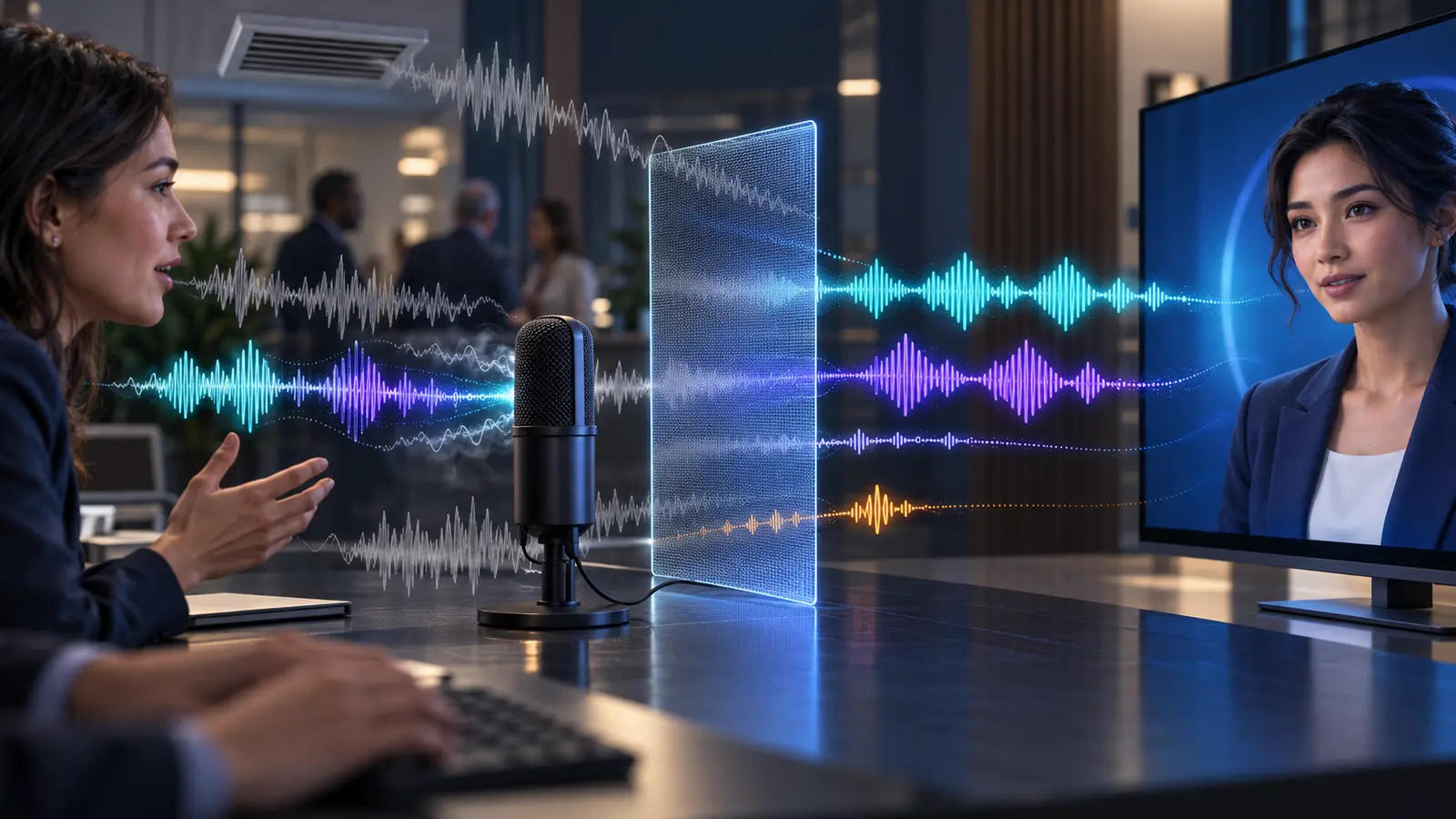
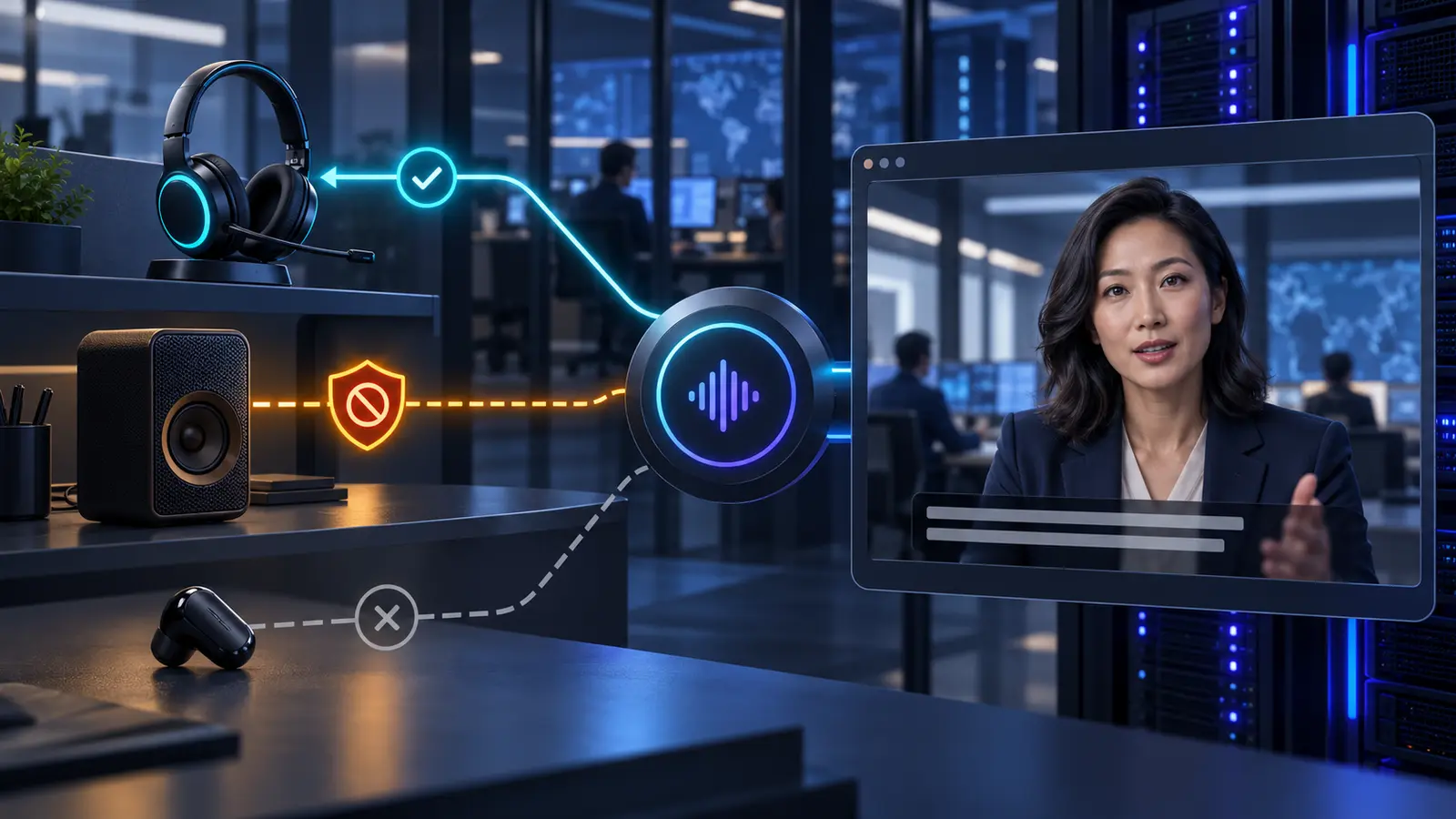
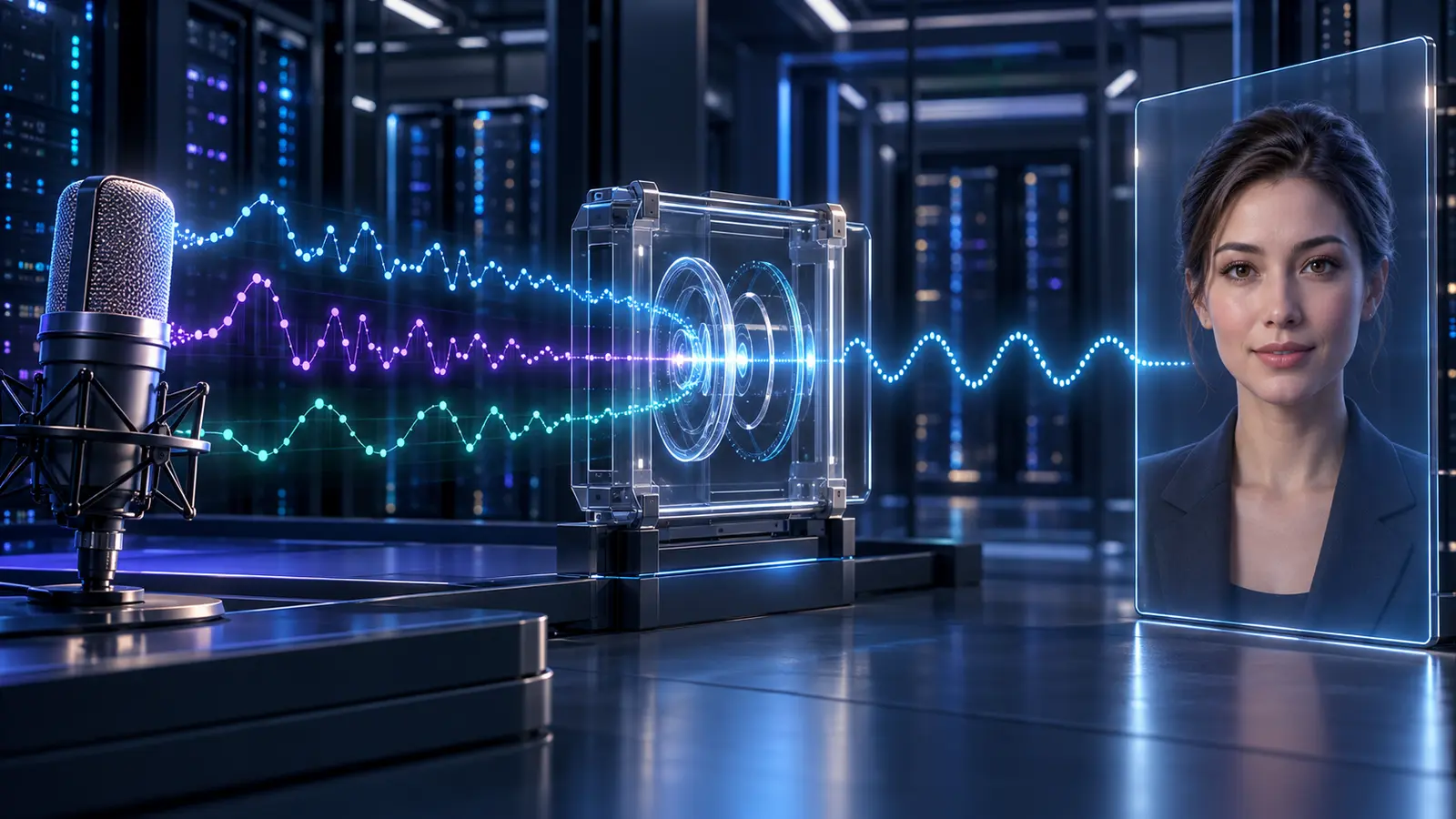
Noise suppression for voice AI should protect useful speech, not pursue silence. Give one processing layer primary responsibility, record what every other layer does, and accept the design on downstream recognition and task outcomes. A waveform that sounds cleaner can still lose quiet syllables, names, numbers or atypical speech.
That distinction matters in a bank branch, citizen-service kiosk, transport operation or healthcare setting. Ventilation, keyboards and distant conversation can trigger false speech, obscure a request and slow turn-taking. But an aggressive suppressor can cause the opposite failure: it classifies part of the person as noise.
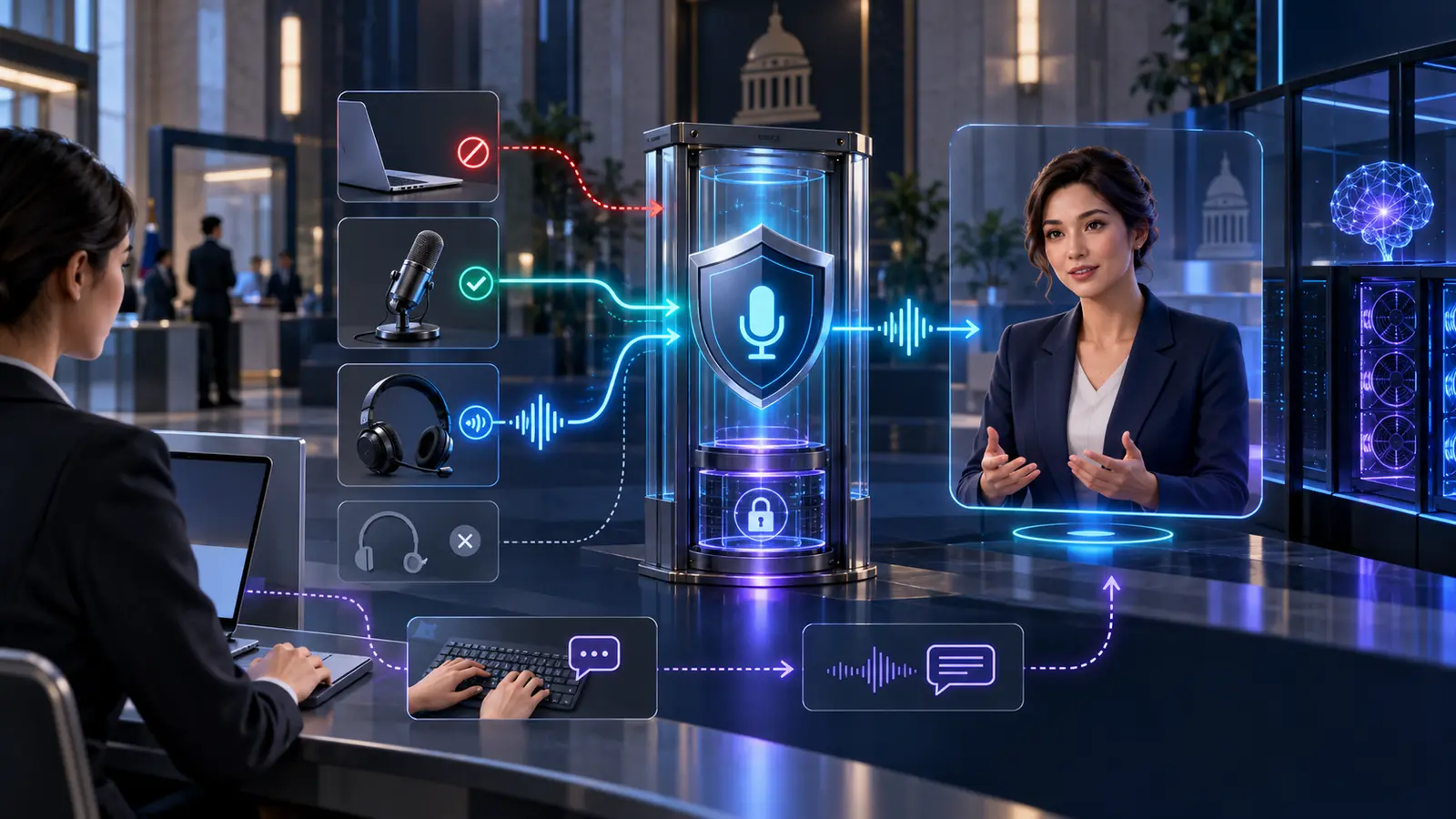
The correct deliverable is therefore a suppression contract covering the endpoint, processing owner, approved environments, people the service must understand, safety sounds it must preserve, measurable acceptance thresholds and fallback behaviour. “Noise cancellation enabled” is not an architecture or an acceptance result.
Separate noise suppression from four neighbouring controls
Audio controls are often grouped under one checkbox even though they solve different problems.
- Noise suppression attenuates unwanted sound such as steady ventilation, keyboard impacts or background activity while trying to retain speech.
- Acoustic echo cancellation removes the avatar’s own loudspeaker output from microphone capture. It normally needs a matched playback reference. Yepic’s guide to acoustic echo cancellation for voice AI explains why suppression cannot replace that reference.
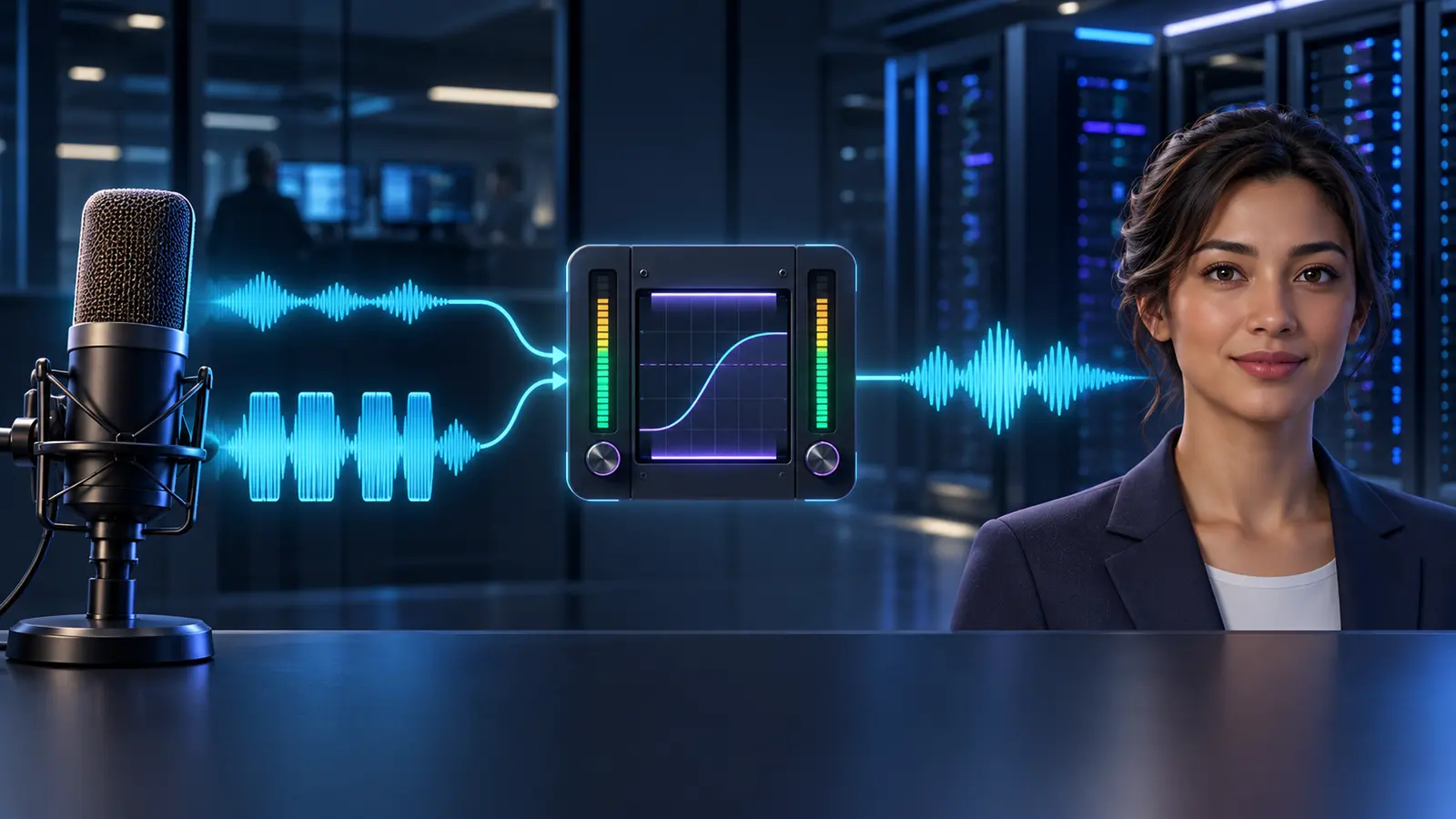
- Automatic gain control adjusts level. It can raise quiet speech, but may also raise residual noise or processing artefacts.
- Beamforming or source separation uses spatial or learned evidence to favour one source. It is useful for arrays and competing speakers, but is not equivalent to removing stationary noise.
- Voice-activity detection decides whether speech is present. It consumes the processed signal and therefore inherits suppression mistakes.
The WebRTC Audio Processing Module, for example, describes echo cancellation, noise suppression and gain control as distinct microphone-processing functions. They may be packaged together, but they still require separate ownership and tests.
Map every place that can alter the microphone signal
A real-time avatar may receive audio that has already been processed several times. Review the chain in order:
- Device or headset DSP: microphone arrays, conferencing hardware and headsets may apply fixed or adaptive processing before the operating system receives audio.
- Operating system or browser: a voice-processing path may combine suppression, echo cancellation, gain and channel conversion.
- Application or edge component: a native client, kiosk application or local service can run a known enhancement model close to capture.
- Private or central service: audio may be enhanced on a server or customer GPU before speech recognition.
- Speech recogniser: the ASR model itself has a particular tolerance to noise, reverberation, accents and devices.
Name one primary suppression owner for each supported endpoint class. Then document unavoidable processing before and after it. Two opaque suppressors can pump the level, smear consonants and make failures hard to diagnose. If an upstream layer cannot be disabled, qualify the combined path rather than pretending the application owns the raw microphone.
A browser request is not proof of an acoustic result
A web application can request the noiseSuppression media constraint. The current W3C Media Capture and Streams specification also exposes capabilities and effective track settings. That is useful control-plane evidence: the application can record what it requested and what setting the browser reports.
It is not evidence that a person will be recognised. The specification describes settings as current target values and notes that processing can alter captured media. Browser, operating-system, device and route implementations still vary. Treat the effective setting as configuration metadata, then test the audio and the conversation produced.
Do not make suppression strength a single global number
More aggressive processing can reduce more noise at the cost of more speech distortion. That trade-off changes with the noise, microphone, speaker and recogniser. One preset should not be assumed to fit a quiet headset, a reflective kiosk and an open-plan branch.
Classify the environments the service must handle:
- Stationary noise: fans, HVAC and electrical hum may be relatively predictable.
- Impulsive noise: keyboards, doors, handling noise and desk impacts can resemble speech onsets.
- Competing speech: a nearby colleague or queue is intelligible human speech, not simple broadband noise.
- Reverberation: reflected copies of the user’s voice may blur phonemes and endpoint timing.
- Operational signals: alarms, announcements and staff instructions may be essential context rather than noise.
- Device faults: clipping, intermittent connections and codec artefacts require route or hardware remediation, not a stronger suppressor.
Include people as deliberately as rooms. Quiet voices, accented speech, code-switching, dysarthric or otherwise atypical speech, older voices and speech through assistive devices can present acoustic patterns that a model has seen less often. A suppressor that removes low-energy consonants or unusual prosody may create a systematic access barrier.
This is why a recent medical-ASR study, When De-noising Hurts, is a useful warning rather than a universal benchmark. In that paper’s tested medical recordings, systems and noise conditions, preprocessing degraded semantic word error rate across all tested configurations. The result does not prove that denoising always harms recognition. It proves that “cleaner” input cannot be assumed to improve the recogniser selected for a service.
Protect turn-taking as well as transcription
Suppression changes the signal that voice-activity detection and endpointing see. It can shorten the apparent beginning or end of a quiet utterance, create choppy speech segments or let an impulsive sound trigger a false turn. The result can be a delayed avatar, an unwanted interruption or a request split before a critical number is complete.
Measure the full chain: speech start, recognised content, end-of-turn decision and downstream action. Yepic’s streaming speech-recognition commit policy separates provisional recognition from committed input. Noise processing belongs upstream of that policy, but its errors can still affect every later decision.
Double-talk deserves its own case. When the avatar is speaking and the person interrupts, echo cancellation should remove the playback reference while suppression preserves the near-end voice. A half-duplex mute may avoid self-transcription, but it also prevents genuine barge-in. Test the controls together.
Keep essential sounds out of the waste bin
In public and regulated environments, some non-speech audio has operational meaning. A fire alarm, boarding announcement, accessibility signal or staff instruction should not be silently erased merely because the recogniser is listening for one user.
The safer design may use physical microphone placement, directional arrays, separate alarm feeds or application policy rather than asking one enhancement model to infer every context. Define whether the avatar should pause, display a message, hand over or continue when an approved signal occurs. The suppression layer should not become an unreviewed safety decision-maker.
Observe performance without retaining every conversation
Teams need enough telemetry to diagnose a failing audio path, but that does not require unlimited storage of raw audio or transcripts. Subject to the service’s data policy, a privacy-minimised record can include:
- endpoint, browser, operating-system and audio-route class;
- requested and effective suppression, echo and gain settings;
- primary processing owner, mode and software or model version;
- input and output level distributions, clipped-sample counts and available noise estimates;
- speech-start, endpoint and false-activation events;
- added processing latency, CPU or GPU utilisation and fallback events;
- aggregate recognition, critical-entity and task outcomes from a governed test set; and
- configuration changes and the acceptance suite rerun after each change.
Raw recordings can be valuable for controlled investigation, but they need a defined purpose, access control, retention period and deletion path. Derived acoustic features may also be sensitive. Decide this before production, not after the first incident.
Write a twelve-field noise-suppression contract
A design or procurement review should be able to fill in these fields for every supported endpoint family:
- device, microphone, speaker and physical geometry;
- operating system, browser or native application and approved versions;
- complete order of capture processing stages;
- primary suppression owner, mode and available controls;
- expected noise, reverberation and competing-speaker classes;
- languages, accents, speaking styles and accessibility profiles to preserve;
- operational sounds that must remain detectable;
- capture format, channel layout and transformations;
- latency, CPU, GPU and capacity budgets;
- recognition, critical-entity, turn and task acceptance measures;
- fallback when the preferred processing path is unavailable; and
- telemetry, retention, change control and retest triggers.
Run ten acceptance tests on the actual service
- Raw baseline: compare unprocessed capture, the approved path and any vendor default using identical recordings.
- Stationary noise: vary fan or HVAC level and user distance.
- Impulsive noise: add keyboards, doors and handling noise at realistic timings.
- Competing speech: vary angle, distance, language and relative level.
- Reverberation: qualify reflective spaces and changes in furniture or crowding.
- Speech diversity: test quiet, accented, multilingual, code-switched and atypical speech with consented evaluators or representative licensed data.
- Critical information: measure names, amounts, dates, addresses and reference numbers, not only average word error rate.
- Double-talk: interrupt avatar playback at different volumes and points in the turn.
- Processing conflict: enable unavoidable device, browser and application stages in every supported combination.
- Load and recovery: test processing latency, resource pressure, reconnect, route change, component failure and the approved fallback.
Listen to failures, but do not accept by listening alone. Report distributions for recognition delay, false speech starts, missed starts, critical-entity accuracy, task completion, correction rate and processing cost. Break results down by endpoint, environment, language and relevant speaker profile.
Place processing according to risk, latency and control
Cloud, private-cloud, customer-hosted and hybrid deployments can all support effective noise processing. None is automatically correct.
Customer-hosted enhancement can keep an application-managed model and selected audio inside the customer environment, subject to a properly scoped implementation. It can also transfer GPU capacity, packaging, patching, model licensing, monitoring and rollback work to the customer and delivery team. It does not control hidden device DSP or make every browser behave identically.
Endpoint processing has direct access to capture and can avoid a network round trip, but offers less central consistency. Server processing can provide a controlled version and richer metrics, but receives only the signal the endpoint sends and adds transport and compute latency. A hybrid architecture may leave echo and immediate capture processing at the edge while placing governed enhancement or recognition inside a private environment.
Yepic’s Abu Dhabi Aviation and Oracle enterprise avatar integration included microphone behaviour, captions, WebRTC, browser, mobile and corporate-network testing across development and production environments. That is relevant evidence for treating capture as part of the whole enterprise service. It is not a claim that the project was a customer-hosted noise-suppression deployment.
Start with a governed noisy corpus
Before selecting an algorithm or promising a suppression level, record or assemble a consented test corpus from the actual endpoints, rooms, languages and speaking conditions. Preserve a raw reference. Compare each candidate path against the recogniser and workflows that will be used in production, then make the accepted configuration a versioned service component.
The objective is not silence. It is a stable conversational input that preserves the people, words and operational context the service exists to understand. Yepic can scope real-time avatar architectures across cloud, private-cloud and customer-hosted environments, including the audio path, acceptance evidence and operating boundary required for a regulated deployment.