Sovereign AI Avatars for Government: A Citizen-Service Design Framework
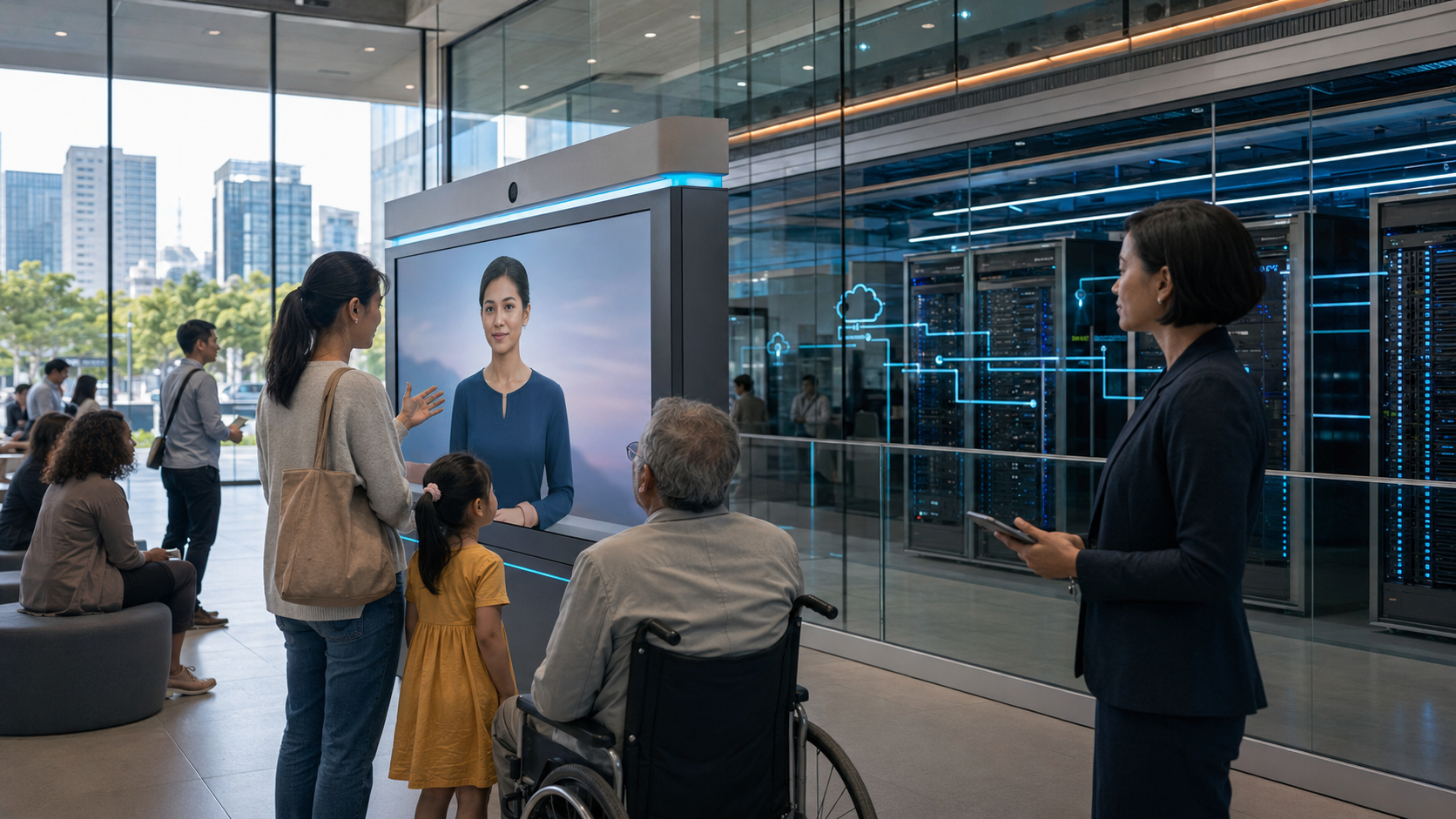
A sovereign AI avatar for government is not simply a digital person hosted inside national borders. It is a citizen-facing service whose data, infrastructure, models, operational access, language behaviour and public accountability remain under explicitly chosen authority.
That distinction matters. A government can keep a database in-country while sending every spoken question to an external speech service. It can run an open model on national GPUs while relying on a foreign control plane for updates. It can retain technical control while deploying an avatar that handles local language, culture or public-service obligations badly.
Sovereignty therefore needs to be designed across the complete interaction. This framework helps digital-transformation, security, architecture and service teams decide what must remain under national or agency control, what can be externally managed and where an avatar should stop and a public servant should take over.
What is a sovereign AI avatar?
NVIDIA describes sovereign AI as a nation’s capability to produce AI using its own infrastructure, data, workforce and business networks. For an AI avatar, that principle extends beyond the language model. A live conversation may involve:
- microphone, camera, text and accessibility inputs;
- speech recognition and language detection;
- retrieval from approved government information;
- a language model and conversation policy;
- text-to-speech and avatar rendering;
- identity, case-management or appointment systems;
- real-time media transport; and
- monitoring, audit, updates and incident response.
A credible sovereignty claim maps every component, runtime call, administrator and data store. “Hosted locally” is useful information, but it is not the whole answer.
Start with the service, not the infrastructure
Not every citizen interaction needs the same boundary. Before choosing hardware or models, place the proposed service on a consequence ladder.
Level 1: public information
The avatar explains published information such as opening hours, required documents, event schedules or general eligibility rules. It does not identify the citizen or access a personal record. This may be suitable for a managed or hybrid deployment if prompts, retention and external dependencies are acceptable.
Level 2: contextual guidance
The service adapts information using non-sensitive context such as preferred language, region or broad service need. The risk is higher because a confident but incorrect answer can still waste time or exclude someone. Retrieval should be restricted to approved, versioned sources, with clear links or escalation routes.
Level 3: authenticated case support
The avatar accesses personal status, explains correspondence or helps complete a process after identity verification. Personal data, permissions, session isolation and auditability now become central. The conversation layer should receive only the fields required for the current task.
Level 4: decisions or transactions
The service changes a record, submits an application, influences entitlement or communicates a decision. At this level, the avatar must not become an ungoverned decision-maker. Existing authorisation, confirmation, review and appeal processes should remain authoritative. Meaningful human control belongs at the point where consequences become difficult to reverse.
This classification prevents a common error: applying one “government AI” architecture to both an anonymous information kiosk and an authenticated benefits journey.
The six layers of sovereignty
1. Data sovereignty
Define where raw audio, camera frames, transcripts, retrieved passages, personal identifiers, generated responses and operational logs are processed and retained. Treat them as separate data classes. A policy for transcripts does not automatically cover voice recordings or model prompts.
For every class, record its purpose, location, retention, encryption, authorised roles and deletion process. Avoid retaining conversation content merely because it helps with debugging; operational telemetry can often be separated from citizen content.
2. Infrastructure sovereignty
Decide which services run on agency-owned GPUs, national infrastructure, a sovereign cloud, a private cloud or a public service. Customer-hosted inference can provide direct control, but it also transfers responsibility for capacity, drivers, patching, resilience and hardware lifecycle.
A sovereign cloud may offer an appropriate balance where dedicated jurisdictional and administrative controls matter more than physical ownership. Public cloud may remain proportionate for anonymous, low-consequence information. The right boundary follows the workload.
3. Model sovereignty
List the models used for speech recognition, retrieval, language generation, voice and visual rendering. Establish who owns or licenses the weights, who can update them, whether runtime calls leave the environment and what evidence supports language performance.
Open weights can improve control, but an open licence does not create a secure operating model. Proprietary components can also run privately when licensing and deployment terms permit. The useful question is whether the government can govern the model’s use, version, access and replacement.
4. Operational sovereignty
A service is dependent on whoever can administer it. Document supplier access, privileged support, update routes, signing and approval of artefacts, key custody, monitoring, rollback and disaster recovery. Test what happens when external connectivity or a vendor service is unavailable.
Operational independence does not require rejecting every international supplier. It requires understanding dependencies, preserving an acceptable continuity path and avoiding hidden runtime reliance.
5. Governance sovereignty
The public body must retain authority over what the avatar may say and do. That means approved knowledge, action policies, escalation thresholds, evaluation criteria, incident ownership and public redress cannot be left to a model provider’s defaults.
The UK Government AI Playbook is a useful reference beyond the UK. It calls for lawful and responsible use, secure deployment, meaningful human control, full-lifecycle management, transparency and appropriate assurance. A sovereign architecture should make those responsibilities easier to exercise, not merely change the hosting location.
6. Linguistic and cultural sovereignty
Citizen services operate in real languages, dialects and social contexts. Measure recognition, pronunciation, formality, code-switching, names, place names and policy terminology with representative users. Do not translate an English evaluation set and assume equivalent performance.
Language choice can also reveal sensitive context. Set clear rules for whether language preferences are stored, and offer text, captions and human assistance when speech interaction is unsuitable.
A reference architecture for citizen-facing avatars
A practical design separates experience from authority:
- Citizen channel: kiosk, web, mobile or contact-centre interface with clear AI disclosure, microphone controls, captions and text alternatives.
- Session gateway: creates an isolated session, applies network policy and connects to identity only when the workflow requires it.
- Speech and language services: convert speech, detect language and return audio under the chosen deployment boundary.
- Knowledge and orchestration: retrieves only approved information, applies conversation rules and records source versions.
- Action gateway: exposes narrow, authorised functions rather than broad access to government databases.
- Avatar rendering: generates the responsive visual person on appropriately sized customer-controlled or dedicated GPUs when policy requires it.
- Safety and handoff: detects unsupported requests, communicates limits and transfers the citizen with useful context and consent.
- Operations: monitors service health, latency and capacity separately from sensitive conversation content.
Every connection should have an owner, authentication method, allowed data, timeout, failure behaviour and audit policy. Running all components in one network segment is not a substitute for service identities and least privilege.
Design for public trust at the interface
A face can make a service easier to approach, but it can also make generated information feel more authoritative. Government deployments should clearly identify the avatar as AI and state what it can do. The visual identity should not imply that a real official personally reviewed every response.
Give citizens a way to:
- repeat, slow down or read the answer;
- see the source or effective date of important guidance;
- correct misunderstood speech;
- decline camera or microphone use;
- switch language or interaction mode;
- reach a person without starting again; and
- challenge or correct an outcome through the normal public-service route.
These controls are part of service quality, not merely compliance. They reduce the cost of inevitable uncertainty in speech and generative systems.
How to test before public release
Public-sector AI needs continuous assurance rather than a single acceptance test. The UK cross-government testing framework recommends context-appropriate tests and ongoing monitoring across fairness, explainability, robustness, autonomy and system evolution.
For a sovereign AI avatar, build an evaluation set that covers:
- approved and deliberately unanswerable questions;
- regional accents, dialects, background noise and code-switching;
- prompt injection and requests for restricted information;
- outdated, contradictory or missing source material;
- identity and permission failures;
- network loss, GPU saturation and unavailable dependencies;
- handoff, complaints and accessibility journeys; and
- model, knowledge and configuration changes after launch.
Record not only whether the final answer was correct, but whether the system used an authorised source, stayed within its role and failed safely.
What Yepic’s government work demonstrates
For Oman’s first digital-only Shura Council election, Yepic worked with the Ministry of Interior to turn structured election data into more than 10,000 presenter-led videos in one day. The Oman digital-election case study demonstrates national-scale, time-sensitive and multilingual public communication. It also shows why the trusted-data pipeline matters as much as the presenter.
At Microsoft’s COMEX Oman stand, Yepic’s live avatar Omar answered unscripted questions and could work across more than 115 languages, including Arabic dialects. The Microsoft COMEX avatar was an event deployment, not a sovereign citizen-service system. It is useful evidence of real-time multilingual interaction in a public setting.
Together, these projects support a credible direction: combine Yepic’s proprietary talking-photo, AI-video and real-time avatar technology with customer-selected speech, language, knowledge and infrastructure components. Private, on-premise and sovereign deployments are custom implementations. They must be scoped against the agency’s GPUs, network, language requirements, risk classification and operating model.
For deployment trade-offs, see on-premise versus private-cloud versus public-cloud AI avatars. Teams designing kiosks and visitor-facing services should also use the practical guide to real-time AI avatars in public spaces. For the delivery lessons behind national multilingual communication, read how Yepic produced 10,000 election videos in one day.
Twelve questions for a government RFP
- Which citizen services and consequences are in scope?
- Where does every component run during a live interaction?
- Which data classes cross organisational or national boundaries?
- Which models and licences permit the required deployment?
- Who can administer, update and support each component?
- How are approved knowledge, effective dates and source permissions enforced?
- Which actions require identity, confirmation or human approval?
- How are dialects, accessibility needs and representative users tested?
- What is retained, for how long and for what operational purpose?
- How does the service fail when a model, GPU, network or integration is unavailable?
- What evidence is produced for continuous assurance and public accountability?
- How can the government replace a model or supplier without losing its service?
Sovereignty is the ability to govern the whole service
A sovereign AI avatar is not defined by where its face is rendered. It is defined by whether the responsible public body can understand, control, operate, test and change the complete citizen interaction.
Begin with one bounded service, classify its consequences and draw the full data and authority map. Decide which sovereignty layers genuinely matter for that workload. Then select infrastructure and suppliers that preserve those decisions.
The goal is not technological isolation. It is public-service autonomy with clear accountability.