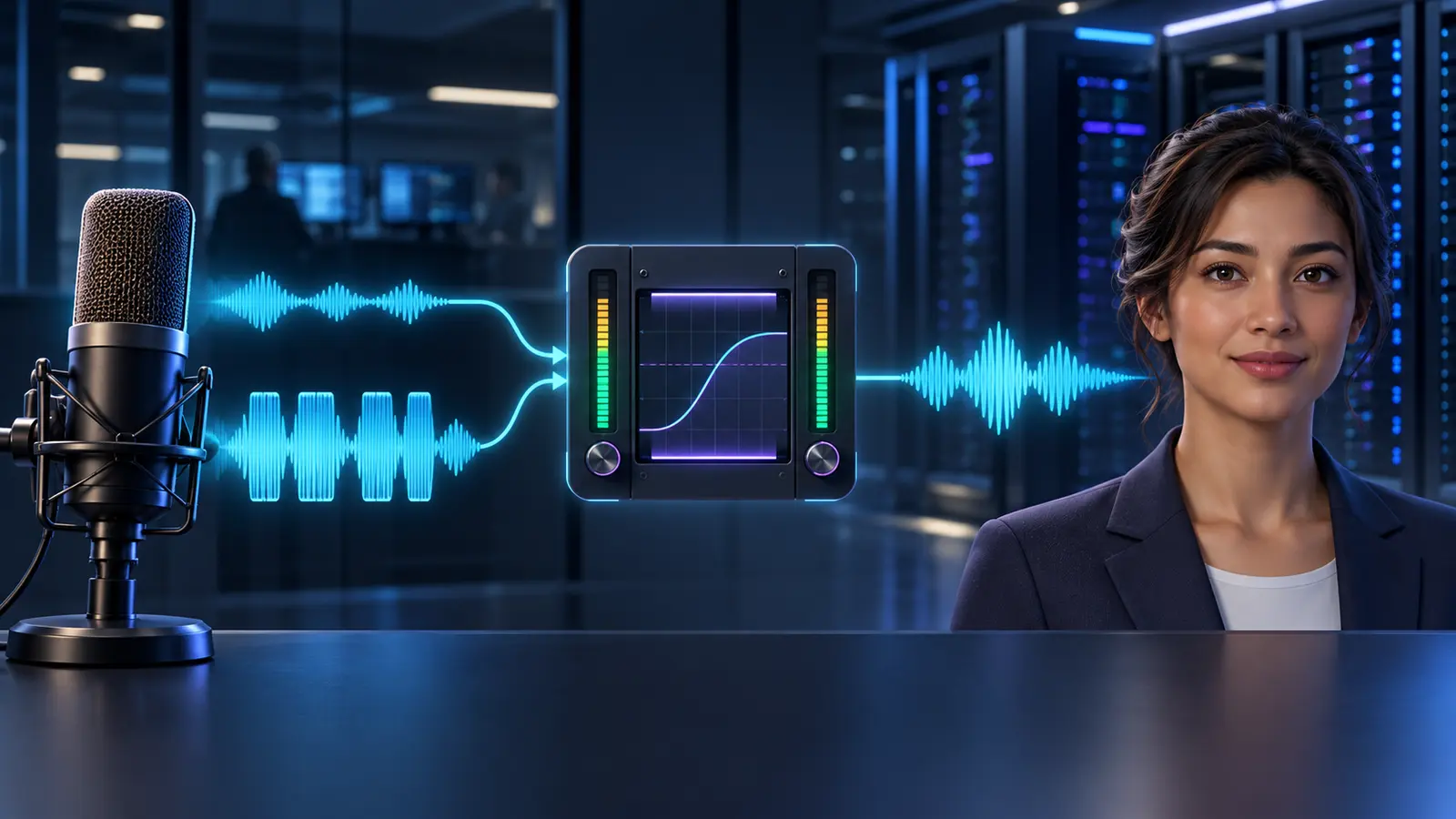
Arabic AI Avatars On-Premise: An Enterprise Evaluation Guide

“Supports Arabic” is not a sufficient requirement for a real-time AI avatar. A bank, government department or regulated enterprise should specify the people, dialects, tasks and environments the service must handle, then test the complete spoken journey on the proposed deployment.
Arabic readiness spans far more than text translation. It includes speech recognition, dialect and code-switching, names and numbers, knowledge retrieval, response register, voice, lip movement, captions, right-to-left presentation and the latency introduced by every component. For customer-hosted systems, it must also be clear which of those components can actually run inside the customer boundary.
This guide gives technical and procurement teams a practical way to evaluate Arabic and multilingual AI avatars without relying on a language-count headline.
Define the Arabic service you actually need
Arabic is used across countries, dialects, professional settings and levels of formality. Modern Standard Arabic may suit official prepared communication. A live citizen-service or banking conversation may include regional speech, English product terms, names from several language traditions and numbers expressed differently from the format stored in a database.
Begin with a language-service profile for each journey:
- countries and regions served;
- expected dialects and accents;
- Modern Standard Arabic, dialectal Arabic or both;
- likely Arabic-English code-switching;
- formal, conversational or sector-specific register;
- critical names, organisations, products and abbreviations;
- dates, currencies, account references and other structured values;
- audio conditions, devices and background noise;
- required written scripts, captions and interface direction;
- the fallback when the system is uncertain.
A single deployment may need several profiles. An authenticated wealth-management assistant in the UAE, a government information kiosk in Oman and an internal interview coach in Saudi Arabia should not share an acceptance test merely because all three use Arabic.
Evaluate the whole conversational pipeline
A spoken avatar is a chain. Weakness at any stage can be misdiagnosed as “the Arabic model is poor”. Architecture teams should measure each stage separately and then test the complete interaction.
1. Audio capture and turn detection
Microphone position, echo, room acoustics and background conversation affect every language. In public spaces, the system also needs to decide when the user has finished speaking. If turn detection interrupts natural pauses or waits too long, even accurate recognition will feel broken.
Test the actual kiosk, browser, headset or mobile device. Include the network and WebRTC path rather than uploading clean studio files to an isolated model.
2. Speech recognition
Measure more than overall word error rate. Check whether the recogniser preserves the information the service needs:
- person and organisation names;
- Arabic and Latin product names;
- numbers, dates, currencies and reference codes;
- regional vocabulary;
- words spoken in English inside an Arabic sentence;
- punctuation and sentence boundaries used by downstream systems.
Research on dialectal and code-switched Arabic speech recognition treats Modern Standard Arabic, regional dialects and Arabic-English or Arabic-French switching as distinct evaluation conditions. The more recent Casablanca multidialectal speech project covers eight dialects and annotates code-switching, reflecting how important representative data is to useful evaluation.
A model name or generic Arabic locale does not establish fitness for a specific population. For example, current NVIDIA Riva documentation lists Arabic within its speech-recognition model support. Current Microsoft Speech documentation lists numerous country-specific Arabic locales across cloud capabilities. Those lists describe different products and deployment models; neither replaces a test using the intended dialect, hardware and service journey.
3. Language detection and routing
Automatic language identification can be useful, but it can also add delay or route a short utterance incorrectly. A user-selected language or profile attribute may be more reliable for some journeys. Other services may need turn-by-turn switching.
Decide whether the session has one primary language, allows code-switching within a turn or supports deliberate language changes. Record the routing decision in privacy-safe telemetry so recognition failures can be traced without routinely exporting conversation content.
4. Knowledge retrieval
Arabic questions must retrieve the right approved evidence. This is not guaranteed when the source material is mainly English.
Test at least four patterns:
- Arabic question against Arabic source material;
- Arabic question against English source material;
- code-switched question containing names or product terms;
- Arabic and English versions of the same question against permission-controlled sources.
Normalisation needs care. Diacritics, letter forms, spacing and transliterated names can affect search, but an aggressive transformation can also merge terms that should remain distinct. Preserve the original query alongside any normalised form and test retrieval on the organisation’s real vocabulary.
5. Response generation
A grammatically valid answer can still be wrong for the audience. Define whether the avatar should use Modern Standard Arabic, a regional conversational style or a controlled mix. Set rules for formality, gendered language, titles, public-sector terminology and how untranslated product or legal terms should appear.
Native Arabic authoring and translation are different workflows. For stable regulated content, an approved Arabic source may be preferable to translating an English answer on every turn. For open conversation, the system may generate directly in Arabic but still needs grounded evidence and policy controls.
6. Voice and pronunciation
Evaluate text-to-speech with local listeners from the target audience. Ask them to rate:
- dialect and accent fit;
- pronunciation of names and sector terms;
- numbers, dates, currency and mixed-script phrases;
- pace, pauses and emphasis;
- authority, warmth and appropriateness for the service;
- consistency during long and short responses.
A voice may sound attractive in a prepared sample but struggle with live generated text. Maintain a pronunciation test set and a governed mechanism for terms that need custom treatment. If a cloned voice is used, consent, permitted use and language coverage must be explicit.
7. Avatar rendering and conversational timing
The renderer must follow Arabic speech without adding unacceptable delay. Test lip movement, interruptions, listening behaviour and the transition between languages. Longer response generation or speech synthesis can make the visual system appear unresponsive even when each component passes in isolation.
Measure time to first audio, time to first frame and turn latency by language and scenario. Yepic’s GPU capacity-planning guide explains why language, voice and model choice belong in the production workload rather than being treated as cosmetic settings.
8. Captions and right-to-left presentation
Arabic captions are not simply English captions aligned to the other side. Mixed Arabic, English, numbers, punctuation and product codes create bidirectional text. The W3C Arabic and Persian layout requirements explain that Arabic runs right to left while numbers and embedded Latin text may run left to right.
Test line wrapping, punctuation, cursor behaviour, copy and paste, text fields, error messages, charts, references and captions on every target browser and device. Use language and direction metadata rather than relying solely on automatic detection. Also check that the visual order matches the order announced by assistive technology.
On-premise changes the component decision
A hosted service may advertise many language locales while its downloadable container, embedded model or approved private deployment supports a smaller set. Procurement teams should ask for support at component level:
- Can speech recognition run locally for the target dialects?
- Can language identification and code-switching run locally?
- Which language model and retrieval components remain inside the boundary?
- Is the chosen Arabic voice available in the customer-hosted form?
- Where do audio, transcripts, prompts and diagnostic samples go?
- How are models, pronunciation data and safety configurations updated?
- What GPU memory, concurrency and latency were measured for this exact stack?
- Which capabilities require an external API or licence check?
Do not assume that every component must come from one supplier. A customer-hosted architecture can combine approved speech, retrieval, language and rendering components, but the integration and support boundaries must be clear. Fewer components can simplify operations; specialised components may improve a critical dialect or voice. Both approaches need end-to-end testing.
Yepic supports private, sovereign and customer-hosted architectures through scoped custom implementations. This does not mean that every language, voice or dependency can automatically run offline on any GPU. The selected stack has to be verified against the customer’s language profile and infrastructure.
Build an Arabic acceptance corpus
A useful test set comes from the intended service, not a generic benchmark alone. Build it before choosing the final architecture.
Include:
- consented speakers representing the target regions and user groups;
- formal Arabic, expected dialects and realistic code-switching;
- quiet, office, kiosk and telephone-quality audio where relevant;
- short answers, long questions, interruptions and corrections;
- approved names, products, policies, places and abbreviations;
- numbers, dates, currencies and identifiers;
- questions that should retrieve an answer;
- questions that should trigger clarification, refusal or human handover;
- Arabic, English and mixed-script interface examples.
Keep a separate held-back set for acceptance. If every test phrase is used to tune the system, the final score measures memorisation of the test rather than readiness for users.
Use measures that reflect the service
No single score captures multilingual conversational quality. Combine technical and human measures:
- speech-recognition error by dialect and noise condition;
- critical entity and number accuracy;
- retrieval success and grounded-answer accuracy;
- task completion, clarification and safe-handover rates;
- median and tail response latency;
- voice pronunciation and appropriateness ratings;
- caption, bidirectional-layout and accessibility defects;
- performance differences across speaker groups;
- GPU utilisation and concurrent-session capacity.
Set thresholds per journey. A wrong branch-opening time, an incorrect account number and a slightly unnatural pause do not have the same impact. Review serious errors individually rather than hiding them inside an average.
What Yepic’s Arabic and multilingual work demonstrates
At Microsoft COMEX Oman, Yepic delivered Omar, a live unscripted avatar that answered visitor questions and moved across English, Arabic and more than 115 supported languages. The public event required real-time conversation in a noisy, multilingual environment.
Yepic also built an Arabic-English employment coach with SDAIA and King Saud University. More than 100 students completed five-minute interviews with follow-up questions and individual feedback; 92% reported greater confidence. The AI role-play training guide explains the coaching and evaluation design behind that work.
For Oman’s digital Shura election, Yepic produced more than 10,000 structured videos in one day. That was not a real-time on-premise avatar deployment, but it provides evidence of high-volume government communication and multilingual delivery. The national-scale multilingual video case study covers the data and quality-control lessons.
These projects support Yepic’s experience in Arabic, multilingual interaction and government-facing delivery. They do not prove that one unchanged component stack will meet every dialect, security boundary or performance target.
Twelve questions for an Arabic avatar pilot
- Which countries, dialects, registers and code-switching patterns are in scope?
- Which critical names, numbers and terms must be recognised without error?
- Where does every speech, language, retrieval, voice and rendering component run?
- Are cloud and customer-hosted language capabilities being described separately?
- How is the input language selected or detected?
- Can Arabic questions retrieve approved Arabic and English evidence correctly?
- Who approves the avatar’s register, terminology and pronunciation?
- Have captions and mixed-direction interfaces been tested on target devices?
- What are the latency and capacity results for Arabic under realistic load?
- Which diagnostic content is retained, where and for how long?
- What happens when dialect, intent or a critical entity is uncertain?
- Does the acceptance panel include native speakers from the intended users?
Make language a system requirement
Arabic should be designed into the architecture, knowledge, interface, operating model and acceptance plan. Adding a voice at the end of an English-first pilot will not reveal the real work.
The most useful first deliverable is an Arabic service profile and held-back acceptance corpus. With those in place, a buyer can compare cloud, private-cloud and on-premise options using the same speakers, tasks, evidence, devices and thresholds. The result is a multilingual avatar chosen for the service it must deliver, not the length of its language list.