AI Avatars for Events: From Information Kiosk to Live Persona
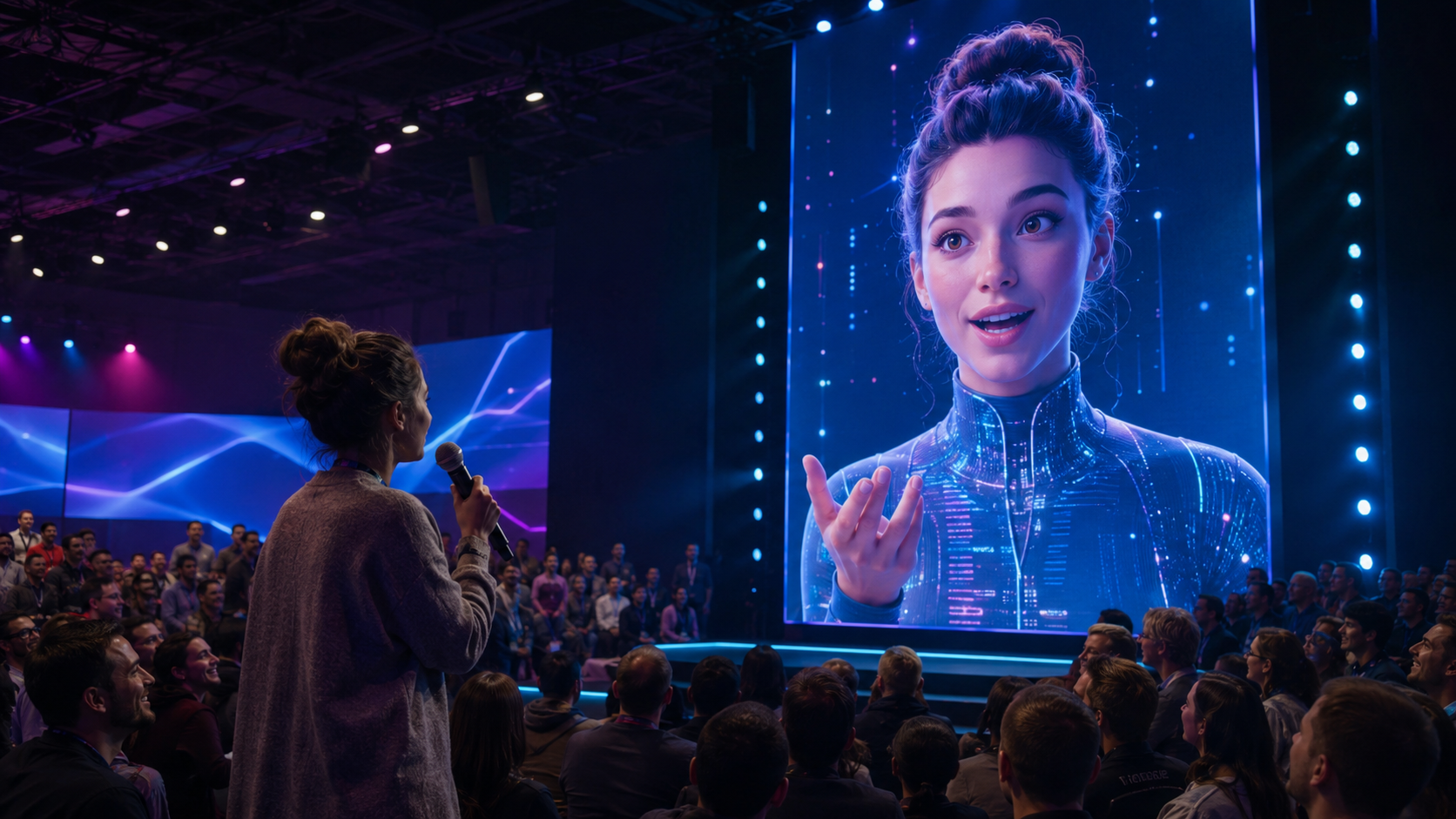
AI avatars for events are moving beyond novelty demos and digital information desks. The more interesting opportunity is to make a personality, expert or character available as a live format: something an audience can question, challenge and experience together.
That changes the creative brief. The job is no longer to place a talking face on a screen. It is to design who the persona is, why the audience would approach it, what it knows, how it behaves and what role it plays in the event.
What is an AI event avatar?
An AI event avatar is a digital person or character that speaks with attendees through generated video or real-time conversation. It may appear on a kiosk, website, mobile experience, stage screen or large-format installation.
Some event avatars deliver fixed messages. Others listen to a spoken question and respond live using an AI model and event-specific knowledge. The latter can act as a guide, interviewer, host, expert, entertainer or representation of a real public personality.
Five useful formats for AI avatars at events
1. The event guide
A guide answers practical questions, recommends sessions and helps visitors navigate a complex programme. It becomes more valuable when it can use the visitor’s interests and current location rather than reciting a generic agenda.
2. The expert
An expert avatar makes specialist knowledge available beyond one scheduled talk. Attendees can ask follow-up questions in their own words and explore a subject at their own depth.
3. The live persona
A recognisable person’s appearance, voice and point of view become an audience-facing format. With consent and clear disclosure, the persona can extend access to a founder, presenter, public figure or brand personality.
4. The character
Not every avatar needs to reproduce a real human. A fictional guide can embody the event theme, create a more playful interaction and avoid the expectation that the system is a perfect digital copy of somebody.
5. The stage participant
A real-time avatar can answer questions, interview a guest or become part of a performance. In this format, latency, moderation and an experienced human operator matter as much as the visual model.
Five event formats Yepic has already built
Yepic’s event work has not repeated the same avatar behind different sponsor logos. Each project gave the AI a different audience role and required a different combination of capture, persona design, knowledge, staging and live operation.
London Tech Week: recognisable co-hosts with knowledge from six stages
At London Tech Week 2025, Yepic created live AI personas of Oli Barrett and Susannah Streeter. The team captured their visual performance and delivery, prepared the footage for the real-time system and designed a distinct audience role for each personality.
The personas used knowledge drawn from content across six stages. Visitors could ask natural questions and receive personalised recommendations about what to see next. Yepic turned the function of an event directory into a conversation with people the audience already recognised. Explore the London Tech Week personas.
Rory Sutherland at MADFest: from smartphone footage to a live persona in two days
Rory Sutherland’s source footage was captured on a smartphone only two days before the activation. Yepic translated his recognisable likeness, voice and contrarian worldview into a live audience format built for humour, challenge and follow-up questions.
The result was part interview, part performance and part experiment in making a famous person available as an interactive medium. MADFest could programme it as content, not hide it in a technology corner. Watch the Rory Sutherland AI persona at MADFest.
Kwebbelkop at LEAP and DeepFest: the AI twin became the interviewer
Yepic had one week to build a real-time AI twin of creator Jordi van den Bussche, known as Kwebbelkop. The team combined high-resolution facial animation, a cloned low-latency voice, characteristic movement and an LLM persona, then assigned the twin a clear stage role: interview its human counterpart.
The live exchange made a complex technical proposition immediately understandable to the audience. The AI had a face, voice, personality and purpose. See the Kwebbelkop AI twin.
Microsoft at COMEX: a multilingual conversational focal point
On Microsoft Oman’s COMEX stand, Yepic deployed Omar, a live avatar that answered unscripted visitor questions across English, Arabic and more than 115 supported languages. It could discuss Microsoft products, Oman Vision 2040 and broader topics.
The build had to cope with a noisy exhibition environment, a large and multilingual audience and questions that could not be predicted in advance. Yepic supported the experience and its live presentation throughout the event. See Microsoft’s conversational COMEX stand.
GAIN: a five-metre AI agent and holographic companion
At the 2024 Global AI Summit, Yepic turned a real-time agent into event architecture. The main avatar appeared at five-metre scale with target response latency below one second, while a holographic companion provided a more intimate interaction format.
The summit-aware knowledge layer answered delegate questions, and the Yepic team operated the installation live across three days. The experience proved that a conversational agent can be both useful to the person asking and visible to the wider room. Explore the GAIN installation.
What Yepic built across these projects
- Custom visual and vocal personas based on real people, with consent.
- Original fictional and branded event characters.
- Persona instructions shaped around a recognisable worldview and audience role.
- Real-time spoken questions, answers, interruptions and follow-up conversation.
- Knowledge layers connected to event programmes and approved content.
- Multilingual speech for international audiences.
- Large-format screens, kiosks, holograms and stage experiences.
- Low-latency rendering, live testing and on-site operational support.
Why event avatars fail
Most weak activations make one of four mistakes.
The persona has no reason to exist
A generic “Ask me anything” screen puts the creative burden on the visitor. Give the persona a clear proposition: find your next session, test your pitch, ask the expert, get challenged or discover what you missed.
The knowledge is broad but shallow
An event agent should know the programme, venue, speakers, sponsors and approved live updates. It should also know what it does not know. A confident wrong answer about a room or schedule destroys trust quickly.
The conversation is too slow for the setting
Trade-show floors are noisy and impatient. Test microphones, speech recognition, response time and network resilience in conditions that resemble the venue. A beautiful response that arrives after the visitor has walked away is not a response.
The experience ignores the queue
A one-to-one conversation can create a crowd with nothing to do. Consider visible subtitles, shared stage moments, timed interactions, multiple stations and a host who helps turn waiting into anticipation.
How to design an AI avatar for a live event
Start with the audience promise
Complete the sentence: “Talk to this persona and you will…” The answer should be specific enough to print on the stand.
Choose the right identity
Decide whether the experience needs a real person, an original character or a neutral guide. A famous likeness can attract attention, but it also raises the standard for voice, behaviour, consent and audience expectations.
Write behaviour, not a speech
Define how the persona opens, asks questions, handles humour, disagrees, redirects and ends. Include prohibited subjects, safe responses and the circumstances that require a human operator.
Build event-specific knowledge
Use the current agenda, venue information and approved source material. Establish who owns last-minute updates and how quickly knowledge can change after doors open.
Plan the physical experience
Screen height, camera position, microphone direction, speakers, lighting and visitor distance affect whether the avatar feels present. Large formats need different pacing and gestures from a laptop widget.
Rehearse failure
Test background noise, unusual accents, overlapping speech, unsafe questions, loss of network and the wrong answer. Give the team simple controls to pause, reset or move to a prepared fallback.
Consent and disclosure are part of the creative
If the avatar represents a real person, obtain explicit rights to their appearance and voice, agree the permitted context and define how approval or withdrawal works. The audience should know that the persona is AI, even when the staging is intentionally theatrical.
Good disclosure does not ruin the magic. It gives the audience permission to engage with the experiment on honest terms.
How to measure an event avatar
Footfall alone can reward spectacle without usefulness. Combine attention with measures linked to the role:
- number and length of completed conversations;
- questions successfully answered;
- session recommendations followed;
- repeat interactions or referrals;
- audience sentiment and qualitative reactions;
- stage participation and crowd dwell time;
- leads or actions completed after the conversation;
- failure, reset and human-intervention rates.
The next event interface is a character
Events have always used hosts, experts, mascots and famous personalities to give information a human shape. Real-time AI makes those roles interactive and scalable, but the technology is only compelling when the character has a purpose.
Yepic has run personas on stages, stands and five-metre screens. The thread across those projects is simple: do not demo an avatar. Create a live format the audience could not have experienced before. Explore Yepic’s live AI case studies.
Related Yepic event work
- London Tech Week: Oli Barrett and Susannah Streeter live personas
- MADFest: Rory Sutherland as an interactive audience format
- LEAP and DeepFest: Kwebbelkop’s AI twin interviewer
- Microsoft COMEX: Omar, a multilingual live avatar
- Global AI Summit: five-metre agent and hologram
- Enterprise AI avatar buyer’s guide